
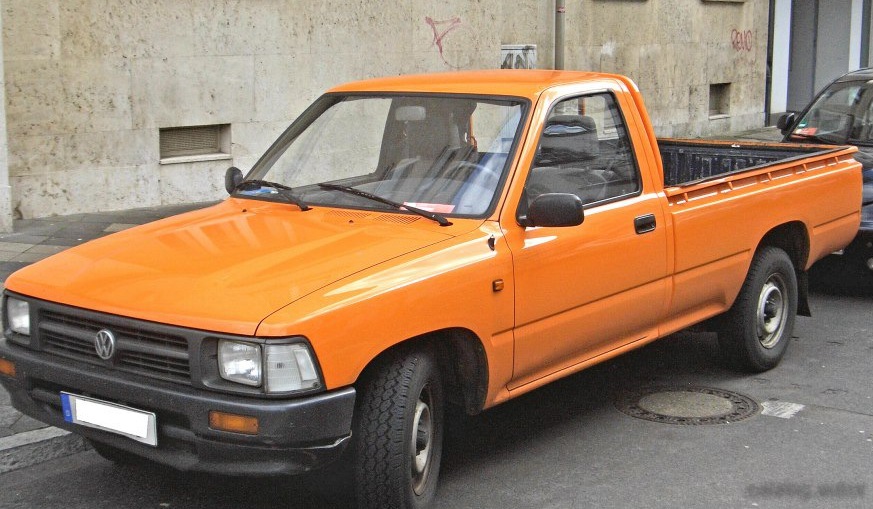
The Volkswagen Taro 2.4 i 4×4, produced from 1989 to 1997, represents a unique collaboration between Volkswagen and Toyota. Essentially a rebadged Toyota Hilux of the fifth generation (N100 series), the Taro was Volkswagen’s entry into the compact pickup truck market, primarily aimed at European buyers seeking a robust and reliable work vehicle. This variant, equipped with the 2.4-liter 22R gasoline engine producing 114 horsepower and a four-wheel-drive system, occupied a mid-range position within the Taro lineup, offering a balance between capability and affordability. It was positioned below the diesel options, which were more popular in Europe due to fuel costs and tax incentives, but above any potential base-level, lower-powered gasoline trims that were not widely offered.
Technical Specifications
| Brand | Volkswagen |
| Model | Taro |
| Generation | Taro |
| Type (Engine) | 2.4 i (114 Hp) 4×4 |
| Start of production | 1989 |
| End of production | 1997 |
| Powertrain Architecture | Internal Combustion engine |
| Body type | Pick-up |
| Fuel Type | Petrol (Gasoline) |
| Power | 114 Hp |
| Engine Model/Code | 22R |
| Engine aspiration | Naturally aspirated engine |
| Engine oil capacity | 4.3 l / 4.54 US qt / 3.78 UK qt |
Introduction
The Volkswagen Taro emerged from a strategic partnership between Volkswagen and Toyota in the late 1980s. Facing increasing demand for pickup trucks in Europe, Volkswagen lacked a suitable model in its existing lineup. Rather than develop a completely new platform, Volkswagen opted to rebadge the Toyota Hilux, a well-regarded and proven vehicle known for its durability and off-road capability. The Taro, named after a playing card in Italian, was intended to provide Volkswagen customers with a reliable and practical pickup option. Production took place at Toyota’s plant in Japan, with minor cosmetic changes to differentiate it from the Hilux. The 2.4 i 4×4 variant was a key offering, appealing to those needing a capable vehicle for both work and leisure.
Powertrain & Engine Architecture
The heart of the Taro 2.4 i 4×4 is Toyota’s 22R engine, a 2.4-liter inline-four cylinder gasoline engine. This engine is a naturally aspirated, overhead valve (OHV) design known for its simplicity and reliability. It features a cast iron block and cylinder head, contributing to its robustness. Fuel delivery is managed by a carburetor, a relatively simple system compared to the fuel injection systems becoming more common at the time. The 22R produces 114 horsepower at approximately 4,800 rpm and 139 lb-ft of torque at 3,200 rpm. The engine’s torque curve is relatively flat, providing usable power across a wide range of engine speeds. The transmission is typically a five-speed manual, although a four-speed automatic transmission was also available, though less common. The 4×4 system is part-time, selectable via a lever inside the cabin, allowing the driver to switch between two-wheel drive (rear-wheel drive) and four-wheel drive for increased traction in challenging conditions. A low-range gear is also included for serious off-road work.
Driving Characteristics
The Taro 2.4 i 4×4 offers a utilitarian driving experience. The 22R engine, while not particularly powerful, provides adequate performance for everyday tasks and light hauling. Acceleration is modest, and the engine can feel strained when fully loaded or climbing steep hills. The five-speed manual transmission allows the driver to keep the engine in its optimal power band, while the automatic transmission, when equipped, offers convenience at the expense of some responsiveness. The part-time four-wheel-drive system provides excellent traction on loose surfaces, making the Taro a capable off-road vehicle. However, it’s important to remember that this is a body-on-frame pickup truck, so the ride quality is firm and can be bouncy, especially when unladen. Steering is relatively direct, but lacks the precision of more modern vehicles. Compared to the diesel-powered Taros, the 2.4 i offers a quieter and smoother driving experience, but sacrifices fuel economy.
Equipment & Trim Levels
The Taro 2.4 i 4×4 was typically equipped with basic, functional features. Standard equipment generally included vinyl or cloth upholstery, a simple dashboard with analog gauges, and manual windows and door locks. Power steering was often included, but air conditioning and other comfort features were typically optional extras. Trim levels were relatively limited, with most Taros falling into a single, fairly basic specification. Optional extras could include upgraded audio systems, alloy wheels, and a more luxurious interior trim. The interior design is functional and durable, prioritizing practicality over aesthetics. The cabin is relatively spacious, offering comfortable seating for two occupants, with limited space for passengers in the rear.
Chassis & Braking
The Taro utilizes a traditional body-on-frame construction, providing a robust and durable chassis. The suspension consists of independent double wishbones at the front and leaf springs at the rear. This setup is designed to handle heavy loads and provide a reasonable level of off-road capability. The rear leaf springs contribute to the firm ride quality. Braking is typically accomplished with disc brakes at the front and drum brakes at the rear. Power-assisted steering is common, making the Taro relatively easy to maneuver, despite its size. The braking system is adequate for normal use, but lacks the stopping power of more modern vehicles. Stabilizer bars were not typically fitted as standard, contributing to the truck’s body roll in corners.
Market Reception & Comparison
The Volkswagen Taro received a mixed reception in the European market. While it was praised for its reliability and durability, inherited from the Toyota Hilux, it was often criticized for its relatively basic features and lack of refinement compared to some of its competitors. The gasoline engine was also seen as a disadvantage in many European countries, where diesel fuel was cheaper and subject to lower taxes. Compared to the diesel-powered Taros, the 2.4 i 4×4 offered less fuel economy but a smoother and quieter driving experience. Against competitors like the Nissan Datsun Pickup and the Ford Courier, the Taro offered a comparable level of capability and reliability, but often at a slightly higher price point.
Legacy
The Volkswagen Taro, while not a massive sales success, remains a respected vehicle among pickup truck enthusiasts. Its Toyota Hilux underpinnings ensure a high level of reliability and durability, making it a popular choice for those seeking a classic workhorse. Parts availability is generally good, thanks to the Hilux’s widespread use. Today, the Taro 2.4 i 4×4 is a relatively rare sight on the roads, and well-maintained examples are becoming increasingly collectible. The simplicity of the 22R engine and the robust construction of the chassis contribute to its longevity, making it a viable option for those seeking a dependable and affordable pickup truck. The Taro serves as a reminder of Volkswagen’s brief foray into the pickup truck market and its successful collaboration with Toyota.
