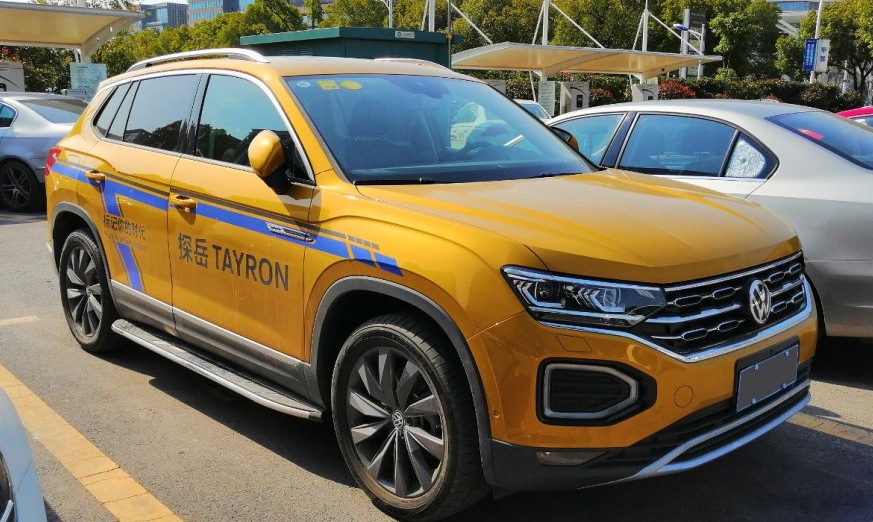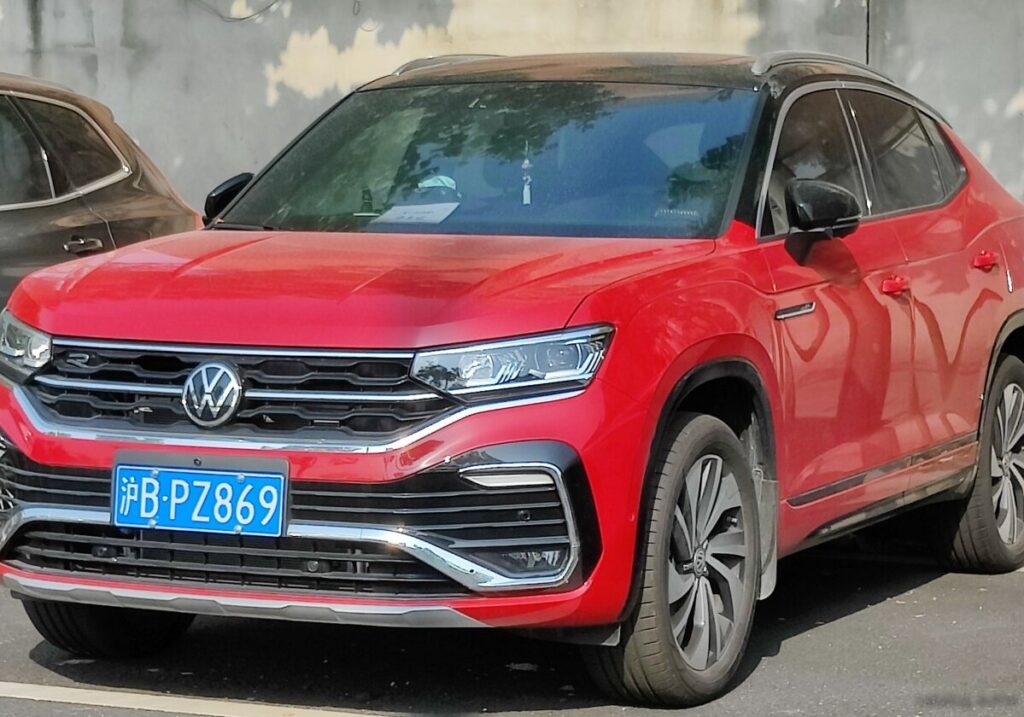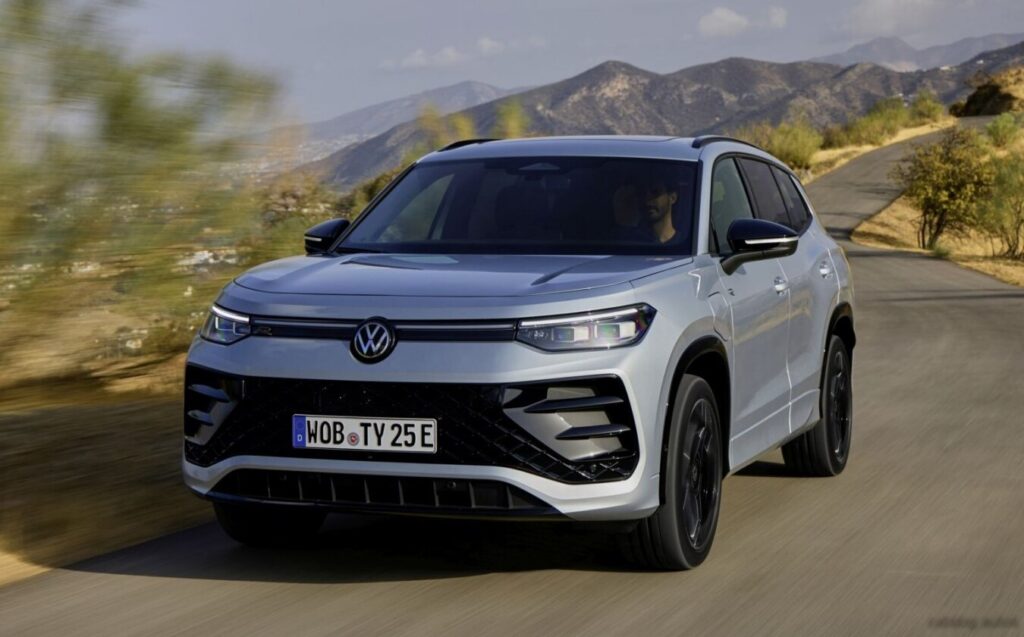
The Volkswagen Tayron II 1.5 TSI eHybrid DSG, launched in November 2024, represents Volkswagen’s entry into the increasingly competitive plug-in hybrid SUV market. Positioned as a mid-range offering within the broader Tayron II lineup, this variant combines a 1.5-liter turbocharged gasoline engine with an electric motor, delivering a combined system output of 204 horsepower. It’s primarily aimed at consumers seeking a balance between fuel efficiency, reduced emissions, and the practicality of a compact SUV. The Tayron II itself is a significant model for Volkswagen, particularly in markets where larger SUVs are favored, offering a modern design and a suite of advanced technologies.
Technical Specifications
| Brand | Volkswagen |
| Model | Tayron |
| Generation | Tayron II |
| Type (Engine) | 1.5 TSI (204 Hp) eHybrid DSG |
| Start of production | November, 2024 |
| Powertrain Architecture | PHEV (Plug-in Hybrid Electric Vehicle) |
| Body type | SUV |
| Seats | 5 |
| Doors | 5 |
| Combined fuel consumption (WLTP) | 0.4-0.5 l/100 km (588 – 470.4 US mpg, 706.2 – 565 UK mpg, 250 – 200 km/l) |
| CO2 emissions (WLTP) | 9-12 g/km |
| Fuel Type | Petrol / electricity |
| Acceleration 0 – 100 km/h | 8.6 sec |
| Acceleration 0 – 62 mph | 8.6 sec |
| Acceleration 0 – 60 mph | 8.2 sec |
| Maximum speed | 210 km/h (130.49 mph) |
| Emission standard | Euro 6e |
| Weight-to-power ratio | 9.1 kg/Hp, 109.4 Hp/tonne |
| Weight-to-torque ratio | 5.3 kg/Nm, 187.8 Nm/tonne |
| Gross battery capacity | 25.7 kWh |
| Net (usable) battery capacity | 19.7 kWh |
| Battery technology | Lithium nickel manganese cobalt oxides (Li-NMC) |
| Battery location | Under the rear seats |
| All-electric range (WLTP) | 111-127 km (68.97 – 78.91 mi) |
| Average Energy consumption (WLTP) | 17-18.9 kWh/100 km (27.36 – 30.42 kWh/100 mi, 123 – 111 MPGe, 5.9 – 5.3 km/kWh, 3.7 – 3.3 mi/kWh) |
| Electric motor power | 115 Hp |
| Electric motor Torque | 150 Nm (110.63 lb.-ft.) |
| Electric motor location | Between the combustion engine and the transmission |
| Electric motor type | Synchronous |
| System power | 204 Hp |
| System torque | 350 Nm (258.15 lb.-ft.) |
| Power | 150 Hp @ 5000 rpm |
| Torque | 250 Nm @ 1500-4000 rpm (184.39 lb.-ft. @ 1500-4000 rpm) |
| Engine layout | Front, Transverse |
| Engine Model/Code | EA211 evo2 |
| Engine displacement | 1498 cm3 (91.41 cu. in.) |
| Number of cylinders | 4 |
| Engine configuration | Inline |
| Cylinder Bore | 74.5 mm (2.93 in.) |
| Piston Stroke | 85.9 mm (3.38 in.) |
| Number of valves per cylinder | 4 |
| Fuel injection system | Direct injection |
| Engine aspiration | Turbocharger, Intercooler |
| Valvetrain | DOHC |
| Kerb Weight | 1864 kg (4109.42 lbs.) |
| Max. weight | 2500 kg (5511.56 lbs.) |
| Max load | 636 kg (1402.14 lbs.) |
| Trunk (boot) space – minimum | 705 l (24.9 cu. ft.) |
| Trunk (boot) space – maximum | 1915 l (67.63 cu. ft.) |
| Fuel tank capacity | 45 l (11.89 US gal | 9.9 UK gal) |
| Permitted trailer load with brakes (12%) | 1800 kg (3968.32 lbs.) |
| Permitted trailer load without brakes | 750 kg (1653.47 lbs.) |
| Permitted towbar download | 100 kg (220.46 lbs.) |
| Length | 4792 mm (188.66 in.) |
| Width | 1853 mm (72.95 in.) |
| Width including mirrors | 2151 mm (84.69 in.) |
| Height | 1666 mm (65.59 in.) |
| Wheelbase | 2789 mm (109.8 in.) |
| Front track | 1584-1588 mm (62.36 – 62.52 in.) |
| Rear (Back) track | 1575-1579 mm (62.01 – 62.17 in.) |
| Drag coefficient (Cd) | 0.28 |
| Minimum turning circle (turning diameter) | 12.1 m (39.7 ft.) |
| Approach angle | 16.8° |
| Departure angle | 17.5° |
| Ramp-over (brakeover) angle | 19.7° |
| Drivetrain Architecture | The Internal combustion engine (ICE) and electric motor drive the front wheels of the car with the ability to work in full electric or mixed mode. |
| Drive wheel | Front wheel drive |
| Number of gears and type of gearbox | 6 gears, automatic transmission DSG |
| Front suspension | Independent, type McPherson with coil spring and anti-roll bar |
| Rear suspension | Independent multi-link spring suspension with stabilizer |
| Front brakes | Ventilated discs |
| Assisting systems | ABS (Anti-lock braking system) |
| Steering type | Steering rack and pinion |
| Power steering | Electric Steering |
| Tires size | 215/65 R17; 235/55 R18; 235/50 R19; 255/45 R19; 235/45 R20; 255/40 R20 |
| Wheel rims size | 7J x 17; 7.5J x 18; 7.5J x 19; 8.5J x 19; 8J x 20; 8.5J x 20 |
INTRODUCTION
The Volkswagen Tayron II 1.5 TSI eHybrid DSG, introduced in late 2024, is a plug-in hybrid variant of the second-generation Tayron SUV. Built on the MQB Evo platform, the Tayron II is designed to appeal to a broad audience seeking a practical and technologically advanced SUV. The eHybrid model specifically targets environmentally conscious buyers who desire the flexibility of electric driving for shorter commutes combined with the range and convenience of a gasoline engine for longer journeys. This variant slots into the Tayron II range as a compelling alternative to purely combustion engine models, offering improved fuel economy and reduced emissions.
Powertrain & Engine Architecture
At the heart of the Tayron II 1.5 TSI eHybrid is Volkswagen’s EA211 evo2 1.5-liter turbocharged four-cylinder gasoline engine. This engine produces 150 horsepower and 250 Nm (184 lb-ft) of torque. It features direct fuel injection and a turbocharger with intercooling, optimizing both power and efficiency. The engine is paired with an 115 horsepower electric motor integrated between the engine and the seven-speed dual-clutch DSG transmission. The combined system output is 204 horsepower and 350 Nm (258 lb-ft) of torque. The 19.7 kWh lithium-ion battery pack, located under the rear seats, provides an all-electric range of 111-127 km (69-79 miles) according to WLTP standards. The DSG transmission is crucial for seamless transitions between electric and gasoline power, offering quick and precise gear changes. The engine also incorporates a particulate filter to further reduce emissions, meeting stringent Euro 6e standards.
Driving Characteristics
The Tayron II 1.5 TSI eHybrid DSG delivers a refined and responsive driving experience. In electric mode, the vehicle offers near-silent operation and brisk acceleration, particularly in urban environments. The electric motor provides instant torque, making it well-suited for city driving. When the battery is depleted or when more power is demanded, the gasoline engine seamlessly kicks in, providing a smooth and linear power delivery. The DSG transmission contributes to this smoothness, offering quick shifts and efficient power management. Compared to the standard gasoline-powered Tayron II models, the eHybrid variant offers improved fuel economy and reduced emissions. While the 0-60 mph time of around 8.2 seconds is respectable, it’s slightly slower than higher-powered Tayron II trims. The added weight of the battery pack does impact handling slightly, but the well-tuned suspension maintains a comfortable and controlled ride.
Equipment & Trim Levels
The Tayron II 1.5 TSI eHybrid DSG typically comes well-equipped as standard. Features generally include automatic climate control, a touchscreen infotainment system with Apple CarPlay and Android Auto compatibility, a digital instrument cluster, and a suite of safety features such as automatic emergency braking, lane departure warning, and adaptive cruise control. Interior upholstery is typically cloth or leatherette, with higher trims offering full leather options. Optional extras may include a panoramic sunroof, premium sound system, and advanced driver-assistance systems like park assist and a 360-degree camera. The specific trim levels and available options can vary depending on the market.
Chassis & Braking
The Tayron II 1.5 TSI eHybrid utilizes an independent McPherson strut suspension at the front and a multi-link suspension at the rear, providing a comfortable and controlled ride. Stabilizer bars are fitted to both axles to reduce body roll during cornering. Braking duties are handled by ventilated disc brakes at the front and solid disc brakes at the rear. The vehicle is equipped with ABS (Anti-lock Braking System) and electronic stability control as standard safety features. The steering is electrically assisted, providing a light and precise feel.
Market Reception & Comparison
The Volkswagen Tayron II 1.5 TSI eHybrid has been generally well-received by automotive critics. Reviewers have praised its fuel efficiency, comfortable ride, and refined driving experience. Compared to other Tayron II trims, the eHybrid offers a significant advantage in terms of fuel economy and emissions, making it an attractive option for environmentally conscious buyers. However, the higher purchase price and slightly reduced performance compared to the more powerful gasoline-powered models are noted drawbacks. Competitors in the plug-in hybrid SUV segment include models from Toyota, Hyundai, and Kia.
Legacy
The long-term reliability of the EA211 evo2 engine and the DSG transmission is generally good, although regular maintenance is crucial. The battery pack is expected to have a lifespan of at least eight years or 100,000 miles, and Volkswagen offers a warranty on the battery. As the demand for electric and hybrid vehicles continues to grow, the Tayron II 1.5 TSI eHybrid is likely to become an increasingly popular choice in the used car market, offering a compelling combination of practicality, efficiency, and technology.