
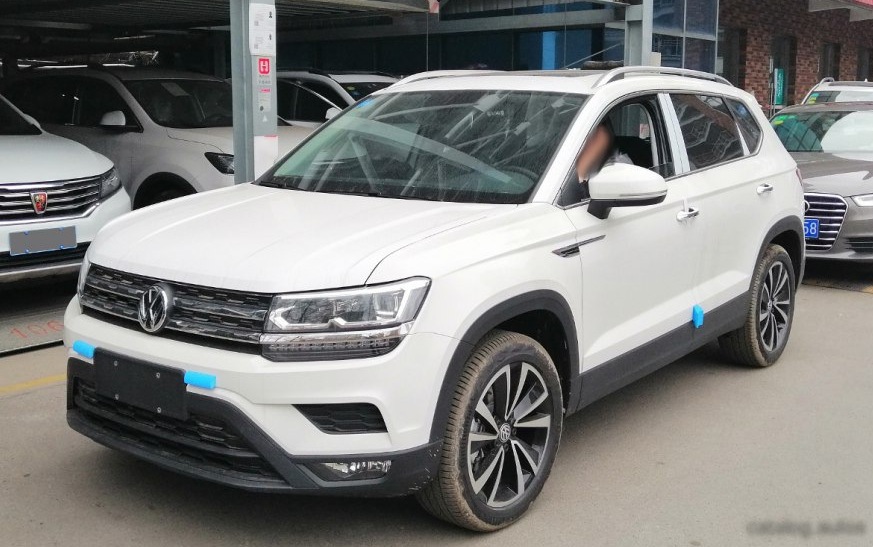
Technical Specifications
| Brand | Volkswagen |
| Model | Tharu |
| Type (Engine) | R-Line 280TSI (150 Hp) DSG |
| Start of production | 2018 |
| Powertrain Architecture | Internal Combustion engine |
| Body type | SUV |
| Seats | 5 |
| Doors | 5 |
| Fuel consumption (economy) – extra urban | 5.2 l/100 km (45.2 US mpg, 54.3 UK mpg, 19.2 km/l) |
| Fuel consumption (economy) – combined | 5.9 l/100 km (39.9 US mpg, 47.9 UK mpg, 16.9 km/l) |
| Fuel Type | Petrol (Gasoline) |
| Acceleration 0 – 100 km/h | 9.3 sec |
| Acceleration 0 – 62 mph | 9.3 sec |
| Acceleration 0 – 60 mph | 8.8 sec |
| Weight-to-power ratio | 9.5 kg/Hp, 105.3 Hp/tonne |
| Weight-to-torque ratio | 5.7 kg/Nm, 175.4 Nm/tonne |
| Power | 150 Hp @ 5000 rpm |
| Power per litre | 107.5 Hp/l |
| Torque | 250 Nm @ 1750-3000 rpm (184.39 lb.-ft. @ 1750-3000 rpm) |
| Engine layout | Front, Transverse |
| Engine Model/Code | EA211 |
| Engine displacement | 1395 cm3 (85.13 cu. in.) |
| Number of cylinders | 4 |
| Engine configuration | Inline |
| Number of valves per cylinder | 4 |
| Fuel injection system | Direct injection |
| Engine aspiration | Turbocharger, Intercooler |
| Engine systems | Particulate filter |
| Kerb Weight | 1425 kg (3141.59 lbs.) |
| Trunk (boot) space – minimum | 455 l (16.07 cu. ft.) |
| Trunk (boot) space – maximum | 1543 l (54.49 cu. ft.) |
| Fuel tank capacity | 50 l (13.21 US gal | 11 UK gal) |
| Length | 4453 mm (175.31 in.) |
| Width | 1841 mm (72.48 in.) |
| Height | 1632 mm (64.25 in.) |
| Wheelbase | 2680 mm (105.51 in.) |
| Drivetrain Architecture | The Internal combustion engine (ICE) drives the front wheels of the vehicle. |
| Drive wheel | Front wheel drive |
| Number of gears and type of gearbox | 7 gears, automatic transmission DSG |
| Front suspension | Independent type McPherson |
| Rear suspension | Independent multi-link suspension |
| Front brakes | Ventilated discs |
| Rear brakes | Disc |
| Assisting systems | ABS (Anti-lock braking system) |
| Steering type | Steering rack and pinion |
| Power steering | Electric Steering |
| Wheel rims size | 18 |
The Volkswagen Tharu R-Line 280TSI, introduced in 2018, is a compact SUV designed to appeal to the growing crossover market. Primarily sold in regions like China and South America, the Tharu aimed to provide a more accessible and affordable SUV option within Volkswagen’s lineup, positioned below the Tiguan. The “280TSI” designation refers to the engine’s approximate power output in metric horsepower, while the “R-Line” trim signifies a sportier aesthetic package. This particular variant occupied a mid-range position, balancing performance, features, and price point.
Powertrain & Engine Architecture
At the core of the Tharu 280TSI lies the EA211 engine family, a 1.4-liter inline-four cylinder gasoline engine. This engine employs direct fuel injection and a turbocharger with an intercooler to enhance both power and fuel efficiency. The EA211 is recognized for its compact design and relatively lightweight construction, contributing to the Tharu’s overall handling characteristics. The engine’s identification code is commonly found as CJSA or similar variations, depending on the specific market it was sold in. Paired with the engine is a 7-speed DSG (Direct-Shift Gearbox), a dual-clutch transmission known for its rapid and seamless gear changes. Operating on the principle of two manual transmissions within one unit, the DSG allows for both automatic and manual shifting through paddle shifters or the gear selector. This transmission is crucial for maximizing engine efficiency and delivering a responsive driving experience.
Driving Characteristics
The 150 horsepower and 250 Nm (184 lb-ft) of torque generated by the 1.4TSI engine and DSG transmission provide sufficient performance for typical daily driving. Acceleration from 0-60 mph is achieved in approximately 8.8 seconds, making it competitive within its class. The DSG transmission contributes to a relatively smooth and quick acceleration feel. Compared to higher-output Tharu models, or those equipped with a manual transmission, this variant exhibits a less aggressive acceleration profile, especially at higher speeds. The emphasis is placed on fuel economy and comfortable cruising rather than outright performance. The gear ratios are optimized for efficiency, with taller gearing in higher gears to reduce engine RPM during highway driving. The overall driving experience is geared towards practicality and ease of use.
Equipment & Trim Levels
The R-Line trim package enhances the Tharu’s appearance with sporty design elements, including unique front and rear bumpers, side skirts, and alloy wheels. Standard features generally include air conditioning, a touchscreen infotainment system compatible with Apple CarPlay and Android Auto, and a comprehensive suite of safety features such as ABS, electronic stability control, and multiple airbags. Interior upholstery is typically cloth, with optional leather seats available for an upgraded feel. Additional options could include a panoramic sunroof, automatic climate control, and a premium sound system. The R-Line trim offered a more complete feature set compared to base models, but positioned itself below the fully-equipped premium trims in terms of luxury and technology.
Chassis & Braking
The Tharu utilizes a front-wheel-drive layout, coupled with an independent McPherson strut suspension in the front and an independent multi-link suspension in the rear. This suspension configuration aims to provide a comfortable ride quality while maintaining reasonable handling characteristics. The front brakes consist of ventilated discs, while the rear brakes utilize solid discs. The steering system is electric power-assisted, offering light and precise steering feel. Stabilizer bars are incorporated on both the front and rear axles to minimize body roll during cornering maneuvers. The chassis is tuned to prioritize comfort and stability over sporty handling dynamics.
Market Reception & Comparison
The Tharu 280TSI received generally positive reviews from automotive critics, who praised its practicality and affordability as a compact SUV. Its fuel economy of around 39.9 US mpg combined was considered competitive within its segment. However, some reviewers pointed out that the 1.4-liter engine could feel somewhat underpowered when the vehicle is fully loaded or when tackling steep inclines. Compared to other trims within the Tharu lineup, such as those equipped with larger engines, the 280TSI presented a more budget-friendly option with lower running costs. It competed directly with other popular compact SUVs like the Hyundai Creta, Kia Seltos, and Honda HR-V.
Legacy
The EA211 engine, in its various iterations, has established a reputation for reliability and durability. While the Tharu itself hasn’t reached the iconic status of some other Volkswagen models, the 280TSI variant remains a popular choice in the used car market, particularly for buyers seeking a fuel-efficient and practical compact SUV. The DSG transmission, while generally reliable, benefits from regular maintenance, specifically fluid changes, to ensure its long-term durability. Overall, the Tharu 280TSI represents a dependable and solid option for those looking for a comfortable and affordable entry point into the compact SUV segment. It provides a good balance of features, fuel economy, and practicality for everyday use.
