
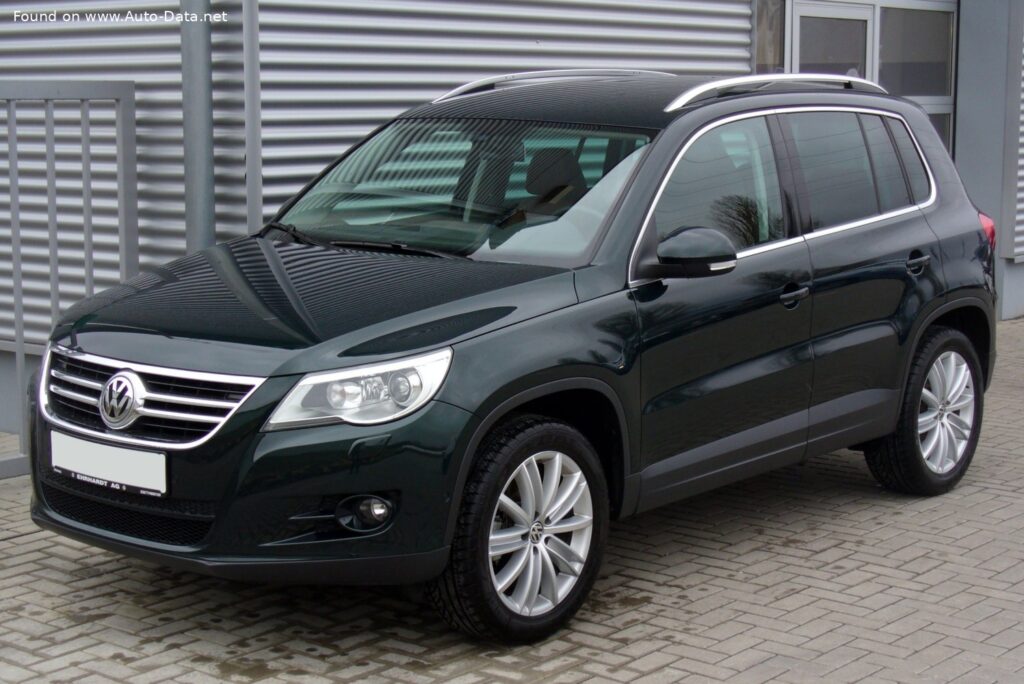
The Volkswagen Tiguan I 1.4 TSI (150 Hp) represents Volkswagen’s entry into the burgeoning compact SUV market. Introduced in 2008 and produced through 2011, the Tiguan I was a significant model for the German automaker, offering a more accessible and versatile alternative to traditional hatchbacks and sedans. While not initially sold in the United States during this first generation, the Tiguan quickly gained popularity in Europe and other global markets, establishing a foothold for Volkswagen in a segment that would become increasingly competitive. This model aimed to blend the practicality of a small SUV with the driving dynamics expected of a Volkswagen, utilizing a technologically advanced, albeit modestly powered, turbocharged engine.
Volkswagen Tiguan I 1.4 TSI: An Overview
The Tiguan I, internally designated as the 5N series, was built on the PQ35 platform, shared with other Volkswagen Group vehicles like the Golf Mk5 and Audi TT. It was positioned as a premium compact SUV, offering a more refined experience than many of its competitors. The 1.4 TSI engine variant, producing 150 horsepower, was a popular choice, balancing fuel efficiency with adequate performance for everyday driving. The Tiguan I offered a five-seat configuration and a practical cargo area, making it suitable for small families and individuals seeking a versatile vehicle.
Engine & Performance
The heart of the Tiguan I 1.4 TSI is a 1.4-liter inline-four cylinder engine, designated BWK or CAVA. This engine is notable for its combination of turbocharging and supercharging – a relatively uncommon setup. The supercharger provides immediate boost at low engine speeds, eliminating turbo lag and improving responsiveness during acceleration. As the engine speed increases, the turbocharger takes over, delivering sustained power. This dual-charging system results in a peak output of 150 horsepower at 5800 rpm and 240 Nm (177 lb-ft) of torque available from 1750 to 4000 rpm. Power is delivered to the front wheels via a six-speed manual transmission. Performance figures include a 0-100 km/h (0-62 mph) acceleration time of 9.3 seconds and a top speed of 195 km/h (121.17 mph). Fuel economy, according to the NEDC standard, is rated at 7.4 l/100 km (31.8 US mpg) combined, with CO2 emissions of 171 g/km. The engine’s power-to-weight ratio is 9.7 kg/Hp, and the torque-to-weight ratio is 6 kg/Nm.
Design & Features
The Tiguan I features a classic SUV silhouette with a relatively upright stance and a robust appearance. Its design language reflects the Volkswagen aesthetic of the late 2000s, characterized by clean lines and a focus on functionality. The vehicle is a five-door SUV with seating for five passengers. Key features include independent suspension on all four wheels – McPherson struts at the front and a multi-link setup at the rear – providing a comfortable ride and good handling characteristics. Safety features, typical for the era, include ABS (Anti-lock Braking System). Interior appointments focused on practicality and build quality, with a focus on durable materials and a user-friendly layout. The trunk offers a minimum capacity of 470 liters (16.6 cu ft), expanding to 1510 liters (53.33 cu ft) with the rear seats folded down. The Tiguan I also offers a respectable towing capacity, with a maximum braked trailer load of 2000 kg (4409.25 lbs).
Technical Specifications
| Brand | Volkswagen |
| Model | Tiguan |
| Generation | Tiguan I |
| Type (Engine) | 1.4 TSI (150 Hp) |
| Start of production | 2008 |
| End of production | 2011 |
| Powertrain Architecture | Internal Combustion engine |
| Body type | SUV |
| Seats | 5 |
| Doors | 5 |
| Fuel consumption (economy) – urban (NEDC) | 9.4 l/100 km (25 US mpg, 30.1 UK mpg, 10.6 km/l) |
| Fuel consumption (economy) – extra urban (NEDC) | 6.2 l/100 km (37.9 US mpg, 45.6 UK mpg, 16.1 km/l) |
| Fuel consumption (economy) – combined (NEDC) | 7.4 l/100 km (31.8 US mpg, 38.2 UK mpg, 13.5 km/l) |
| CO2 emissions (NEDC) | 171 g/km |
| Fuel Type | Petrol (Gasoline) |
| Acceleration 0 – 100 km/h | 9.3 sec |
| Acceleration 0 – 62 mph | 9.3 sec |
| Acceleration 0 – 60 mph | 8.8 sec |
| Maximum speed | 195 km/h (121.17 mph) |
| Emission standard | Euro 5 |
| Weight-to-power ratio | 9.7 kg/Hp |
| Weight-to-torque ratio | 6 kg/Nm |
| Power | 150 Hp @ 5800 rpm |
| Torque | 240 Nm @ 1750-4000 rpm (177.01 lb.-ft. @ 1750-4000 rpm) |
| Engine layout | Front, Transverse |
| Engine Model/Code | BWK, CAVA |
| Engine displacement | 1390 cm3 (84.82 cu. in.) |
| Number of cylinders | 4 |
| Engine configuration | Inline |
| Cylinder Bore | 76.5 mm (3.01 in.) |
| Piston Stroke | 75.6 mm (2.98 in.) |
| Compression ratio | 10:1 |
| Number of valves per cylinder | 4 |
| Fuel injection system | Direct injection |
| Engine aspiration | Turbocharging and Supercharger, Intercooler |
| Valvetrain | DOHC |
| Engine oil capacity | 4 l (4.23 US qt | 3.52 UK qt) |
| Kerb Weight | 1451 kg (3198.91 lbs.) |
| Max. weight | 2080 kg (4585.62 lbs.) |
| Max load | 629 kg (1386.71 lbs.) |
| Trunk (boot) space – minimum | 470 l (16.6 cu. ft.) |
| Trunk (boot) space – maximum | 1510 l (53.33 cu. ft.) |
| Fuel tank capacity | 64 l (16.91 US gal | 14.08 UK gal) |
| Max. roof load | 100 kg (220.46 lbs.) |
| Permitted trailer load with brakes (8%) | 2000 kg (4409.25 lbs.) |
| Permitted trailer load with brakes (12%) | 1800 kg (3968.32 lbs.) |
| Permitted trailer load without brakes | 750 kg (1653.47 lbs.) |
| Permitted towbar download | 100 kg (220.46 lbs.) |
| Length | 4427 mm (174.29 in.) |
| Width | 1809 mm (71.22 in.) |
| Width including mirrors | 2041 mm (80.35 in.) |
| Height | 1686 mm (66.38 in.) |
| Wheelbase | 2604 mm (102.52 in.) |
| Front track | 1570 mm (61.81 in.) |
| Rear (Back) track | 1570 mm (61.81 in.) |
| Ride height (ground clearance) | 200 mm (7.87 in.) |
| Minimum turning circle (turning diameter) | 12 m (39.37 ft.) |
| Drive wheel | Front wheel drive |
| Number of gears and type of gearbox | 6 gears, manual transmission |
The Volkswagen Tiguan I 1.4 TSI, while not initially available in the US market, proved to be a successful and influential model for Volkswagen, paving the way for the Tiguan’s continued success in the global compact SUV segment. Its combination of practicality, refinement, and innovative engine technology made it a compelling choice for buyers seeking a versatile and efficient vehicle.
