
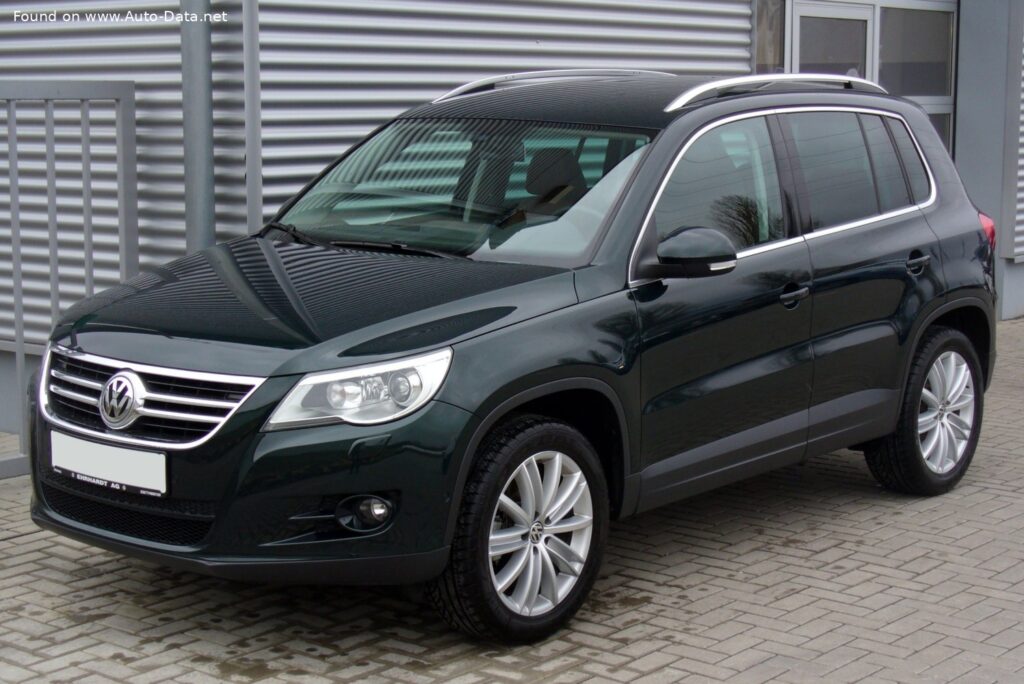
The Volkswagen Tiguan I 1.4 TSI BMT (150 Hp) represents Volkswagen’s entry into the burgeoning compact SUV market. Introduced in 2009 and produced through 2011, this model was primarily aimed at the European market, offering a blend of practicality, fuel efficiency, and Volkswagen’s typically refined driving experience. While not initially sold in the United States, the Tiguan I laid the groundwork for the model’s eventual introduction to North America. It served as a key competitor to vehicles like the Nissan Qashqai and Renault Kadjar in Europe, offering a more premium feel and driving dynamics than many of its rivals.
Volkswagen Tiguan I 1.4 TSI BMT: An Overview
The Tiguan I, internally designated as the 5N series, was Volkswagen’s first dedicated compact SUV. It distinguished itself from larger SUVs by focusing on a more car-like driving experience and a smaller footprint, making it well-suited for urban environments and tighter European roads. The 1.4 TSI BMT variant, equipped with a turbocharged and supercharged engine, was a popular choice for buyers seeking a balance between performance and fuel economy. The “BMT” designation stands for “BlueMotion Technology,” indicating the inclusion of fuel-saving features.
Engine & Performance
The heart of the Tiguan I 1.4 TSI BMT is its 1.4-liter inline-four cylinder engine. This engine is notable for its combined use of both a turbocharger and a supercharger – a relatively uncommon configuration. The supercharger provides immediate boost at low engine speeds, eliminating turbo lag and delivering responsive acceleration. As engine speed increases, the turbocharger takes over, providing sustained power. This setup generates 150 horsepower at 5800 rpm and 240 Nm (177 lb-ft) of torque between 1750 and 4000 rpm. Power is delivered to the front wheels via a six-speed manual transmission.
Performance figures include a 0-100 km/h (0-62 mph) acceleration time of 9.3 seconds and a top speed of 197 km/h (122.41 mph). While not exceptionally quick, the engine provides adequate performance for everyday driving and highway cruising. Fuel economy is a strong point, with combined fuel consumption rated at 6.7 l/100 km (35.1 US mpg, 42.2 UK mpg), and CO2 emissions of 156 g/km, meeting Euro 5 emission standards.
Design & Features
The Tiguan I features a relatively conservative, yet modern SUV design. Its body style is a traditional five-door SUV with a sloping roofline. The exterior design emphasizes practicality and a robust appearance. Inside, the Tiguan I offers seating for five passengers and a versatile interior. The rear seats can be folded down to increase cargo space, ranging from a minimum of 470 liters (16.6 cu ft) to a maximum of 1510 liters (53.33 cu ft) with the rear seats folded.
Standard features typically included air conditioning, power windows, and a basic audio system. Safety features, important for the era, included ABS (Anti-lock Braking System) and multiple airbags. The Tiguan I also offered optional features such as alloy wheels, a sunroof, and a more advanced infotainment system. The vehicle’s suspension utilizes an independent McPherson strut setup at the front and an independent multi-link suspension at the rear, providing a comfortable ride and predictable handling.
Technical Specifications
| Brand | Volkswagen |
| Model | Tiguan |
| Generation | Tiguan I |
| Type (Engine) | 1.4 TSI BMT (150 Hp) |
| Start of production | 2009 |
| End of production | 2011 |
| Powertrain Architecture | Internal Combustion engine |
| Body type | SUV |
| Seats | 5 |
| Doors | 5 |
| Fuel consumption (urban) | 8.5 l/100 km (27.7 US mpg) |
| Fuel consumption (extra urban) | 5.7 l/100 km (41.3 US mpg) |
| Fuel consumption (combined) | 6.7 l/100 km (35.1 US mpg) |
| CO2 emissions | 156 g/km |
| Fuel Type | Petrol (Gasoline) |
| Acceleration 0 – 100 km/h | 9.3 sec |
| Acceleration 0 – 60 mph | 8.8 sec |
| Maximum speed | 197 km/h (122.41 mph) |
| Emission standard | Euro 5 |
| Weight-to-power ratio | 9.6 kg/Hp |
| Power | 150 Hp @ 5800 rpm |
| Torque | 240 Nm @ 1750-4000 rpm (177.01 lb.-ft.) |
| Engine layout | Front, Transverse |
| Engine Model/Code | BWK, CAVA |
| Engine displacement | 1390 cm3 (84.82 cu. in.) |
| Number of cylinders | 4 |
| Engine configuration | Inline |
| Cylinder Bore | 76.5 mm (3.01 in.) |
| Piston Stroke | 75.6 mm (2.98 in.) |
| Compression ratio | 10:1 |
| Engine oil capacity | 4 l (4.23 US qt | 3.52 UK qt) |
| Kerb Weight | 1435 kg (3163.63 lbs.) |
| Max. weight | 2080 kg (4585.62 lbs.) |
| Trunk (boot) space – minimum | 470 l (16.6 cu. ft.) |
| Trunk (boot) space – maximum | 1510 l (53.33 cu. ft.) |
| Fuel tank capacity | 64 l (16.91 US gal | 14.08 UK gal) |
| Length | 4427 mm (174.29 in.) |
| Width | 1809 mm (71.22 in.) |
| Height | 1686 mm (66.38 in.) |
| Wheelbase | 2604 mm (102.52 in.) |
| Number of gears | 6 |
| Gearbox type | Manual transmission |
The Volkswagen Tiguan I 1.4 TSI BMT, while not a groundbreaking vehicle, represented a significant step forward for Volkswagen in the compact SUV segment. Its combination of fuel efficiency, practicality, and a refined driving experience made it a popular choice in Europe, and it paved the way for the Tiguan’s successful expansion into global markets.
