
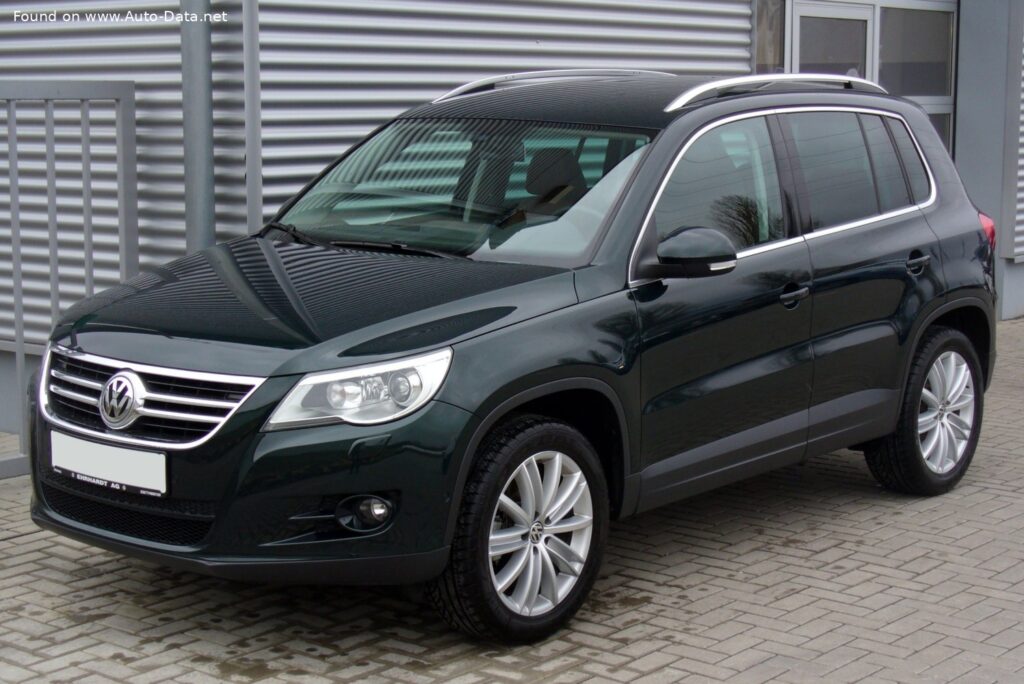
The Volkswagen Tiguan I 2.0 TSI (200 Hp) 4MOTION DSG, produced from 2010 to 2011, represents Volkswagen’s entry into the burgeoning compact SUV market. Positioned as a more premium offering than some of its competitors, the Tiguan aimed to blend the practicality of a small SUV with the driving dynamics expected of the Volkswagen brand. This first-generation Tiguan, while not initially a high-volume seller in the United States (it arrived in the US in 2009 as a 2009 model), was a significant vehicle for Volkswagen in Europe, where it quickly gained popularity as a versatile and well-engineered family vehicle. The “Tiguan” name itself is a portmanteau of “tiger” and “iguana,” intended to convey a sense of ruggedness and agility.
Volkswagen Tiguan I: A Detailed Overview
The Tiguan I was built on the Volkswagen Group’s PQ35 platform, shared with models like the Golf Mk5 and Audi TT. This platform allowed for a relatively compact footprint while still providing a spacious interior. The 2.0 TSI 4MOTION DSG variant, specifically, combined a turbocharged gasoline engine with Volkswagen’s all-wheel-drive system (4MOTION) and a dual-clutch gearbox (DSG) for a balance of performance and all-weather capability. It was designed to appeal to buyers seeking a more sophisticated and engaging driving experience than typically found in the compact SUV segment.
Engine & Performance
At the heart of the Tiguan I 2.0 TSI 4MOTION DSG lies a 1.984-liter (121.07 cubic inches) inline-four cylinder engine. This engine, designated CAWB or CCZA depending on the specific market and year, utilizes direct fuel injection and a turbocharger with an intercooler to produce 200 horsepower at 5100 rpm and 280 Nm (206.52 lb.-ft.) of torque between 1700 and 5000 rpm. This configuration delivers a power-to-liter ratio of 100.8 hp/l. The engine’s output is channeled through a seven-speed dual-clutch DSG transmission, which provides quick and seamless gear changes. The 4MOTION all-wheel-drive system is a permanent system, meaning all four wheels are driven constantly, enhancing traction and stability, particularly in adverse weather conditions. Performance figures include a 0-100 km/h (0-62 mph) acceleration time of 7.4 seconds and a top speed of 210 km/h (130.49 mph). The weight-to-power ratio is 8 kg/Hp, and the weight-to-torque ratio is 5.7 kg/Nm.
Design & Features
The Tiguan I features a classic SUV body style with a five-door configuration and seating for five passengers. Its design, penned by Murat Gueler, was relatively conservative for its time, prioritizing a clean and functional aesthetic over radical styling. The exterior dimensions are 4427 mm (174.29 in) in length, 1809 mm (71.22 in) in width, and 1686 mm (66.38 in) in height. The interior of the Tiguan I is well-appointed, with a focus on practicality and build quality. Features included standard air conditioning, power windows and locks, and a basic audio system. Higher trim levels offered options such as leather upholstery, a sunroof, and a more advanced infotainment system. Safety features, while not as comprehensive as those found in modern vehicles, included ABS (Anti-lock Braking System) and a range of airbags. Trunk space is a useful 470 liters (16.6 cu. ft.) with the rear seats up, expanding to 1510 liters (53.33 cu. ft.) when the rear seats are folded down. The vehicle’s ride height (ground clearance) is 200 mm (7.87 in), providing adequate capability for light off-road driving.
Technical Specifications
| Brand | Volkswagen |
| Model | Tiguan |
| Generation | Tiguan I |
| Type (Engine) | 2.0 TSI (200 Hp) 4MOTION DSG |
| Start of production | 2010 |
| End of production | 2011 |
| Powertrain Architecture | Internal Combustion engine |
| Body type | SUV |
| Seats | 5 |
| Doors | 5 |
| Fuel consumption (economy) – urban (NEDC) | 11.8 l/100 km (19.9 US mpg, 23.9 UK mpg, 8.5 km/l) |
| Fuel consumption (economy) – extra urban (NEDC) | 6.7 l/100 km (35.1 US mpg, 42.2 UK mpg, 14.9 km/l) |
| Fuel consumption (economy) – combined (NEDC) | 8.6 l/100 km (27.4 US mpg, 32.8 UK mpg, 11.6 km/l) |
| CO2 emissions (NEDC) | 199 g/km |
| Fuel Type | Petrol (Gasoline) |
| Acceleration 0 – 100 km/h | 7.4 sec |
| Acceleration 0 – 62 mph | 7.4 sec |
| Acceleration 0 – 60 mph | 7 sec |
| Maximum speed | 210 km/h (130.49 mph) |
| Emission standard | Euro 5 |
| Weight-to-power ratio | 8 kg/Hp |
| Weight-to-torque ratio | 5.7 kg/Nm |
| Power | 200 Hp @ 5100 rpm |
| Torque | 280 Nm @ 1700-5000 rpm (206.52 lb.-ft. @ 1700-5000 rpm) |
| Engine layout | Front, Transverse |
| Engine Model/Code | CAWB, CCZA |
| Engine displacement | 1984 cm3 (121.07 cu. in.) |
| Number of cylinders | 4 |
| Engine configuration | Inline |
| Cylinder Bore | 82.5 mm (3.25 in.) |
| Piston Stroke | 92.8 mm (3.65 in.) |
| Compression ratio | 9.6:1 |
| Number of valves per cylinder | 4 |
| Fuel injection system | Direct injection |
| Engine aspiration | Turbocharger, Intercooler |
| Valvetrain | DOHC |
| Engine oil capacity | 4.7 l (4.97 US qt | 4.14 UK qt) |
| Kerb Weight | 1591 kg (3507.55 lbs.) |
| Max. weight | 2230 kg (4916.31 lbs.) |
| Max load | 639 kg (1408.75 lbs.) |
| Trunk (boot) space – minimum | 470 l (16.6 cu. ft.) |
| Trunk (boot) space – maximum | 1510 l (53.33 cu. ft.) |
| Fuel tank capacity | 64 l (16.91 US gal | 14.08 UK gal) |
| Max. roof load | 75 kg (165.35 lbs.) |
| Permitted trailer load with brakes (8%) | 2200 kg (4850.17 lbs.) |
| Permitted trailer load with brakes (12%) | 2200 kg (4850.17 lbs.) |
| Permitted trailer load without brakes | 750 kg (1653.47 lbs.) |
| Permitted towbar download | 100 kg (220.46 lbs.) |
| Length | 4427 mm (174.29 in.) |
| Width | 1809 mm (71.22 in.) |
| Width including mirrors | 2041 mm (80.35 in.) |
| Height | 1686 mm (66.38 in.) |
| Wheelbase | 2604 mm (102.52 in.) |
| Front track | 1570 mm (61.81 in.) |
| Rear (Back) track | 1570 mm (61.81 in.) |
| Front overhang | 925 mm (36.42 in.) |
| Rear overhang | 898 mm (35.35 in.) |
| Ride height (ground clearance) | 200 mm (7.87 in.) |
| Minimum turning circle (turning diameter) | 12 m (39.37 ft.) |
| Drivetrain Architecture | The Internal combustion engine (ICE) drives the front wheels permanently, and the rear wheels are driven through an electrically or mechanically operated clutch if necessary. |
| Drive wheel | All wheel drive (4×4) |
| Number of gears and type of gearbox | 7 gears, automatic transmission DSG |
| Front suspension | Independent type McPherson, Transverse stabilizer |
| Rear suspension | Independent multi-link suspension, Transverse stabilizer |
| Front brakes | Ventilated discs |
| Rear brakes | Disc |
| Assisting systems | ABS (Anti-lock braking system) |
| Steering type | Steering rack and pinion |
| Power steering | Electric Steering |
| Tires size | 235/55 R17 |
| Wheel rims size | 7J x 17 |
