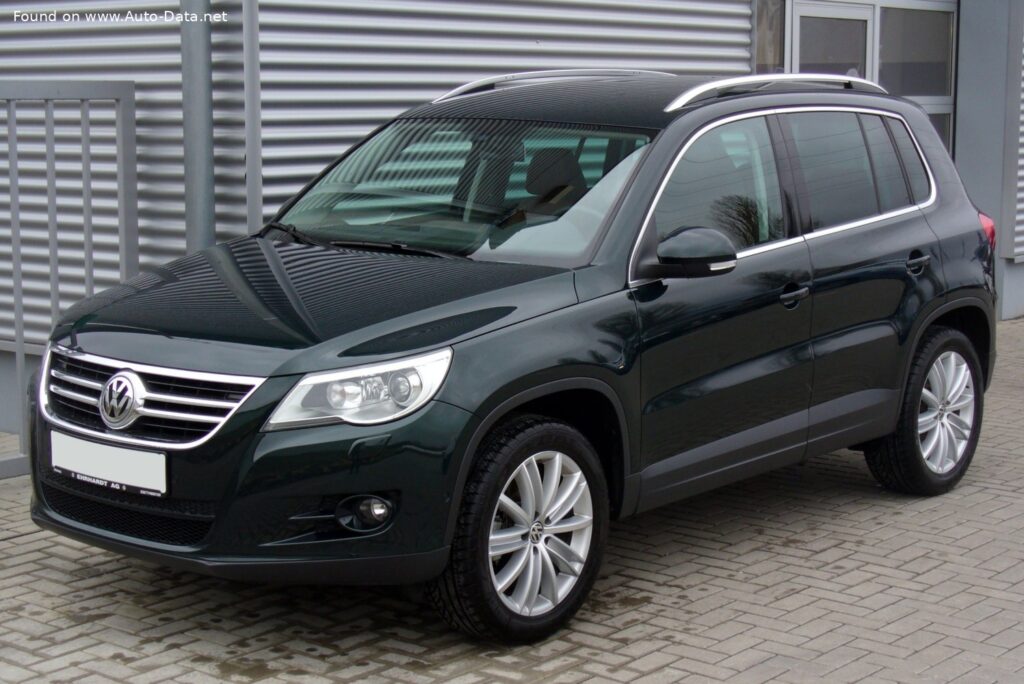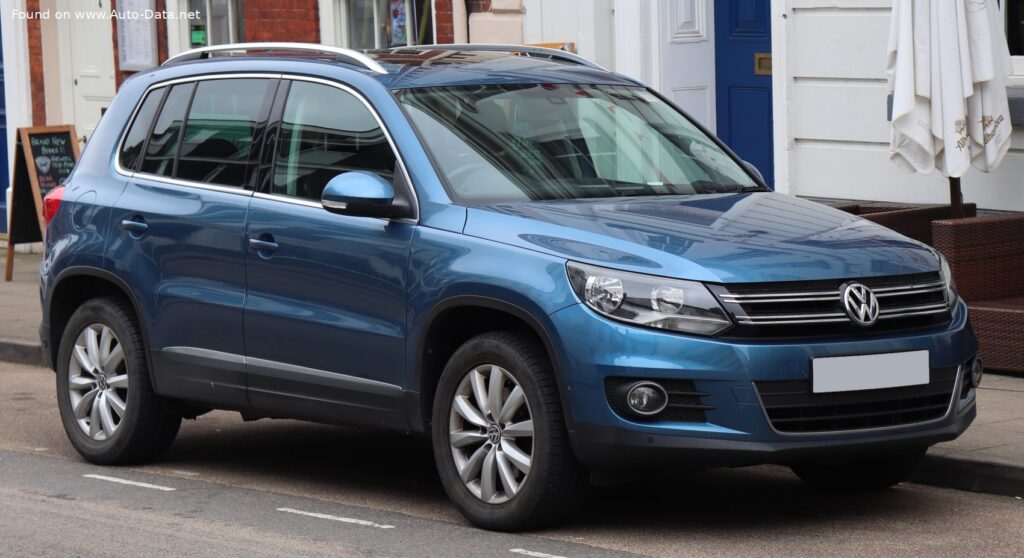
The Volkswagen Tiguan I (facelift 2011) 2.0 TDI BMT (140 Hp) represents a significant iteration of Volkswagen’s entry into the burgeoning compact SUV market. Introduced as a more road-focused alternative to larger SUVs, the Tiguan aimed to blend the practicality of a small family vehicle with a degree of off-road capability and a more premium feel. The facelifted model, produced from 2011 to 2015, brought styling updates and refinements to the original Tiguan, launched in 2007. While not initially a major seller in the United States (the Tiguan was introduced to the US market in 2009, but sales were relatively modest compared to European markets), the Tiguan I established Volkswagen as a contender in the competitive SUV segment, particularly in Europe where it proved popular due to its size, fuel efficiency, and build quality.
Volkswagen Tiguan I (Facelift 2011) Overview
The Tiguan I, particularly the 2011 facelifted version, was positioned as a versatile vehicle designed for both urban commuting and weekend adventures. It offered a five-seat configuration and a practical cargo area, making it suitable for small families or individuals needing flexible space. The 2.0 TDI BMT variant, powered by a turbocharged diesel engine, was a common choice in European markets due to its balance of performance and fuel economy. The “BMT” designation stands for “BlueMotion Technology,” indicating the inclusion of fuel-saving features. This model competed with vehicles like the Nissan Qashqai, Kia Sportage, and Hyundai ix35.
Engine & Performance
The heart of the Tiguan I (facelift 2011) 2.0 TDI BMT is a 1,968 cc (120.09 cu. in.) inline-four cylinder diesel engine. This engine produces 140 horsepower (Hp) at 4,200 rpm and 320 Newton-meters (236.02 lb.-ft.) of torque between 1,750 and 2,500 rpm. The engine utilizes a turbocharger with an intercooler to enhance performance and efficiency. Fuel is delivered via a Diesel Commonrail injection system, ensuring precise fuel metering for optimal combustion. The engine’s 18:1 compression ratio is typical for a diesel engine, contributing to its efficiency. Power is delivered to the front wheels through a six-speed manual transmission. Acceleration from 0 to 100 km/h (0-62 mph) takes 10.2 seconds, while 0 to 60 mph is achieved in approximately 9.7 seconds. The vehicle has a maximum speed of 193 km/h (119.92 mph). The weight-to-power ratio of 10.5 kg/Hp and weight-to-torque ratio of 4.6 kg/Nm demonstrate a reasonable balance between engine output and vehicle mass.
Design & Features
The Tiguan I (facelift 2011) features a classic SUV body style with a five-door configuration. The exterior design was updated with the facelift to include revised headlights, a new front grille, and updated bumpers, giving it a more modern appearance. The interior offers a functional and relatively spacious cabin, with seating for five passengers. Standard features typically included air conditioning, power windows, and a basic audio system. Safety features, while not as comprehensive as in modern vehicles, included ABS (Anti-lock Braking System) and driver/passenger airbags. The vehicle’s trunk (boot) space is a practical 470 liters (16.6 cu. ft.) with the rear seats up, expanding to 1,510 liters (53.33 cu. ft.) when the rear seats are folded down. The Tiguan I offered a comfortable ride and predictable handling, making it well-suited for everyday driving. The inclusion of a particulate filter in the exhaust system, a hallmark of BlueMotion Technology, helped to reduce emissions.
Technical Specifications
| Brand | Volkswagen |
| Model | Tiguan |
| Generation | Tiguan I (facelift 2011) |
| Type (Engine) | 2.0 TDI BMT (140 Hp) |
| Start of production | 2011 |
| End of production | 2015 |
| Powertrain Architecture | Internal Combustion engine |
| Body type | SUV |
| Seats | 5 |
| Doors | 5 |
| Fuel consumption (economy) – urban (NEDC) | 6.2 l/100 km (37.9 US mpg, 45.6 UK mpg, 16.1 km/l) |
| Fuel consumption (economy) – extra urban (NEDC) | 4.7 l/100 km (50 US mpg, 60.1 UK mpg, 21.3 km/l) |
| Fuel consumption (economy) – combined (NEDC) | 5.3 l/100 km (44.4 US mpg, 53.3 UK mpg, 18.9 km/l) |
| CO2 emissions (NEDC) | 138 g/km |
| Fuel Type | Diesel |
| Acceleration 0 – 100 km/h | 10.2 sec |
| Acceleration 0 – 62 mph | 10.2 sec |
| Acceleration 0 – 60 mph | 9.7 sec |
| Maximum speed | 193 km/h (119.92 mph) |
| Emission standard | Euro 5 |
| Weight-to-power ratio | 10.5 kg/Hp |
| Weight-to-torque ratio | 4.6 kg/Nm |
| Power | 140 Hp @ 4200 rpm |
| Torque | 320 Nm @ 1750-2500 rpm (236.02 lb.-ft. @ 1750-2500 rpm) |
| Engine layout | Front, Transverse |
| Engine Model/Code | CBAB, CFFB |
| Engine displacement | 1968 cm3 (120.09 cu. in.) |
| Number of cylinders | 4 |
| Engine configuration | Inline |
| Cylinder Bore | 81 mm (3.19 in.) |
| Piston Stroke | 95.5 mm (3.76 in.) |
| Compression ratio | 18:1 |
| Number of valves per cylinder | 4 |
| Fuel injection system | Diesel Commonrail |
| Engine aspiration | Turbocharger, Intercooler |
| Valvetrain | DOHC |
| Engine oil capacity | 4 l (4.23 US qt | 3.52 UK qt) |
| Kerb Weight | 1466 kg (3231.98 lbs.) |
| Max. weight | 2080 kg (4585.62 lbs.) |
| Max load | 614 kg (1353.64 lbs.) |
| Trunk (boot) space – minimum | 470 l (16.6 cu. ft.) |
| Trunk (boot) space – maximum | 1510 l (53.33 cu. ft.) |
| Fuel tank capacity | 64 l (16.91 US gal | 14.08 UK gal) |
| Max. roof load | 75 kg (165.35 lbs.) |
| Permitted trailer load with brakes (8%) | 2000 kg (4409.25 lbs.) |
| Permitted trailer load with brakes (12%) | 2000 kg (4409.25 lbs.) |
| Permitted trailer load without brakes | 750 kg (1653.47 lbs.) |
| Permitted towbar download | 100 kg (220.46 lbs.) |
| Length | 4426 mm (174.25 in.) |
| Width | 1809 mm (71.22 in.) |
| Width including mirrors | 2041 mm (80.35 in.) |
| Height | 1703 mm (67.05 in.) |
| Wheelbase | 2604 mm (102.52 in.) |
| Front track | 1569 mm (61.77 in.) |
| Rear (Back) track | 1571 mm (61.85 in.) |
| Ride height (ground clearance) | 200 mm (7.87 in.) |
| Minimum turning circle (turning diameter) | 12 m (39.37 ft.) |
| Drivetrain Architecture | The Internal combustion engine (ICE) drives the front wheels of the vehicle. |
| Drive wheel | Front wheel drive |
| Number of gears and type of gearbox | 6 gears, manual transmission |
| Front suspension | Independent type McPherson, Transverse stabilizer |
| Rear suspension | Independent multi-link suspension, Transverse stabilizer |
| Front brakes | Ventilated discs |
| Rear brakes | Disc |
| Assisting systems | ABS (Anti-lock braking system) |
| Steering type | Steering rack and pinion |
| Power steering | Electric Steering |
| Tires size | 215/65 R16 |
| Wheel rims size | 6.5J x 16 |