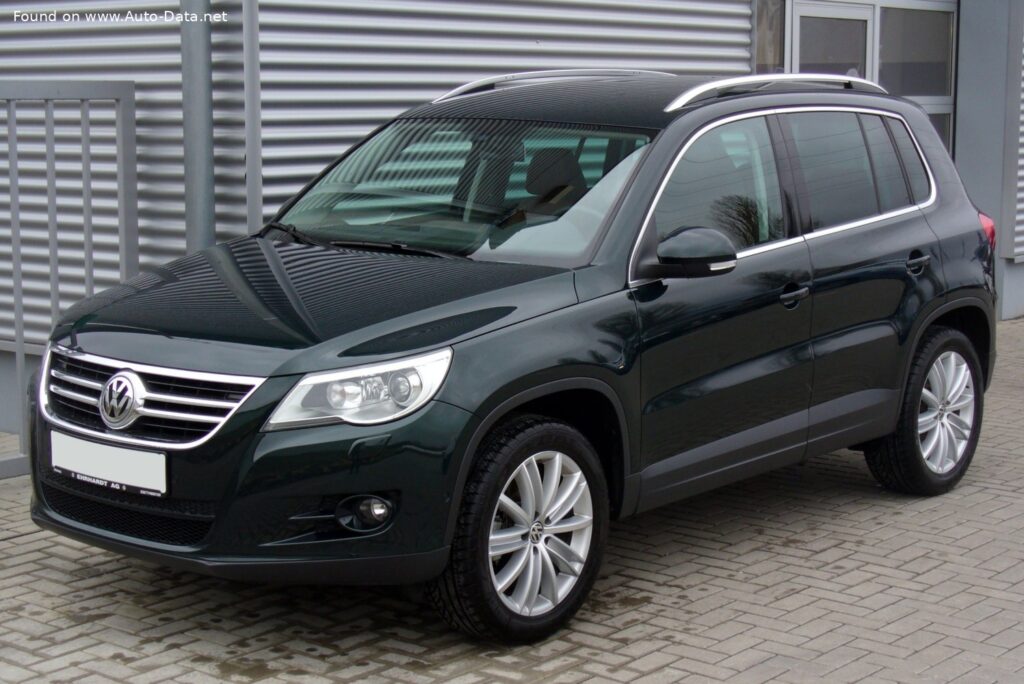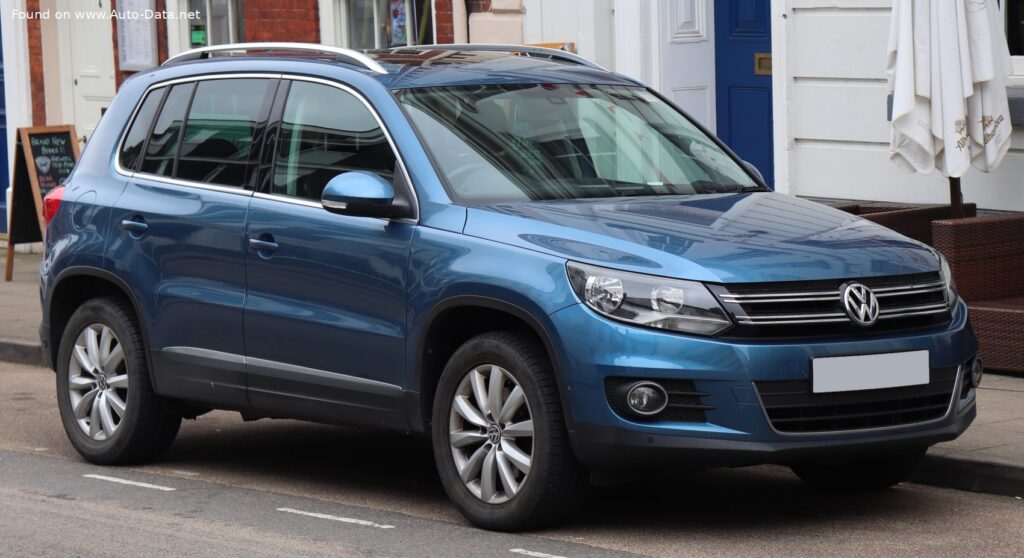
The Volkswagen Tiguan I (facelift 2011) 2.0 TSI (180 Hp) 4MOTION DSG represents a significant refresh for the first generation of Volkswagen’s popular compact crossover SUV. Introduced in 2011 and produced until 2015, this particular iteration showcased Volkswagen’s commitment to offering a refined, capable, and efficient vehicle in an increasingly competitive segment. Positioned primarily in European and Asian markets, where its blend of compact dimensions, premium feel, and versatile all-wheel-drive capability resonated strongly with consumers, the Tiguan served as a practical yet sophisticated option for families and individuals seeking a vehicle equally adept at urban commuting and light off-road excursions. This specific configuration, featuring the potent 2.0-liter TSI engine, the advanced 4MOTION all-wheel-drive system, and the smooth DSG automatic transmission, highlighted Volkswagen’s engineering prowess, delivering a balanced package of performance, fuel economy, and driving dynamics within the compact SUV category.
Engine and Performance: The Heart of the Volkswagen Tiguan I (facelift 2011) 2.0 TSI (180 Hp) 4MOTION DSG
At the core of the Volkswagen Tiguan I (facelift 2011) 2.0 TSI (180 Hp) 4MOTION DSG lies a highly capable and efficient 2.0-liter TSI (Turbocharged Stratified Injection) inline-four engine, designated with the model code CCZD. This powerplant is a testament to Volkswagen’s commitment to combining robust performance with contemporary fuel efficiency standards. The engine’s displacement of 1984 cm³ (121.07 cu. in.) is paired with a sophisticated direct injection fuel system, a turbocharger, and an intercooler, allowing it to produce a healthy 180 horsepower, available across a broad rev range from 4500 to 6200 rpm. This wide power band ensures strong acceleration and flexible driving characteristics in various conditions. Torque output is equally impressive, peaking at 206.52 lb.-ft. (280 Nm) from a remarkably low 1700 rpm and sustained up to 4500 rpm. This low-end torque is crucial for responsive throttle feel, confident overtaking maneuvers, and effective performance when laden or towing.
The engine utilizes a DOHC (Double Overhead Camshaft) valvetrain with four valves per cylinder, optimizing airflow for combustion and contributing to its excellent power-per-liter rating of 90.7 Hp/l. With a compression ratio of 9.6:1, it balances power output with efficiency, running on gasoline fuel and meeting the Euro 5 emission standard, reflecting its environmental considerations for its era. Power is seamlessly transmitted through a 7-speed DSG (Direct-Shift Gearbox) automatic transmission. This advanced dual-clutch transmission is renowned for its rapid, smooth gear changes, contributing significantly to both the Tiguan’s sporty driving feel and its fuel efficiency. The DSG’s ability to pre-select the next gear results in virtually uninterrupted power delivery, enhancing the overall driving experience.
Performance figures for this Tiguan variant are competitive for its class. The vehicle can accelerate from 0 to 60 mph in approximately 7.5 seconds (0-100 km/h in 7.9 seconds), making it one of the quicker compact SUVs of its time. Its maximum speed reaches 125.52 mph (202 km/h), demonstrating its capability for sustained highway cruising. Fuel economy is rated at 28 US mpg combined (8.4 l/100 km), with urban consumption at 21 US mpg (11.2 l/100 km) and extra-urban at 35.1 US mpg (6.7 l/100 km). These figures, while not groundbreaking by today’s standards, were commendable for an all-wheel-drive gasoline SUV of its size and power at the time. The 4MOTION all-wheel-drive system, which primarily drives the front wheels but can instantaneously engage the rear wheels via an electrically or mechanically operated clutch when slip is detected, provides enhanced traction and stability, especially in adverse weather conditions or on unpaved roads, further solidifying the Tiguan’s versatile appeal.
Design and Features of the Volkswagen Tiguan I (facelift 2011)
The Volkswagen Tiguan I (facelift 2011) retained the practical and understated design language characteristic of the brand, while incorporating subtle updates that refreshed its aesthetic appeal. As a five-door, five-seat SUV, its body type speaks to its core mission: a versatile family vehicle. Measuring 174.25 inches (4426 mm) in length, 71.22 inches (1809 mm) in width (80.35 inches or 2041 mm including mirrors), and 67.05 inches (1703 mm) in height, the Tiguan presented a compact footprint that made it maneuverable in urban environments, yet spacious enough for occupants and cargo. The wheelbase of 102.52 inches (2604 mm) contributed to both ride comfort and interior volume.
The exterior design of the facelifted Tiguan adopted styling cues from other contemporary Volkswagen models, such as the Golf VI and Passat B7, featuring sharper lines, revised headlights and taillights, and a more pronounced grille. These updates gave the Tiguan a more modern and cohesive look within the Volkswagen lineup. Despite its primary role as a road-biased SUV, the Tiguan offered a respectable ground clearance of 7.87 inches (200 mm), coupled with an 18-degree approach angle, a 25-degree departure angle, and a 20-degree ramp-over angle. These figures, while not suggesting extreme off-road prowess, indicate a capability to handle rough terrain, speed bumps, and moderate trails with greater confidence than a standard passenger car.
Inside, the Tiguan prioritized ergonomic design and quality materials, typical of Volkswagen. The five-seat configuration offered comfortable seating for adults, with a focus on practicality. Cargo capacity was generous for its class, with a minimum trunk space of 16.6 cu. ft. (470 liters), expandable to a substantial 53.33 cu. ft. (1510 liters) with the rear seats folded down. This flexibility made it highly adaptable for various hauling needs, from groceries to sports equipment. The vehicle’s maximum load capacity was 1402.14 lbs. (636 kg), further enhancing its utility.
Underpinning the Tiguan’s driving dynamics were its well-tuned suspension and braking systems. The front suspension featured an independent McPherson strut setup with a transverse stabilizer, while the rear utilized an independent multi-link suspension, also with a transverse stabilizer. This combination provided a comfortable ride quality and composed handling characteristics, striking a good balance between comfort and agility. Braking performance was assured by ventilated discs at the front and disc brakes at the rear, complemented by an Anti-lock Braking System (ABS) for enhanced safety during emergency stops. The electric power steering system offered light and precise control, making parking and low-speed maneuvers effortless, while providing sufficient feedback at higher speeds. The Tiguan rode on 215/60 R17 tires mounted on 6.5J x 17 wheel rims, a practical choice offering a good blend of ride comfort and grip. Furthermore, the Tiguan was equipped with robust towing capabilities, able to tow up to 4850.17 lbs. (2200 kg) with brakes, highlighting its versatility as a utility vehicle.
Technical Specifications: Volkswagen Tiguan I (facelift 2011) 2.0 TSI (180 Hp) 4MOTION DSG
| Brand | Volkswagen |
| Model | Tiguan |
| Generation | Tiguan I (facelift 2011) |
| Type (Engine) | 2.0 TSI (180 Hp) 4MOTION DSG |
| Start of production | 2011 year |
| End of production | 2015 year |
| Powertrain Architecture | Internal Combustion engine |
| Body type | SUV |
| Seats | 5 |
| Doors | 5 |
| Fuel consumption (economy) – urban (NEDC) | 11.2 l/100 km (21 US mpg) |
| Fuel consumption (economy) – extra urban (NEDC) | 6.7 l/100 km (35.1 US mpg) |
| Fuel consumption (economy) – combined (NEDC) | 8.4 l/100 km (28 US mpg) |
| CO2 emissions (NEDC) | 195 g/km |
| Fuel Type | Petrol (Gasoline) |
| Acceleration 0 – 60 mph | 7.5 sec |
| Acceleration 0 – 100 km/h | 7.9 sec |
| Maximum speed | 202 km/h (125.52 mph) |
| Emission standard | Euro 5 |
| Weight-to-power ratio | 8.8 kg/Hp (113.6 Hp/tonne) |
| Weight-to-torque ratio | 5.7 kg/Nm (176.8 Nm/tonne) |
| Power | 180 Hp @ 4500-6200 rpm |
| Power per liter | 90.7 Hp/l |
| Torque | 280 Nm (206.52 lb.-ft.) @ 1700-4500 rpm |
| Engine layout | Front, Transverse |
| Engine Model/Code | CCZD |
| Engine displacement | 1984 cm³ (121.07 cu. in.) |
| Number of cylinders | 4 |
| Engine configuration | Inline |
| Cylinder Bore | 82.5 mm (3.25 in.) |
| Piston Stroke | 92.8 mm (3.65 in.) |
| Compression ratio | 9.6:1 |
| Number of valves per cylinder | 4 |
| Fuel injection system | Direct injection |
| Engine aspiration | Turbocharger, Intercooler |
| Valvetrain | DOHC |
| Engine oil capacity | 4.7 l (4.97 US qt) |
| Kerb Weight | 1584 kg (3492.12 lbs.) |
| Max. weight | 2220 kg (4894.26 lbs.) |
| Max load | 636 kg (1402.14 lbs.) |
| Trunk (boot) space – minimum | 470 l (16.6 cu. ft.) |
| Trunk (boot) space – maximum | 1510 l (53.33 cu. ft.) |
| Fuel tank capacity | 64 l (16.91 US gal) |
| Max. roof load | 75 kg (165.35 lbs.) |
| Permitted trailer load with brakes (8%) | 2200 kg (4850.17 lbs.) |
| Permitted trailer load with brakes (12%) | 2200 kg (4850.17 lbs.) |
| Permitted trailer load without brakes | 750 kg (1653.47 lbs.) |
| Permitted towbar download | 100 kg (220.46 lbs.) |
| Length | 4426 mm (174.25 in.) |
| Width | 1809 mm (71.22 in.) |
| Width including mirrors | 2041 mm (80.35 in.) |
| Height | 1703 mm (67.05 in.) |
| Wheelbase | 2604 mm (102.52 in.) |
| Front track | 1569 mm (61.77 in.) |
| Rear (Back) track | 1571 mm (61.85 in.) |
| Ride height (ground clearance) | 200 mm (7.87 in.) |
| Minimum turning circle (turning diameter) | 12 m (39.37 ft.) |
| Approach angle | 18° |
| Departure angle | 25° |
| Ramp-over (brakeover) angle | 20° |
| Drivetrain Architecture | The Internal combustion engine (ICE) drives the front wheels permanently, and the rear wheels are driven through an electrically or mechanically operated clutch if necessary. |
| Drive wheel | All wheel drive (4×4) |
| Number of gears and type of gearbox | 7 gears, automatic transmission DSG |
| Front suspension | Independent type McPherson, Transverse stabilizer |
| Rear suspension | Independent multi-link suspension, Transverse stabilizer |
| Front brakes | Ventilated discs |
| Rear brakes | Disc |
| Assisting systems | ABS (Anti-lock braking system) |
| Steering type | Steering rack and pinion |
| Power steering | Electric Steering |
| Tires size | 215/60 R17 |
| Wheel rims size | 6.5J x 17 |