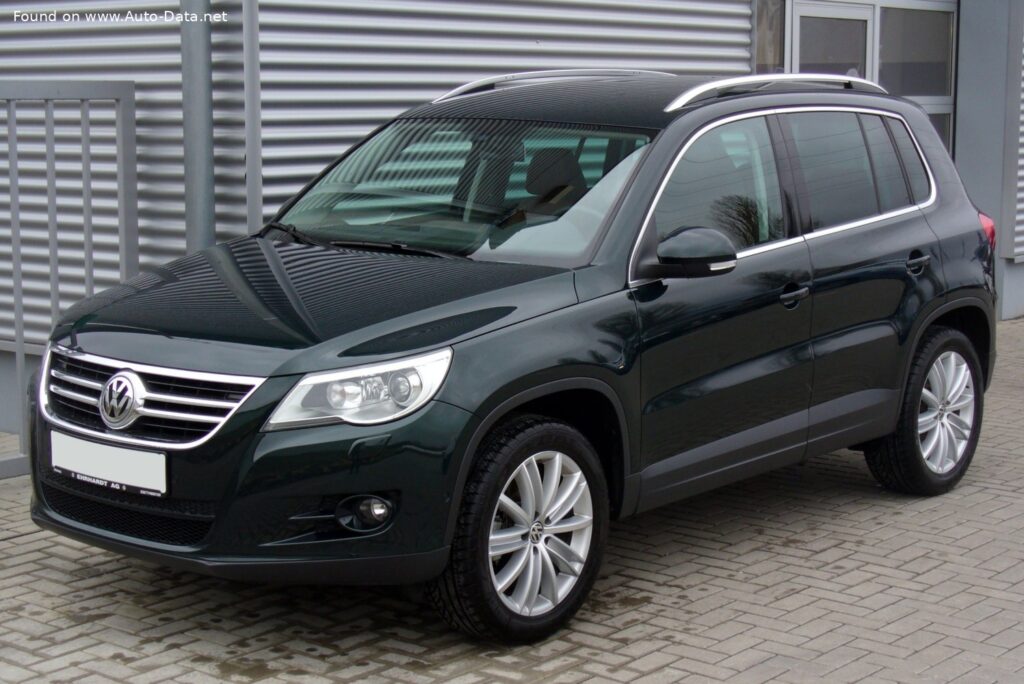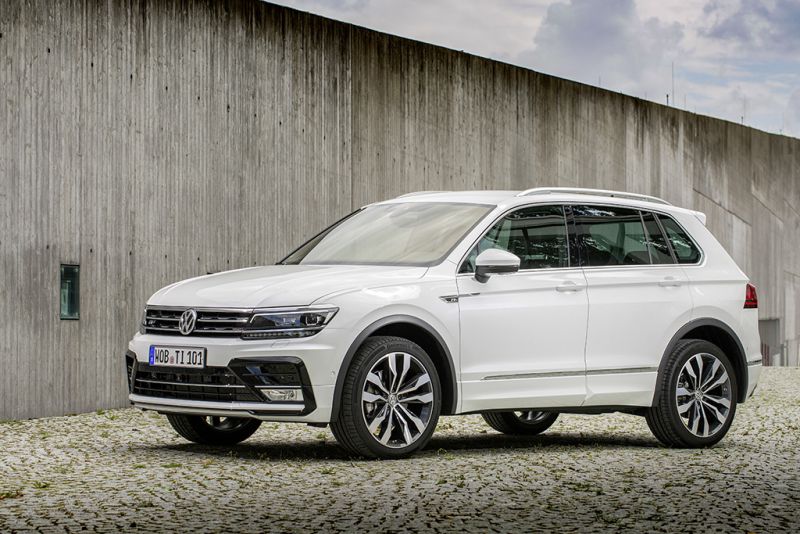
The Volkswagen Tiguan II 1.4 TSI (150 Hp) ACT DSG represents the second generation of Volkswagen’s highly successful compact SUV, a model that quickly established itself as a global player in one of the automotive industry’s most competitive segments. Launched in 2016, this iteration of the Tiguan marked a significant evolution from its predecessor, moving to the Volkswagen Group’s versatile MQB platform. This particular variant, produced between 2016 and 2018, was a popular choice in European and other international markets, offering a compelling blend of efficiency, performance, and practicality, primarily targeting families and urban commuters seeking a versatile and well-engineered vehicle. While not the most powerful engine option available across all Tiguan markets, the 1.4-liter TSI engine with Active Cylinder Technology (ACT) and a Direct Shift Gearbox (DSG) was engineered for optimal balance, providing robust performance for its class while adhering to stringent European emission standards.
Engine & Performance of the Volkswagen Tiguan II 1.4 TSI (150 Hp) ACT DSG
At the heart of this specific Volkswagen Tiguan II is a sophisticated 1.4-liter (1395 cm3 or 85.13 cu. in.) TSI inline-four-cylinder gasoline engine. This powerplant, identified by codes such as CZDA, CZEA, CHPB, and DJVA, delivers a respectable 150 horsepower at a broad range of 5000-6000 rpm, translating to 107.5 Hp per liter. What truly sets this engine apart is its innovative Active Cylinder Technology (ACT) and forced induction via a turbocharger with an intercooler. ACT is a clever system designed to enhance fuel efficiency by temporarily deactivating two of the four cylinders under light to moderate load conditions. For instance, when cruising at a steady speed, cylinders two and three are shut down, effectively turning the four-cylinder engine into a two-cylinder unit. This seamless transition, often imperceptible to the driver, significantly reduces fuel consumption and CO2 emissions without compromising the engine’s ability to deliver full power when needed.
Complementing the efficient engine is Volkswagen’s renowned 6-speed automatic DSG (Direct Shift Gearbox). This dual-clutch transmission is celebrated for its rapid and smooth gear changes, which contribute both to the Tiguan’s sporty driving dynamics and its overall fuel economy. Unlike traditional automatic transmissions, the DSG uses two separate clutches for odd and even gears, allowing the next gear to be pre-selected and engaged almost instantaneously. This design minimizes power loss during shifts and ensures a continuous flow of power to the front wheels, which is the drivetrain architecture for this particular model. The combination of the TSI engine and DSG transmission allows the Tiguan II 1.4 TSI (150 Hp) ACT DSG to accelerate from 0 to 60 mph in a brisk 8.7 seconds, reaching a top speed of 124.27 mph (200 km/h). These figures demonstrate that despite its focus on efficiency, the Tiguan doesn’t compromise on spirited performance for everyday driving.
Fuel economy is a strong suit for this Tiguan variant, largely thanks to the ACT and DSG systems, alongside a standard Start & Stop system that further conserves fuel by shutting down the engine when the vehicle is stationary. The combined fuel consumption is rated at an impressive 38.6 US mpg (6.1 l/100 km), with extra-urban driving seeing up to 42.8 US mpg (5.5 l/100 km) and urban driving achieving 31.8 US mpg (7.4 l/100 km). These figures underscore the Tiguan’s credentials as an economical choice in its segment. Emissions are also kept in check, with CO2 emissions of 140 g/km, meeting the stringent Euro 6 emission standard. The engine’s maximum torque output of 250 Nm (184.39 lb.-ft.) is available across a wide rev range, from 1500 to 3500 rpm, ensuring strong pulling power and flexibility in various driving conditions, whether navigating city streets or cruising on the highway. The front-wheel-drive configuration, combined with ventilated disc brakes at the front and disc brakes at the rear, along with an Anti-lock Braking System (ABS), ensures confident handling and stopping power.
Design & Features of the Volkswagen Tiguan II
The second-generation Volkswagen Tiguan, built on the MQB platform, brought a more mature, assertive, and sophisticated design language compared to its predecessor. As a compact SUV, it features a practical 5-door, 5-seat body type, making it an ideal family vehicle. Its exterior dimensions are well-proportioned for both urban maneuverability and highway stability, measuring 176.61 inches (4486 mm) in length, 72.4 inches (1839 mm) in width (82.64 inches or 2099 mm including mirrors), and 65.12 inches (1654 mm) in height. The wheelbase of 105.39 inches (2677 mm) contributes to a spacious cabin and a stable ride, while the ground clearance of 7.52 inches (191 mm) provides adequate capability for light off-road excursions or navigating challenging urban terrain.
Inside, the Tiguan II focuses on ergonomics, quality materials, and intuitive technology. While the specific trim level is not detailed, standard features for this generation typically included a robust infotainment system, connectivity options, and a suite of passive and active safety features. The design emphasizes practicality, evident in its generous cargo capacity. With all five seats in place, the trunk offers a substantial 21.72 cu. ft. (615 liters) of space. Folding down the rear seats expands this volume significantly to an impressive 58.45 cu. ft. (1655 liters), allowing for the transport of larger items, making it highly versatile for various lifestyles, from grocery runs to family vacations. The maximum roof load capacity of 165.35 lbs (75 kg) further enhances its utility, allowing for roof racks, bike carriers, or cargo boxes.
Further enhancing its utility, the Tiguan II 1.4 TSI (150 Hp) ACT DSG boasts considerable towing capabilities. With brakes, it can tow up to 4409.25 lbs (2000 kg) at an 8% gradient or 3968.32 lbs (1800 kg) at a 12% gradient, and 1631.42 lbs (740 kg) without brakes, with a permissible towbar download of 220.46 lbs (100 kg). These figures underscore its suitability for those needing to tow trailers, boats, or caravans. The vehicle rides on 215/65 R17 tires mounted on 7J x 17-inch wheel rims, providing a balance of comfort and grip. Steering is managed by an electric power-assisted rack and pinion system, offering precise control and ease of maneuverability, particularly in urban environments, with a minimum turning circle of 37.73 ft (11.5 meters).
Technical Specifications
| Brand | Volkswagen |
| Model | Tiguan |
| Generation | Tiguan II |
| Type (Engine) | 1.4 TSI (150 Hp) ACT DSG |
| Start of production | 2016 year |
| End of production | 2018 year |
| Powertrain Architecture | Internal Combustion engine |
| Body type | SUV |
| Seats | 5 |
| Doors | 5 |
| Fuel consumption (economy) – urban | 7.4 l/100 km (31.8 US mpg) |
| Fuel consumption (economy) – extra urban | 5.5 l/100 km (42.8 US mpg) |
| Fuel consumption (economy) – combined | 6.1 l/100 km (38.6 US mpg) |
| CO2 emissions | 140 g/km |
| Fuel Type | Petrol (Gasoline) |
| Acceleration 0 – 60 mph | 8.7 sec |
| Maximum speed | 200 km/h (124.27 mph) |
| Emission standard | Euro 6 |
| Weight-to-power ratio | 9.5 kg/Hp (105.4 Hp/tonne) |
| Weight-to-torque ratio | 5.7 kg/Nm (175.7 Nm/tonne) |
| Power | 150 Hp @ 5000-6000 rpm |
| Power per liter | 107.5 Hp/l |
| Torque | 250 Nm @ 1500-3500 rpm (184.39 lb.-ft.) |
| Engine layout | Front, Transverse |
| Engine Model/Code | CZDA, CZEA, CHPB, DJVA |
| Engine displacement | 1395 cm3 (85.13 cu. in.) |
| Number of cylinders | 4 |
| Engine configuration | Inline |
| Number of valves per cylinder | 4 |
| Fuel injection system | Direct injection |
| Engine aspiration | Turbocharger, Intercooler |
| Engine oil capacity | 4 l (4.23 US qt) |
| Engine systems | Start & Stop System, Cylinder deactivation system |
| Kerb Weight | 1423-1649 kg (3137.18 – 3635.42 lbs) |
| Max. weight | 2140 kg (4717.89 lbs) |
| Max load | 491-717 kg (1082.47 – 1580.71 lbs) |
| Trunk (boot) space – minimum | 615 l (21.72 cu. ft.) |
| Trunk (boot) space – maximum | 1655 l (58.45 cu. ft.) |
| Fuel tank capacity | 58 l (15.32 US gal) |
| Max. roof load | 75 kg (165.35 lbs) |
| Permitted trailer load with brakes (8%) | 2000 kg (4409.25 lbs) |
| Permitted trailer load with brakes (12%) | 1800 kg (3968.32 lbs) |
| Permitted trailer load without brakes | 740 kg (1631.42 lbs) |
| Permitted towbar download | 100 kg (220.46 lbs) |
| Length | 4486 mm (176.61 in.) |
| Width | 1839 mm (72.4 in.) |
| Width including mirrors | 2099 mm (82.64 in.) |
| Height | 1654 mm (65.12 in.) |
| Wheelbase | 2677 mm (105.39 in.) |
| Front track | 1579-1589 mm (62.17 – 62.56 in.) |
| Rear (Back) track | 1570-1580 mm (61.81 – 62.2 in.) |
| Ride height (ground clearance) | 191 mm (7.52 in.) |
| Minimum turning circle (turning diameter) | 11.5 m (37.73 ft) |
| Drivetrain Architecture | The Internal combustion engine (ICE) drives the front wheels of the vehicle. |
| Drive wheel | Front wheel drive |
| Number of gears and type of gearbox | 6 gears, automatic transmission DSG |
| Front brakes | Ventilated discs |
| Rear brakes | Disc |
| Assisting systems | ABS (Anti-lock braking system) |
| Steering type | Steering rack and pinion |
| Power steering | Electric Steering |
| Tires size | 215/65 R17 |
| Wheel rims size | 7J x 17 |