
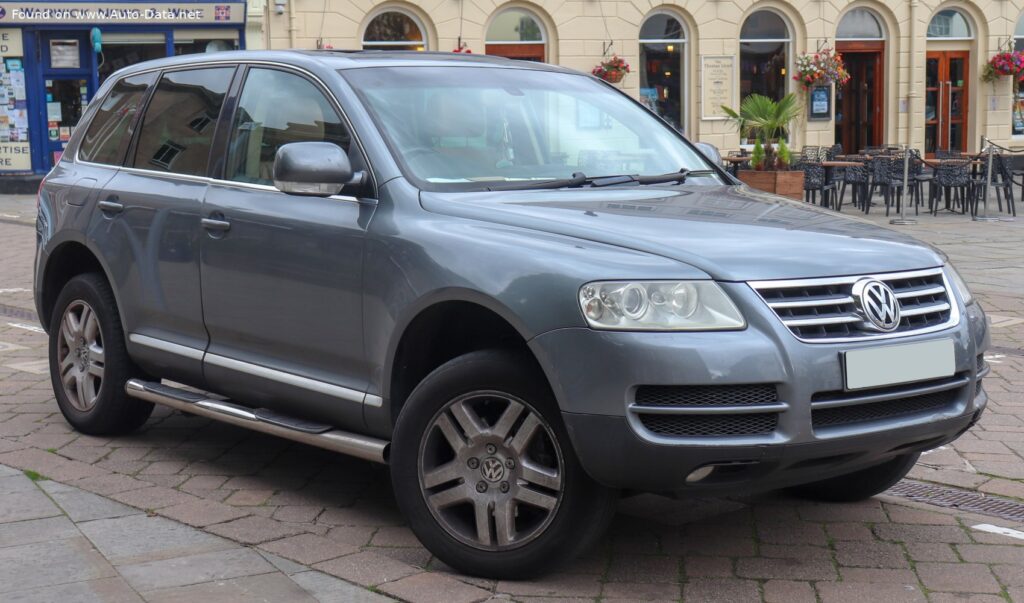
The Volkswagen Touareg I (7L), produced from 2002 to 2006, marked Volkswagen’s entry into the burgeoning luxury SUV market. Developed alongside the Porsche Cayenne (with whom it shares a platform), the Touareg aimed to provide a sophisticated, capable, and technologically advanced vehicle. While not initially a high-volume seller in the United States compared to established American and Japanese SUV brands, the Touareg established Volkswagen as a contender in the premium SUV segment, particularly in Europe where it found a more receptive audience. The 4.2 i V8 Tiptronic model, equipped with a 310 horsepower engine, represented the top-of-the-line offering for the first-generation Touareg.
Volkswagen Touareg I (7L) 4.2 i V8 Tiptronic: An Overview
The Touareg I (7L) was a significant departure for Volkswagen, representing a move upmarket and a commitment to building larger, more luxurious vehicles. The 4.2 i V8 Tiptronic variant specifically targeted buyers seeking a blend of performance, refinement, and off-road capability. The “Tiptronic” designation refers to the six-speed automatic transmission with a manual shift mode, offering drivers greater control over gear selection. This model was positioned as a competitor to vehicles like the BMW X5, Mercedes-Benz M-Class, and Range Rover, offering a unique combination of German engineering and off-road prowess.
Engine & Performance
The heart of the Touareg 4.2 i V8 Tiptronic is its 4.2-liter naturally aspirated V8 engine, designated the AXQ engine code. This engine produces 310 horsepower at 6,200 rpm and 302.4 lb-ft of torque between 3,000 and 4,000 rpm. The engine features a double overhead camshaft (DOHC) valvetrain with five valves per cylinder, and utilizes multi-port fuel injection. The longitudinal engine layout contributes to a balanced weight distribution. Acceleration from 0 to 60 mph is achieved in approximately 7.7 seconds, with a top speed of 135.46 mph (218 km/h). Despite its performance capabilities, fuel economy is relatively low at 16.2 US mpg combined, and CO2 emissions are rated at 355 g/km, reflecting the engine’s size and the vehicle’s weight. The weight-to-power ratio of 8 kg/Hp and weight-to-torque ratio of 6 kg/Nm demonstrate a reasonable balance between power and mass.
Design & Features
The Touareg I (7L) boasts a robust, yet elegant SUV design. Its body-on-frame construction (though increasingly uncommon at the time) contributed to its off-road capability and durability. The vehicle offers seating for five passengers and features five doors for easy access. A key feature of the Touareg was its advanced suspension system, utilizing air suspension on both the front and rear axles. This system allowed for adjustable ride height and improved off-road performance. The interior was designed with a focus on comfort and functionality, offering a range of features including leather upholstery, automatic climate control, and a premium audio system. Safety features included ABS (Anti-lock Braking System) and a hydraulic power steering system. The Touareg’s trunk space is generous, ranging from 19.42 cubic feet with the rear seats up to 55.44 cubic feet with the rear seats folded down. It also has a substantial towing capacity, capable of hauling up to 3,500 kg (7,716.18 lbs) with brakes.
Technical Specifications
| Brand | Volkswagen |
| Model | Touareg |
| Generation | Touareg I (7L) |
| Type (Engine) | 4.2 i V8 (310 Hp) Tiptronic |
| Start of production | December, 2002 |
| End of production | November, 2006 |
| Powertrain Architecture | Internal Combustion engine |
| Body type | SUV |
| Seats | 5 |
| Doors | 5 |
| Fuel consumption (economy) – combined | 14.5 l/100 km |
| Fuel consumption (economy) – combined (US mpg) | 16.2 US mpg |
| Fuel consumption (economy) – combined (UK mpg) | 19.5 UK mpg |
| CO2 emissions | 355 g/km |
| Fuel Type | Petrol (Gasoline) |
| Acceleration 0 – 100 km/h | 8.1 sec |
| Acceleration 0 – 62 mph | 8.1 sec |
| Acceleration 0 – 60 mph | 7.7 sec |
| Maximum speed | 218 km/h (135.46 mph) |
| Emission standard | Euro 4 |
| Weight-to-power ratio | 8 kg/Hp |
| Weight-to-torque ratio | 6 kg/Nm |
| Power | 310 Hp @ 6200 rpm |
| Power per litre | 74.3 Hp/l |
| Torque | 410 Nm @ 3000-4000 rpm (302.4 lb.-ft. @ 3000-4000 rpm) |
| Engine layout | Front, Longitudinal |
| Engine Model/Code | AXQ |
| Engine displacement | 4172 cm3 (254.59 cu. in.) |
| Number of cylinders | 8 |
| Engine configuration | V-engine |
| Cylinder Bore | 84.5 mm (3.33 in.) |
| Piston Stroke | 93 mm (3.66 in.) |
| Compression ratio | 11:1 |
| Number of valves per cylinder | 5 |
| Fuel injection system | Multi-port manifold injection |
| Engine aspiration | Naturally aspirated engine |
| Valvetrain | DOHC |
| Engine oil capacity | 7.5 l (7.93 US qt | 6.6 UK qt) |
| Coolant | 9 l (9.51 US qt | 7.92 UK qt) |
| Kerb Weight | 2467 kg (5438.8 lbs.) |
| Max. weight | 2945 kg (6492.61 lbs.) |
| Max load | 478 kg (1053.81 lbs.) |
| Trunk (boot) space – minimum | 550 l (19.42 cu. ft.) |
| Trunk (boot) space – maximum | 1570 l (55.44 cu. ft.) |
| Fuel tank capacity | 100 l (26.42 US gal | 22 UK gal) |
| Permitted trailer load with brakes (12%) | 3500 kg (7716.18 lbs.) |
| Permitted trailer load without brakes | 750 kg (1653.47 lbs.) |
| Length | 4754 mm (187.17 in.) |
| Width | 1928 mm (75.91 in.) |
| Width including mirrors | 2217 mm (87.28 in.) |
| Height | 1726 mm (67.95 in.) |
| Wheelbase | 2855 mm (112.4 in.) |
| Front track | 1645 mm (64.76 in.) |
| Rear (Back) track | 1657 mm (65.24 in.) |
| Minimum turning circle (turning diameter) | 11.6 m (38.06 ft.) |
| Drive wheel | All wheel drive (4×4) |
| Number of gears and type of gearbox | 6 gears, automatic transmission |
| Front suspension | Air suspension |
| Rear suspension | Air suspension |
| Front brakes | Ventilated discs |
| Rear brakes | Ventilated discs |
| Assisting systems | ABS (Anti-lock braking system) |
| Steering type | Steering rack and pinion |
| Power steering | Hydraulic Steering |
| Tires size | 255/60 R17 |
| Wheel rims size | 17 |
