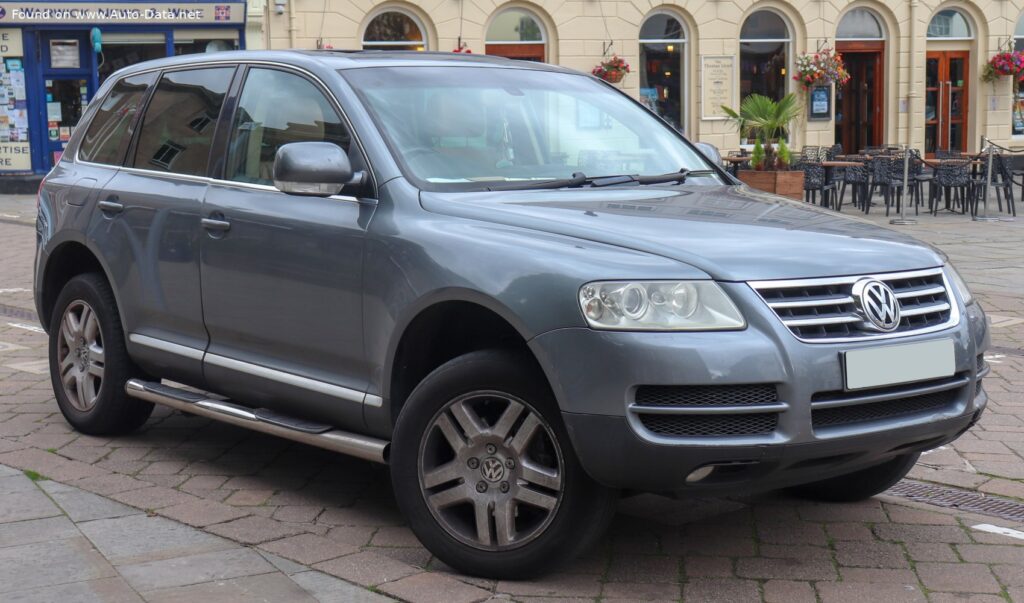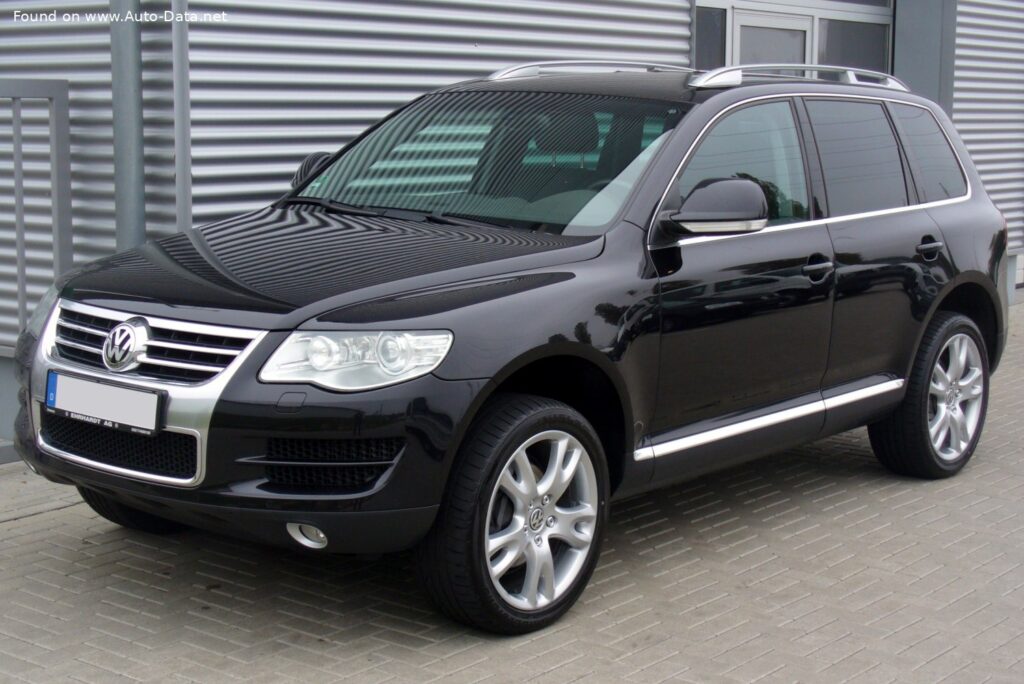
The Volkswagen Touareg I (7L), particularly the facelifted version produced from 2006 to 2010, represents Volkswagen’s initial foray into the burgeoning luxury SUV market. Positioned above the Tiguan in Volkswagen’s lineup, the Touareg aimed to compete with established players like the BMW X5, Mercedes-Benz ML-Class, and Porsche Cayenne – the latter sharing its platform. The 3.6 FSI V6 4MOTION Tiptronic model, equipped with a 280 horsepower engine and all-wheel drive, was a key variant offered during this period, appealing to buyers seeking a blend of performance, luxury, and off-road capability. This generation Touareg was significant for introducing Volkswagen’s 4MOTION permanent all-wheel-drive system to a wider audience and establishing a foothold for the brand in the premium SUV segment.
Volkswagen Touareg I (7L) 3.6 FSI: An Overview
The Touareg I, internally designated the 7L chassis code, was Volkswagen’s first attempt at a full-size SUV. The 2006 facelift brought revised styling, improved interior materials, and updated engine options, including the 3.6-liter FSI V6. This engine, utilizing direct fuel injection (FSI), was designed to offer a balance of power and efficiency. The “4MOTION” designation indicates Volkswagen’s permanent all-wheel-drive system, providing enhanced traction and stability in various driving conditions. The “Tiptronic” label refers to the six-speed automatic transmission with a manual shift mode, allowing drivers to exert more control over gear selection.
Engine & Performance
The heart of the Touareg 3.6 FSI is a 3.6-liter naturally aspirated V6 engine, producing 280 horsepower at 6,250 rpm and 360 Newton-meters (265.52 lb.-ft.) of torque between 2,500 and 5,000 rpm. This engine features direct fuel injection, contributing to improved combustion efficiency and power delivery. The engine’s longitudinal mounting and the 4MOTION all-wheel-drive system work in concert to provide confident handling and acceleration. Performance figures include a 0-100 km/h (0-62 mph) time of 8.6 seconds, and a 0-60 mph time of approximately 8.2 seconds. The Touareg achieves a maximum speed of 218 km/h (135.46 mph). While not a sports car, the 3.6 FSI offers ample power for everyday driving and comfortable highway cruising. Fuel economy, as measured by the NEDC standard, is rated at 12.4 liters per 100 kilometers (19 US mpg) combined, with urban consumption at 18 l/100km (13.1 US mpg) and extra-urban at 9.2 l/100km (25.6 US mpg). CO2 emissions are rated at 296 g/km, meeting Euro 4 emission standards.
Design & Features
The Touareg I (7L) boasts a traditional SUV body style with a five-door configuration and seating for five passengers. The 2006 facelift brought subtle but noticeable changes to the exterior, including revised headlights, a redesigned grille, and updated bumpers. The interior was also upgraded with higher-quality materials and improved ergonomics. Key features of the 3.6 FSI model typically include leather upholstery, automatic climate control, a premium audio system, and various electronic driver aids. Safety features, crucial for a vehicle in this segment, include ABS (Anti-lock Braking System), traction control, and multiple airbags. The Touareg’s 4MOTION system enhances safety by providing superior grip in adverse weather conditions. Practicality is also a strong suit, with a trunk capacity ranging from 555 liters (19.6 cu. ft.) with the rear seats up to 1570 liters (55.44 cu. ft.) with the seats folded down. The Touareg also offers a respectable towing capacity of up to 3500 kg (7716.18 lbs) with brakes.
Technical Specifications
| Brand | Volkswagen |
| Model | Touareg |
| Generation | Touareg I (7L, facelift 2006) |
| Type (Engine) | 3.6 FSI V6 (280 Hp) 4MOTION Tiptronic |
| Start of production | 2006 |
| End of production | 2010 |
| Powertrain Architecture | Internal Combustion engine |
| Body type | SUV |
| Seats | 5 |
| Doors | 5 |
| Fuel consumption (economy) – urban (NEDC) | 18 l/100 km (13.1 US mpg, 15.7 UK mpg, 5.6 km/l) |
| Fuel consumption (economy) – extra urban (NEDC) | 9.2 l/100 km (25.6 US mpg, 30.7 UK mpg, 10.9 km/l) |
| Fuel consumption (economy) – combined (NEDC) | 12.4 l/100 km (19 US mpg, 22.8 UK mpg, 8.1 km/l) |
| CO2 emissions (NEDC) | 296 g/km |
| Fuel Type | Petrol (Gasoline) |
| Acceleration 0 – 100 km/h | 8.6 sec |
| Acceleration 0 – 62 mph | 8.6 sec |
| Acceleration 0 – 60 mph | 8.2 sec |
| Maximum speed | 218 km/h (135.46 mph) |
| Emission standard | Euro 4 |
| Weight-to-power ratio | 8 kg/Hp, 125.1 Hp/tonne |
| Weight-to-torque ratio | 6.2 kg/Nm, 160.9 Nm/tonne |
| Power | 280 Hp @ 6250 rpm |
| Torque | 360 Nm @ 2500-5000 rpm (265.52 lb.-ft. @ 2500-5000 rpm) |
| Engine layout | Front, Longitudinal |
| Engine Model/Code | BHK, BHL |
| Engine displacement | 3597 cm3 (219.5 cu. in.) |
| Number of cylinders | 6 |
| Engine configuration | V-engine |
| Cylinder Bore | 89 mm (3.5 in.) |
| Piston Stroke | 96.4 mm (3.8 in.) |
| Compression ratio | 12:1 |
| Number of valves per cylinder | 4 |
| Fuel injection system | Direct injection |
| Engine aspiration | Naturally aspirated engine |
| Valvetrain | DOHC |
| Engine oil capacity | 6.9 l (7.29 US qt | 6.07 UK qt) |
| Coolant | 9 l (9.51 US qt | 7.92 UK qt) |
| Kerb Weight | 2238 kg (4933.95 lbs.) |
| Max. weight | 2945 kg (6492.61 lbs.) |
| Max load | 707 kg (1558.67 lbs.) |
| Trunk (boot) space – minimum | 555 l (19.6 cu. ft.) |
| Trunk (boot) space – maximum | 1570 l (55.44 cu. ft.) |
| Fuel tank capacity | 100 l (26.42 US gal | 22 UK gal) |
| Max. roof load | 100 kg (220.46 lbs.) |
| Permitted trailer load with brakes (12%) | 3500 kg (7716.18 lbs.) |
| Permitted trailer load without brakes | 750 kg (1653.47 lbs.) |
| Permitted towbar download | 140 kg (308.65 lbs.) |
| Length | 4754 mm (187.17 in.) |
| Width | 1928 mm (75.91 in.) |
| Width including mirrors | 2217 mm (87.28 in.) |
| Height | 1726 mm (67.95 in.) |
| Wheelbase | 2855 mm (112.4 in.) |
| Front track | 1649 mm (64.92 in.) |
| Rear (Back) track | 1661 mm (65.39 in.) |
| Ride height (ground clearance) | 163 mm (6.42 in.) |
| Minimum turning circle (turning diameter) | 11.6 m (38.06 ft.) |
| Drivetrain Architecture | The Internal combustion engine (ICE) drives permanently the four wheels of the vehicle. |
| Drive wheel | All wheel drive (4×4) |
| Number of gears and type of gearbox | 6 gears, automatic transmission Tiptronic |
| Front suspension | Double wishbone, Transverse stabilizer |
| Rear suspension | Double wishbone, Transverse stabilizer |
| Front brakes | Ventilated discs |
| Rear brakes | Ventilated discs |
| Assisting systems | ABS (Anti-lock braking system) |
| Steering type | Steering rack and pinion |
| Power steering | Hydraulic Steering |
| Tires size | 235/65 R17 |
| Wheel rims size | 7.5J x 17 |