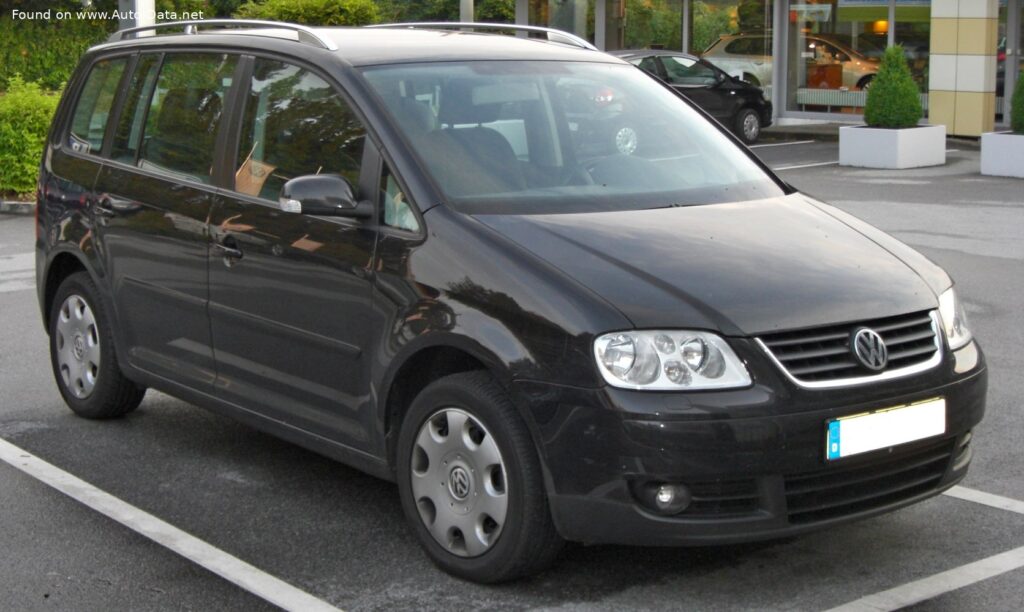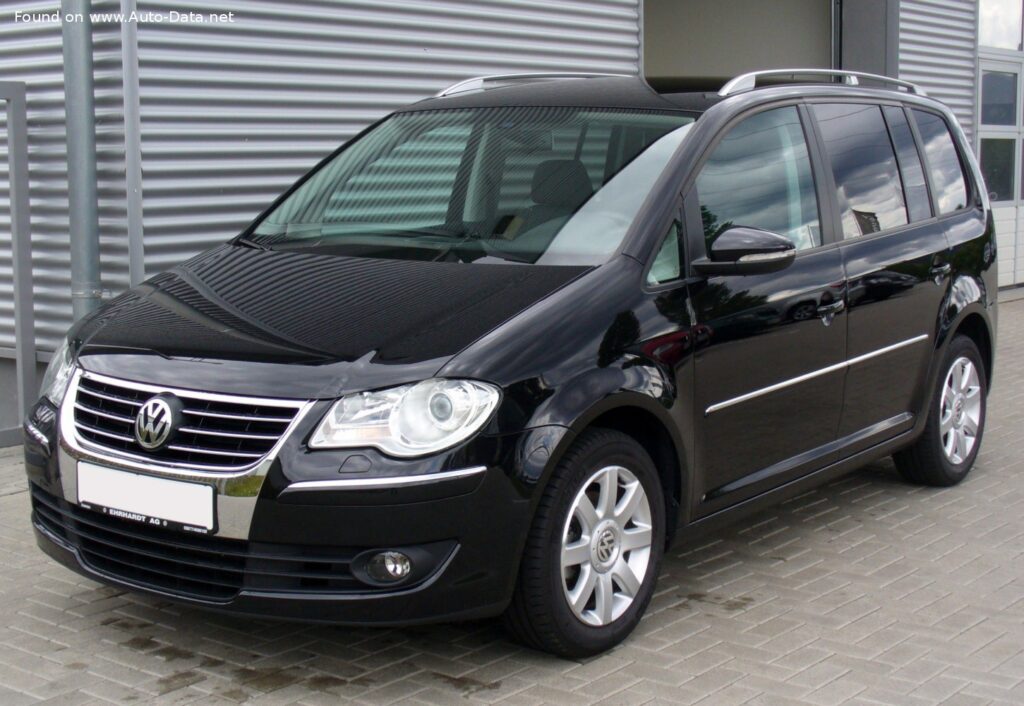
The Volkswagen Touran I (facelift 2006) 2.0 EcoFuel represents a significant offering in the compact minivan segment, particularly within the European market. Introduced as a more affordable and practical alternative to larger MPVs, the Touran aimed to provide family-friendly versatility with a focus on fuel efficiency. The “EcoFuel” designation indicates the vehicle’s capability to run on Compressed Natural Gas (CNG), a cleaner-burning fuel, alongside conventional gasoline. This model, produced from 2006 to 2009, was a key part of Volkswagen’s strategy to offer environmentally conscious options while maintaining practicality and affordability. While not officially sold in the United States, understanding the Touran provides insight into the European compact MPV market and Volkswagen’s early adoption of alternative fuel technologies.
Volkswagen Touran I (Facelift 2006) 2.0 EcoFuel: An Overview
The Touran I, launched in 2003, was Volkswagen’s entry into the increasingly popular compact minivan class. The 2006 facelift brought styling updates, improved interior materials, and refinements to the engine lineup, including the 2.0 EcoFuel variant. This version distinguished itself by offering bi-fuel capability – the ability to seamlessly switch between gasoline and CNG. This allowed drivers to benefit from the lower running costs and reduced emissions associated with CNG, while retaining the flexibility of gasoline for longer journeys or areas without CNG infrastructure. The Touran’s design prioritized interior space and modularity, making it a popular choice for families.
Engine & Performance
The heart of the Touran I (facelift 2006) 2.0 EcoFuel is a 1.984-liter inline-four cylinder engine. This naturally aspirated engine produces 109 horsepower at 5400 rpm and 160 Nm (118.01 lb.-ft.) of torque at 3500 rpm. The engine utilizes multi-port fuel injection and a single overhead camshaft (SOHC) valvetrain. The key feature, however, is its compatibility with CNG. When running on CNG, the engine’s output remains comparable, though slight variations may occur due to the different combustion characteristics of the fuel. Power per liter is rated at 54.9 Hp/l. The engine is transversely mounted at the front of the vehicle, driving the front wheels through a five-speed manual transmission. Acceleration from 0 to 100 km/h (0-62 mph) takes 13.5 seconds, while 0-60 mph is achieved in approximately 12.8 seconds. The top speed is electronically limited to 180 km/h (111.85 mph). The weight-to-power ratio is 13.7 kg/Hp, and the weight-to-torque ratio is 9.3 kg/Nm.
Design & Features
The Touran I (facelift 2006) is a five-door minivan with a practical and functional design. It offers seating for five passengers, although optional seven-seat configurations were also available. The interior is characterized by its modularity, with adjustable and foldable rear seats allowing for a variety of seating and cargo configurations. The trunk space is generous, ranging from 695 liters (24.54 cu. ft.) with the rear seats up to 1989 liters (70.24 cu. ft.) with the seats folded down. Safety features for the era included ABS (Anti-lock Braking System) and front ventilated disc brakes, with disc brakes on the rear. The suspension consists of coil springs with a wishbone setup and a transverse stabilizer at the front, and an independent multi-link suspension with a transverse stabilizer at the rear. The steering utilizes a rack and pinion system with electric power steering. The vehicle’s dimensions are 4407 mm (173.5 in.) in length, 1794 mm (70.63 in.) in width, and 1635 mm (64.37 in.) in height.
Technical Specifications
| Brand | Volkswagen |
| Model | Touran |
| Generation | Touran I (facelift 2006) |
| Type (Engine) | 2.0 EcoFuel (109 Hp) CNG |
| Start of production | 2006 |
| End of production | 2009 |
| Powertrain Architecture | Internal Combustion engine |
| Body type | Minivan |
| Seats | 5 |
| Doors | 5 |
| Fuel consumption (economy) – urban (NEDC) | 12 l/100 km (19.6 US mpg, 23.5 UK mpg, 8.3 km/l) |
| Fuel consumption (economy) – urban (CNG) (NEDC) | 8.1 kg/100 km |
| Fuel consumption (economy) – extra urban (NEDC) | 6.6 l/100 km (35.6 US mpg, 42.8 UK mpg, 15.2 km/l) |
| Fuel consumption (economy) – extra urban (CNG) (NEDC) | 4.5 kg/100 km |
| Fuel consumption (economy) – combined (NEDC) | 8.6 l/100 km (27.4 US mpg, 32.8 UK mpg, 11.6 km/l) |
| Fuel consumption (economy) – combined (CNG) (NEDC) | 5.8 kg/100 km |
| CO2 emissions (NEDC) | 155 g/km |
| CO2 emissions (CNG) (NEDC) | 154 g/km |
| Fuel Type | Petrol / CNG |
| Acceleration 0 – 100 km/h | 13.5 sec |
| Acceleration 0 – 62 mph | 13.5 sec |
| Acceleration 0 – 60 mph | 12.8 sec |
| Maximum speed | 180 km/h (111.85 mph) |
| Emission standard | Euro 4 |
| Weight-to-power ratio | 13.7 kg/Hp |
| Weight-to-torque ratio | 9.3 kg/Nm |
| Power | 109 Hp @ 5400 rpm |
| Torque | 160 Nm @ 3500 rpm (118.01 lb.-ft. @ 3500 rpm) |
| Engine layout | Front, Transverse |
| Engine Model/Code | EA113 / BSX |
| Engine displacement | 1984 cm3 (121.07 cu. in.) |
| Number of cylinders | 4 |
| Engine configuration | Inline |
| Cylinder Bore | 82.5 mm (3.25 in.) |
| Piston Stroke | 92.8 mm (3.65 in.) |
| Compression ratio | 13.5:1 |
| Number of valves per cylinder | 2 |
| Fuel injection system | Multi-port manifold injection |
| Engine aspiration | Naturally aspirated engine |
| Valvetrain | SOHC |
| Engine oil capacity | 4 l (4.23 US qt | 3.52 UK qt) |
| Coolant | 8 l (8.45 US qt | 7.04 UK qt) |
| Kerb Weight | 1488 kg (3280.48 lbs.) |
| Max. weight | 2180 kg (4806.08 lbs.) |
| Max load | 692 kg (1525.6 lbs.) |
| Trunk (boot) space – minimum | 695 l (24.54 cu. ft.) |
| Trunk (boot) space – maximum | 1989 l (70.24 cu. ft.) |
| Fuel tank capacity | 13 l (3.43 US gal | 2.86 UK gal) |
| CNG cylinder capacity | 18 kg |
| Max. roof load | 100 kg (220.46 lbs.) |
| Permitted trailer load with brakes (8%) | 1600 kg (3527.4 lbs.) |
| Permitted trailer load with brakes (12%) | 1300 kg (2866.01 lbs.) |
| Permitted trailer load without brakes | 750 kg (1653.47 lbs.) |
| Permitted towbar download | 75 kg (165.35 lbs.) |
| Length | 4407 mm (173.5 in.) |
| Width | 1794 mm (70.63 in.) |
| Width including mirrors | 2047 mm (80.59 in.) |
| Height | 1635 mm (64.37 in.) |
| Wheelbase | 2678 mm (105.43 in.) |
| Front track | 1541 mm (60.67 in.) |
| Rear (Back) track | 1514 mm (59.61 in.) |
| Minimum turning circle (turning diameter) | 11.2 m (36.75 ft.) |
| Drivetrain Architecture | The Internal combustion engine (ICE) drives the front wheels of the vehicle. |
| Drive wheel | Front wheel drive |
| Number of gears and type of gearbox | 5 gears, manual transmission |
| Front suspension | Coil spring, Wishbone, Transverse stabilizer |
| Rear suspension | Independent multi-link suspension, Transverse stabilizer |
| Front brakes | Ventilated discs |
| Rear brakes | Disc |
| Assisting systems | ABS (Anti-lock braking system) |
| Steering type | Steering rack and pinion |
| Power steering | Electric Steering |
| Tires size | 195/65 R15; 205/55 R16 |
| Wheel rims size | 6J x 15; 6.5J x 16 |