Technical Specifications
| Brand | Volkswagen |
| Model | Transporter |
| Generation | Transporter (T4, facelift 1996) Kombi |
| Type (Engine) | 2.0 (84 Hp) L1H1 |
| Start of production | 1996 |
| End of production | 2003 |
| Powertrain Architecture | Internal Combustion engine |
| Body type | Van |
| Seats | 2-9 |
| Doors | 4-5 |
| Fuel consumption (urban) | 13.3 l/100 km (17.7 US mpg, 21.2 UK mpg, 7.5 km/l) |
| Fuel consumption (extra urban) | 8.7 l/100 km (27 US mpg, 32.5 UK mpg, 11.5 km/l) |
| Fuel Type | Petrol (Gasoline) |
| Maximum speed | 144 km/h (89.48 mph) |
| Weight-to-power ratio | 18.8 kg/Hp, 53.2 Hp/tonne |
| Weight-to-torque ratio | 9.9 kg/Nm, 100.6 Nm/tonne |
| Power | 84 Hp @ 4300 rpm |
| Power per litre | 42.7 Hp/l |
| Torque | 159 Nm @ 2200 rpm (117.27 lb.-ft. @ 2200 rpm) |
| Engine layout | Front, Transverse |
| Engine Model/Code | AAC |
| Engine displacement | 1968 cm3 (120.09 cu. in.) |
| Number of cylinders | 4 |
| Engine configuration | Inline |
| Cylinder Bore | 81 mm (3.19 in.) |
| Piston Stroke | 95.5 mm (3.76 in.) |
| Compression ratio | 8.5:1 |
| Number of valves per cylinder | 2 |
| Fuel injection system | Multi-port manifold injection |
| Engine aspiration | Naturally aspirated engine |
| Valvetrain | SOHC |
| Engine oil capacity | 5 l (5.28 US qt | 4.4 UK qt) |
| Coolant | 9 l (9.51 US qt | 7.92 UK qt) |
| Kerb Weight | 1580 kg (3483.3 lbs.) |
| Max. weight | 2380-2785 kg (5247 – 6139.87 lbs.) |
| Max load | 800-1205 kg (1763.7 – 2656.57 lbs.) |
| Trunk (boot) space – maximum | 5400 l (190.7 cu. ft.) |
| Fuel tank capacity | 80 l (21.13 US gal | 17.6 UK gal) |
| Max. roof load | 100 kg (220.46 lbs.) |
| Permitted trailer load with brakes (12%) | 2000 kg (4409.25 lbs.) |
| Permitted trailer load without brakes | 700 kg (1543.24 lbs.) |
| Permitted towbar download | 100 kg (220.46 lbs.) |
| Length | 4707 mm (185.31 in.) |
| Width | 1840 mm (72.44 in.) |
| Width including mirrors | 2175 mm (85.63 in.) |
| Height | 1940 mm (76.38 in.) |
| Wheelbase | 2920 mm (114.96 in.) |
| Front track | 1589 mm (62.56 in.) |
| Rear (Back) track | 1554 mm (61.18 in.) |
| Front overhang | 886 mm (34.88 in.) |
| Rear overhang | 901 mm (35.47 in.) |
| Ride height (ground clearance) | 180 mm (7.09 in.) |
| Minimum turning circle (turning diameter) | 11.7 m (38.39 ft.) |
| Wading depth | 350 mm (13.78 in.) |
| Drivetrain Architecture | The Internal combustion engine (ICE) drives the front wheels of the vehicle. |
| Drive wheel | Front wheel drive |
| Number of gears and type of gearbox | 5 gears, manual transmission |
| Front suspension | Independent torsion bar, double wishbone, Transverse stabilizer |
| Rear suspension | Independent coil spring, Trailing arm |
| Front brakes | Disc |
| Rear brakes | Disc |
| Assisting systems | ABS (Anti-lock braking system) |
| Steering type | Steering rack and pinion |
| Power steering | Hydraulic Steering |
| Tires size | 195/70 R15; 205/65 R15 |
| Wheel rims size | 6J x 15 |
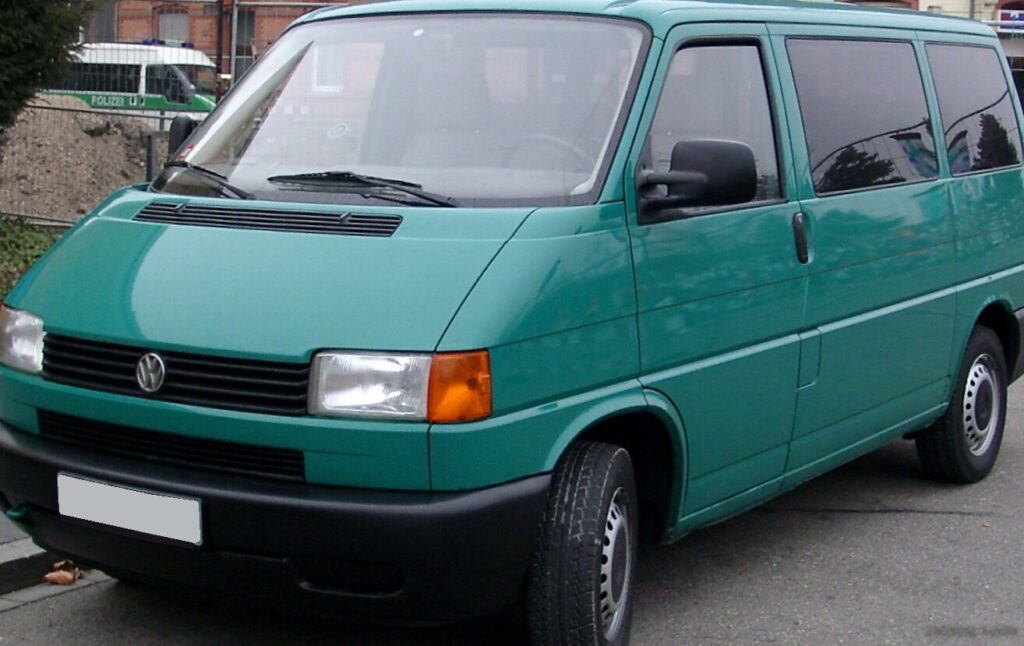
The Volkswagen Transporter T4, launched in 1990 and facelifted in 1996, continued the tradition of the iconic Type 2 (Bus) as Volkswagen’s versatile commercial and passenger vehicle. The 1996 facelift brought cosmetic updates and refinements to the T4, improving its appeal and addressing some earlier criticisms. The Kombi 2.0 with 84 horsepower, designated with engine code AAC, was a popular choice, particularly for those prioritizing affordability and fuel efficiency over outright performance. It slotted into the lineup below the more powerful 2.5L petrol and 1.9L TDI diesel options, offering a more accessible entry point to T4 ownership. The L1H1 designation refers to the short wheelbase and standard roof height, making it a relatively compact and maneuverable van.
Powertrain & Engine Architecture
The heart of the Kombi 2.0 is the AAC engine, a 1.968-liter inline four-cylinder petrol engine. This engine utilizes a multi-port fuel injection system, a common setup for the era, providing a balance between efficiency and power delivery. The engine features a single overhead camshaft (SOHC) valvetrain, operating two valves per cylinder. While not a particularly technologically advanced engine by modern standards, it was known for its relative reliability and ease of maintenance. The 84 horsepower peak is achieved at 4300 rpm, while the 159 Nm (117.27 lb.-ft.) of torque is available at 2200 rpm. The engine’s transverse mounting, common in front-wheel-drive vehicles, contributes to efficient packaging within the van’s chassis. The standard transmission for this variant was a five-speed manual, though a four-speed automatic transmission was also available, albeit less common and often impacting fuel economy.
Driving Characteristics
The 84 hp 2.0L engine, paired with the five-speed manual transmission, provided adequate, but not exhilarating, performance. Acceleration was modest, and overtaking required careful planning. The engine’s torque curve meant that it felt relatively responsive in everyday driving situations, particularly around town. Compared to the more powerful 2.5L petrol or the torquey 1.9 TDI diesel, the 2.0L felt noticeably slower, especially when fully loaded. The automatic transmission option further diminished performance, resulting in sluggish acceleration and increased fuel consumption. The gear ratios were geared towards economy rather than outright speed, prioritizing fuel efficiency and reducing engine strain. Handling was typical for a van of this era – somewhat ponderous, but predictable. The front-wheel-drive configuration provided decent grip in most conditions.
Equipment & Trim Levels
The Kombi 2.0 typically came with a fairly basic level of equipment, reflecting its position as an entry-level model. Standard features generally included power steering, central locking, and a basic stereo system. Interior upholstery was typically cloth, with durable plastics used throughout the cabin. The dashboard layout was functional and straightforward. Optional extras included air conditioning, electric windows, and upgraded stereo systems. The Kombi designation meant that the vehicle was configured with seating for passengers in addition to cargo space, typically with a rear bench seat. Different seating configurations were available, ranging from two to nine seats, depending on customer requirements.
Chassis & Braking
The T4 utilized an independent suspension setup on both the front and rear axles. The front suspension employed a torsion bar and double wishbone configuration, while the rear featured independent coil springs and trailing arms. This setup provided a reasonable level of ride comfort, considering the vehicle’s commercial purpose. Braking was initially disc brakes all around, though some earlier models had rear drum brakes. All T4s were equipped with an Anti-lock Braking System (ABS), enhancing safety and control during emergency braking. Stabilizer bars were fitted to both the front and rear axles to reduce body roll during cornering. The steering system was a rack and pinion setup with hydraulic power assistance, making it relatively easy to maneuver, even when fully loaded.
Market Reception & Comparison
The Kombi 2.0 was generally well-received as a practical and affordable van. Critics praised its versatility, build quality, and relatively low running costs. However, the 84 hp engine was often criticized for being underpowered, particularly when compared to the more potent alternatives in the T4 range. The 1.9 TDI diesel, for example, offered significantly more torque and better fuel economy, making it a popular choice for those covering long distances or frequently carrying heavy loads. The 2.5L petrol engine provided more power but at the expense of fuel efficiency. The 2.0L Kombi appealed to those who prioritized affordability and simplicity over outright performance.
Legacy
The Volkswagen T4, including the 2.0L Kombi variant, has developed a strong following among enthusiasts and classic vehicle collectors. The AAC engine, while not known for its exceptional performance, is generally considered reliable and relatively easy to maintain. Parts availability remains good, making it a viable option for those seeking a classic van for restoration or everyday use. Today, well-maintained examples of the Kombi 2.0 command reasonable prices in the used car market, reflecting their enduring appeal and practicality. The T4 represents a significant chapter in Volkswagen’s history, bridging the gap between the iconic Type 2 and the more modern Transporter models.