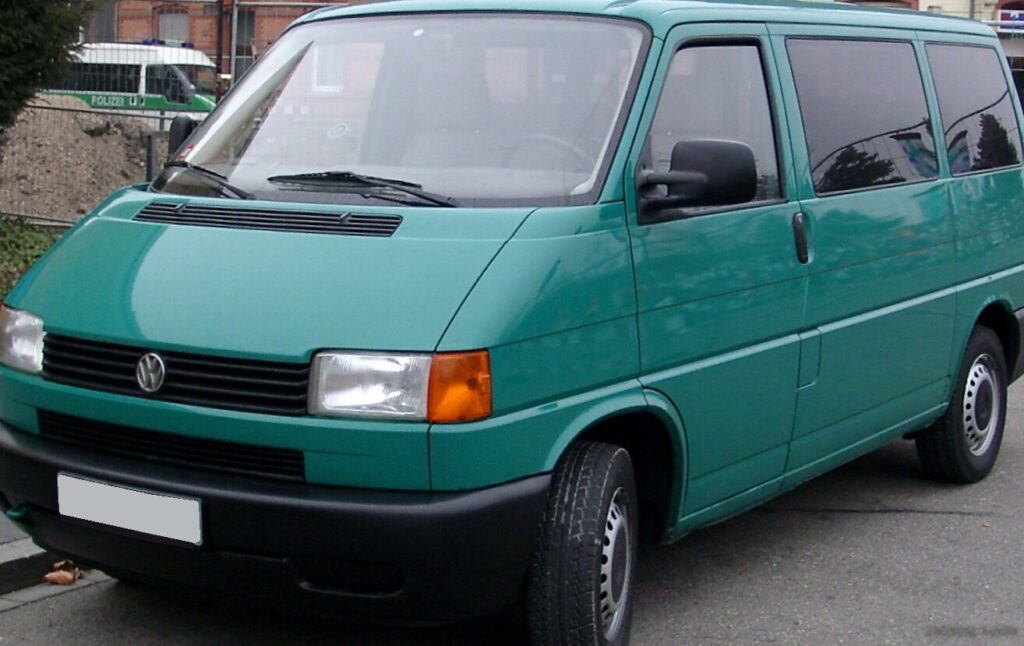
The Volkswagen Transporter (T4), particularly the Kombi variant with the 2.4 D engine producing 78 horsepower, represented a pragmatic and popular choice within the European commercial vehicle market during its 1996-1998 production run. This specific configuration, often designated as the L2H2 denoting its long wheelbase and high roof, served as a versatile workhorse for businesses and families alike. Introduced as part of the T4 facelift in 1996, it offered a balance between affordability, practicality, and the inherent robustness associated with Volkswagen commercial vehicles. It sat firmly in the entry-level to mid-range segment of the T4 lineup, appealing to buyers prioritizing functionality over outright performance.
Technical Specifications
| Brand | Volkswagen |
| Model | Transporter |
| Generation | Transporter (T4, facelift 1996) Kombi |
| Type (Engine) | 2.4 D (78 Hp) L2H2 |
| Start of production | 1996 |
| End of production | 1998 |
| Powertrain Architecture | Internal Combustion engine |
| Body type | Van |
| Seats | 2-9 |
| Doors | 4-5 |
| Fuel consumption (urban) | 10.4 l/100 km (22.6 US mpg, 27.2 UK mpg, 9.6 km/l) |
| Fuel consumption (extra urban) | 8.1 l/100 km (29 US mpg, 34.9 UK mpg, 12.3 km/l) |
| Fuel Type | Diesel |
| Maximum speed | 131 km/h (81.4 mph) |
| Weight-to-power ratio | 22.5 kg/Hp, 44.4 Hp/tonne |
| Weight-to-torque ratio | 10.7 kg/Nm, 93.4 Nm/tonne |
| Power | 78 Hp @ 3700 rpm |
| Power per litre | 32.9 Hp/l |
| Torque | 164 Nm @ 1800-2500 rpm (120.96 lb.-ft. @ 1800-2500 rpm) |
| Engine layout | Front, Transverse |
| Engine Model/Code | AAB |
| Engine displacement | 2370 cm3 (144.63 cu. in.) |
| Number of cylinders | 5 |
| Engine configuration | Inline |
| Cylinder Bore | 79.5 mm (3.13 in.) |
| Piston Stroke | 95.5 mm (3.76 in.) |
| Compression ratio | 22.5:1 |
| Number of valves per cylinder | 2 |
| Fuel injection system | Precombustion chamber injection |
| Engine aspiration | Naturally aspirated engine |
| Valvetrain | SOHC |
| Engine oil capacity | 5.5 l (5.81 US qt, 4.84 UK qt) |
| Coolant | 9 l (9.51 US qt, 7.92 UK qt) |
| Kerb Weight | 1755 kg (3869.11 lbs.) |
| Max. weight | 2700-2800 kg (5952.48 – 6172.94 lbs.) |
| Max load | 945-1045 kg (2083.37 – 2303.83 lbs.) |
| Trunk (boot) space – maximum | 7800 l (275.45 cu. ft.) |
| Fuel tank capacity | 80 l (21.13 US gal, 17.6 UK gal) |
| Max. roof load | 100 kg (220.46 lbs.) |
| Permitted trailer load with brakes (12%) | 2000 kg (4409.25 lbs.) |
| Permitted trailer load without brakes | 700 kg (1543.24 lbs.) |
| Permitted towbar download | 100 kg (220.46 lbs.) |
| Length | 5107 mm (201.06 in.) |
| Width | 1840 mm (72.44 in.) |
| Width including mirrors | 2175 mm (85.63 in.) |
| Height | 2430 mm (95.67 in.) |
| Wheelbase | 3320 mm (130.71 in.) |
| Front track | 1589 mm (62.56 in.) |
| Rear (Back) track | 1554 mm (61.18 in.) |
| Front overhang | 886 mm (34.88 in.) |
| Rear overhang | 901 mm (35.47 in.) |
| Ride height (ground clearance) | 180 mm (7.09 in.) |
| Minimum turning circle (turning diameter) | 12.9 m (42.32 ft.) |
| Wading depth | 350 mm (13.78 in.) |
| Drivetrain Architecture | The Internal combustion engine (ICE) drives the front wheels of the vehicle. |
| Drive wheel | Front wheel drive |
| Number of gears and type of gearbox | 5 gears, manual transmission |
| Front suspension | Independent torsion bar, double wishbone, Transverse stabilizer |
| Rear suspension | Independent coil spring, Trailing arm |
| Front brakes | Disc |
| Rear brakes | Disc |
| Assisting systems | ABS (Anti-lock braking system) |
| Steering type | Steering rack and pinion |
| Power steering | Hydraulic Steering |
| Tires size | 195/70 R15; 205/65 R15 |
| Wheel rims size | 6J x 15 |
INTRODUCTION
The Volkswagen Transporter T4, launched in 1990 and facelifted in 1996, continued the legacy of the iconic Type 2 (Bus) as Volkswagen’s primary offering in the light commercial vehicle segment. The 2.4 D Kombi variant, powered by the AAB engine and producing 78 horsepower, was a mainstay of the lineup from 1996 to 1998. The “Kombi” designation signified a more passenger-oriented configuration, offering flexible seating arrangements and a larger interior space compared to the panel van versions. The L2H2 specification indicated a long wheelbase and high roof, maximizing cargo and passenger capacity. This model was particularly popular in Europe, where it served as a versatile vehicle for both commercial and private use.
Powertrain & Engine Architecture
The heart of the T4 2.4 D Kombi was the Volkswagen AAB engine, a 2.4-liter inline five-cylinder diesel. This engine utilized a precombustion chamber injection system, a common technology for diesel engines of the era. This system involved injecting fuel into a small precombustion chamber within the cylinder head, where it partially ignited before being fully combusted in the main cylinder. This design aided in smoother combustion and reduced engine noise. The engine featured a single overhead camshaft (SOHC) valvetrain operating two valves per cylinder. The 78 horsepower output was achieved at 3700 rpm, while peak torque of 164 Nm (120.96 lb.-ft.) was available between 1800 and 2500 rpm. The engine’s transverse mounting and front-wheel drive configuration were typical for European vans of this period. The manual transmission offered five forward gears, providing a reasonable balance between fuel economy and drivability.
Driving Characteristics
The 2.4 D engine, while robust, was not known for its blistering performance. With 78 horsepower propelling a relatively heavy vehicle, acceleration was modest. The focus was on providing sufficient torque for hauling loads and maintaining comfortable cruising speeds on highways. The five-speed manual transmission allowed drivers to keep the engine within its optimal torque band, making it relatively easy to manage in everyday driving situations. Compared to the more powerful gasoline-powered T4 variants (like those with the VR6 engine), the 2.4 D was significantly slower. However, it offered substantially better fuel economy and lower running costs. The gear ratios were geared towards maximizing fuel efficiency and providing adequate pulling power, rather than sporty acceleration. The front-wheel drive configuration provided predictable handling, but it could be prone to understeer when pushed hard.
Equipment & Trim Levels
The T4 2.4 D Kombi L2H2 typically came with a fairly basic level of equipment, reflecting its workhorse nature. Standard features included power steering, a driver’s airbag, and a basic audio system. The interior was typically trimmed with durable, easy-to-clean materials. The Kombi configuration allowed for flexible seating arrangements, with options for multiple rows of seats and various configurations to accommodate passengers and cargo. Optional extras included air conditioning, electric windows, and upgraded audio systems. Higher trim levels offered more comfortable seating, improved interior trim, and additional convenience features.
Chassis & Braking
The T4 utilized an independent suspension system on both the front and rear axles. The front suspension employed a torsion bar setup with double wishbones and a transverse stabilizer bar, providing a comfortable ride and predictable handling. The rear suspension featured independent coil springs and trailing arms. Braking was handled by disc brakes on all four wheels, supplemented by an Anti-lock Braking System (ABS) to enhance safety. The ABS system helped prevent wheel lockup during hard braking, improving steering control. The chassis was designed to handle the weight of passengers and cargo, providing a stable and secure driving experience.
Market Reception & Comparison
The T4 2.4 D Kombi was generally well-received by critics and buyers alike. It was praised for its practicality, reliability, and fuel efficiency. However, its modest performance was often noted. Compared to the more powerful gasoline-powered T4 variants, the 2.4 D offered significantly better fuel economy, making it a popular choice for businesses and individuals who prioritized running costs. Compared to other diesel-powered vans in its class, the T4 was considered to be well-built and relatively refined. Its reputation for reliability contributed to its strong resale value.
Legacy
The Volkswagen T4 2.4 D Kombi, particularly the AAB-engined variants, have proven to be remarkably durable vehicles. Many examples are still on the road today, testament to their robust construction and reliable powertrains. While maintenance costs can increase with age, the availability of spare parts remains relatively good. In the used car market, these vans are often sought after by those looking for a practical and affordable workhorse. The AAB engine, while not particularly powerful, is known for its longevity and relatively simple mechanical design, making it a favorite among DIY mechanics. The T4 continues to hold a strong following among van enthusiasts and remains a popular choice for camper conversions and commercial applications.