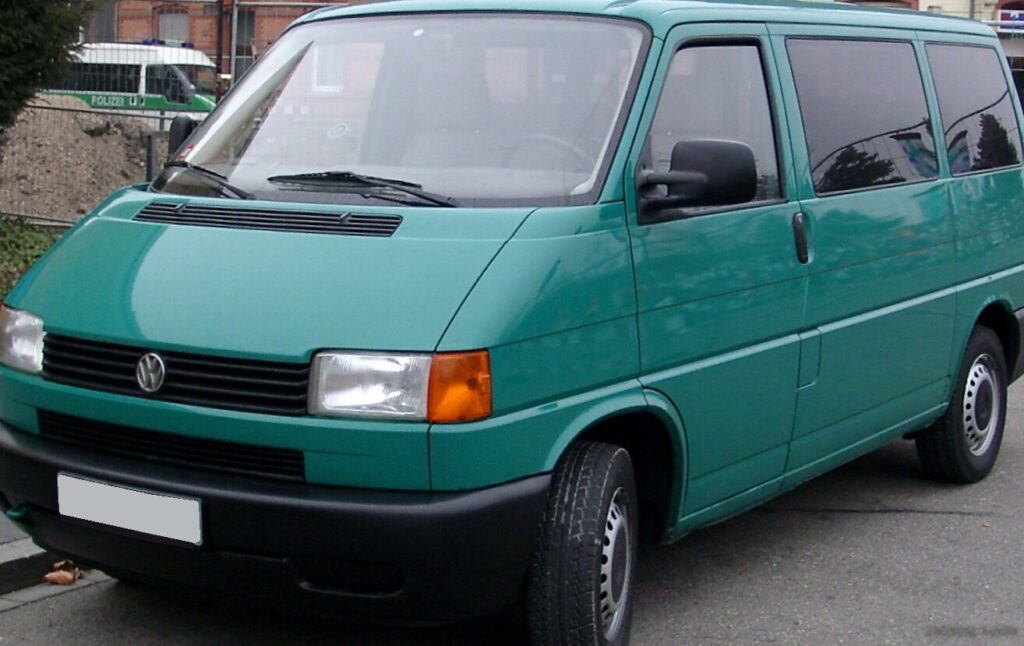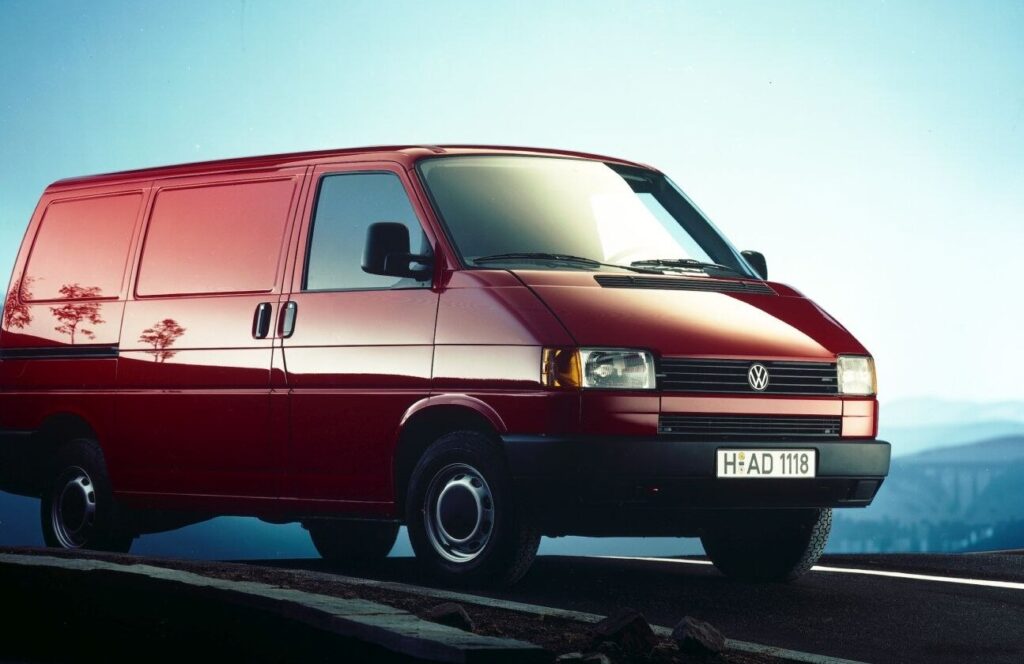
The Volkswagen Transporter (T4), produced from 1990 to 2003, represented a significant leap forward in the popular van’s evolution. The 1.9 TD (68 hp) L2H2 variant, specifically manufactured between 1992 and 1995, occupied a crucial position in the T4 lineup as an entry-level diesel option geared towards practicality and economy. The “L2H2” designation refers to the vehicle’s body length (L2 – long wheelbase) and roof height (H2 – high roof), offering a substantial cargo capacity. This version was particularly popular in Europe as a workhorse vehicle for tradespeople and businesses, offering a balance between affordability, fuel efficiency, and load-carrying capability.
Technical Specifications
| Brand | Volkswagen |
| Model | Transporter |
| Generation | Transporter (T4) Panel Van |
| Type (Engine) | 1.9 TD (68 Hp) L2H2 |
| Start of production | 1992 |
| End of production | 1995 |
| Powertrain Architecture | Internal Combustion engine |
| Body type | Van |
| Seats | 2 |
| Doors | 4-5 |
| Fuel Type | Diesel |
| Maximum speed | 126 km/h (78.29 mph) |
| Weight-to-power ratio | 23.8 kg/Hp, 42 Hp/tonne |
| Weight-to-torque ratio | 11.6 kg/Nm, 86.4 Nm/tonne |
| Power | 68 Hp @ 3700 rpm |
| Power per litre | 35.9 Hp/l |
| Torque | 140 Nm @ 2000-3000 rpm (103.26 lb.-ft. @ 2000-3000 rpm) |
| Engine layout | Front, Transverse |
| Engine Model/Code | ABL |
| Engine displacement | 1896 cm3 (115.7 cu. in.) |
| Number of cylinders | 4 |
| Engine configuration | Inline |
| Cylinder Bore | 79.5 mm (3.13 in.) |
| Piston Stroke | 95.5 mm (3.76 in.) |
| Compression ratio | 22.5:1 |
| Number of valves per cylinder | 2 |
| Fuel injection system | Precombustion chamber injection |
| Engine aspiration | Turbocharger |
| Valvetrain | SOHC |
| Engine oil capacity | 5 l (5.28 US qt | 4.4 UK qt) |
| Coolant | 9 l (9.51 US qt | 7.92 UK qt) |
| Kerb Weight | 1620 kg (3571.49 lbs.) |
| Max. weight | 2565-2750 kg (5654.86 – 6062.71 lbs.) |
| Max load | 945-1130 kg (2083.37 – 2491.22 lbs.) |
| Trunk (boot) space – maximum | 7800 l (275.45 cu. ft.) |
| Fuel tank capacity | 80 l (21.13 US gal | 17.6 UK gal) |
| Max. roof load | 100 kg (220.46 lbs.) |
| Permitted trailer load with brakes (12%) | 2000 kg (4409.25 lbs.) |
| Permitted trailer load without brakes | 700 kg (1543.24 lbs.) |
| Permitted towbar download | 100 kg (220.46 lbs.) |
| Length | 5055 mm (199.02 in.) |
| Width | 1840 mm (72.44 in.) |
| Height | 2400 mm (94.49 in.) |
| Wheelbase | 3320 mm (130.71 in.) |
| Front track | 1575 mm (62.01 in.) |
| Rear (Back) track | 1540 mm (60.63 in.) |
| Front overhang | 860 mm (33.86 in.) |
| Rear overhang | 875 mm (34.45 in.) |
| Ride height (ground clearance) | 180 mm (7.09 in.) |
| Minimum turning circle (turning diameter) | 12.9 m (42.32 ft.) |
| Drivetrain Architecture | The Internal combustion engine (ICE) drives the front wheels of the vehicle. |
| Drive wheel | Front wheel drive |
| Number of gears and type of gearbox | 5 gears, manual transmission |
| Front suspension | Independent torsion bar, double wishbone, Transverse stabilizer |
| Rear suspension | Independent coil spring, Trailing arm |
| Front brakes | Disc |
| Rear brakes | Drum |
| Steering type | Steering rack and pinion |
| Tires size | 195/70 R15; 205/65 R15; 215/65 R15 |
| Wheel rims size | 6J x 15; 7J x 15 |
INTRODUCTION
The Volkswagen Transporter T4 1.9 TD (68 hp) L2H2, produced between 1992 and 1995, was a cornerstone of the fourth-generation Transporter range. Built on the 1HX0/A3 platform, it represented a move towards a more car-like driving experience compared to its predecessors, while retaining the practicality expected of a commercial vehicle. This variant served as the entry point into the T4 diesel lineup, offering a cost-effective solution for businesses and individuals needing a reliable and spacious van. It was primarily sold in Europe, where diesel engines were – and continue to be – favored for their fuel efficiency and durability.
Powertrain & Engine Architecture
At the heart of the T4 1.9 TD L2H2 lies the ABL engine code, a 1.9-liter inline four-cylinder diesel engine. This engine utilized a precombustion chamber injection system, a common technology in diesel engines of the era. This system involved injecting fuel into a precombustion chamber, where it partially ignited before being fully combusted in the main cylinder. This design aided in smoother combustion and reduced engine noise. The engine featured a single overhead camshaft (SOHC) valvetrain operating two valves per cylinder. A turbocharger was employed to boost power output, bringing it to 68 horsepower at 3700 rpm and 140 Nm (103.26 lb-ft) of torque between 2000 and 3000 rpm. The engine’s transverse mounting and front-wheel-drive configuration were typical for European vans of this period. The standard transmission was a five-speed manual gearbox, optimized for fuel efficiency and providing adequate performance for typical commercial applications.
Driving Characteristics
The 1.9 TD 68 hp engine, paired with the five-speed manual transmission, delivered a driving experience focused on practicality rather than performance. Acceleration was modest, and overtaking required careful planning. However, the engine’s torque characteristics made it well-suited for carrying heavy loads. The gear ratios were chosen to maximize fuel economy and provide sufficient pulling power at lower speeds. Compared to the more powerful 1.9 TDI variants or the gasoline-powered options, the 1.9 TD felt noticeably slower. The manual transmission allowed for greater driver control, but the engine lacked the responsiveness of its higher-output counterparts. The front-wheel-drive setup provided predictable handling, but it wasn’t designed for spirited driving. The focus was firmly on providing a reliable and economical workhorse.
Equipment & Trim Levels
The T4 1.9 TD L2H2 was typically equipped with basic, functional features. Standard equipment included a driver and passenger seat, basic instrumentation, and a steering wheel. Interior upholstery was typically hard-wearing vinyl or cloth. The dashboard layout was simple and utilitarian, prioritizing functionality over aesthetics. Optional extras included power steering, electric windows, and a basic radio. Air conditioning was rarely fitted to this base model. The L2H2 body style provided a generous cargo area, making it ideal for transporting goods. The rear doors offered wide access for loading and unloading, and the high roof allowed for standing room inside the cargo bay.
Chassis & Braking
The T4’s chassis featured independent suspension on all four wheels. The front suspension utilized a torsion bar and double wishbone setup, while the rear employed a trailing arm configuration with coil springs. A transverse stabilizer bar was fitted to the front to reduce body roll. The braking system consisted of disc brakes on the front wheels and drum brakes on the rear. This configuration was typical for vans in this weight class. The steering was rack and pinion, providing reasonably precise control. Tire sizes varied, with 195/70 R15, 205/65 R15, and 215/65 R15 being common options. The suspension was tuned for comfort and load-carrying capacity, rather than sporty handling.
Market Reception & Comparison
The T4 1.9 TD L2H2 was generally well-received as a practical and economical work van. Critics praised its fuel efficiency and reliability, but noted its lack of performance. Compared to the more powerful TDI variants, the 1.9 TD offered significantly less power and refinement. However, it was also more affordable to purchase and maintain. The TDI models, while offering better performance, were more expensive and had more complex fuel injection systems, potentially leading to higher repair costs. The 1.9 TD appealed to businesses and individuals who prioritized economy and reliability over outright performance. Its lower purchase price and simpler mechanicals made it an attractive option for those on a budget.
Legacy
The Volkswagen Transporter T4 1.9 TD L2H2 has proven to be a remarkably durable vehicle. Many examples are still on the road today, testament to the robustness of the engine and chassis. While age and mileage inevitably take their toll, the 1.9 TD engine is generally considered to be reliable, provided it has been properly maintained. In the used car market, these vans are often sought after by tradespeople and enthusiasts looking for a classic workhorse. Parts availability is generally good, although some components may be becoming increasingly difficult to find. The T4 1.9 TD L2H2 remains a popular choice for those seeking a simple, reliable, and affordable van with a spacious cargo area.