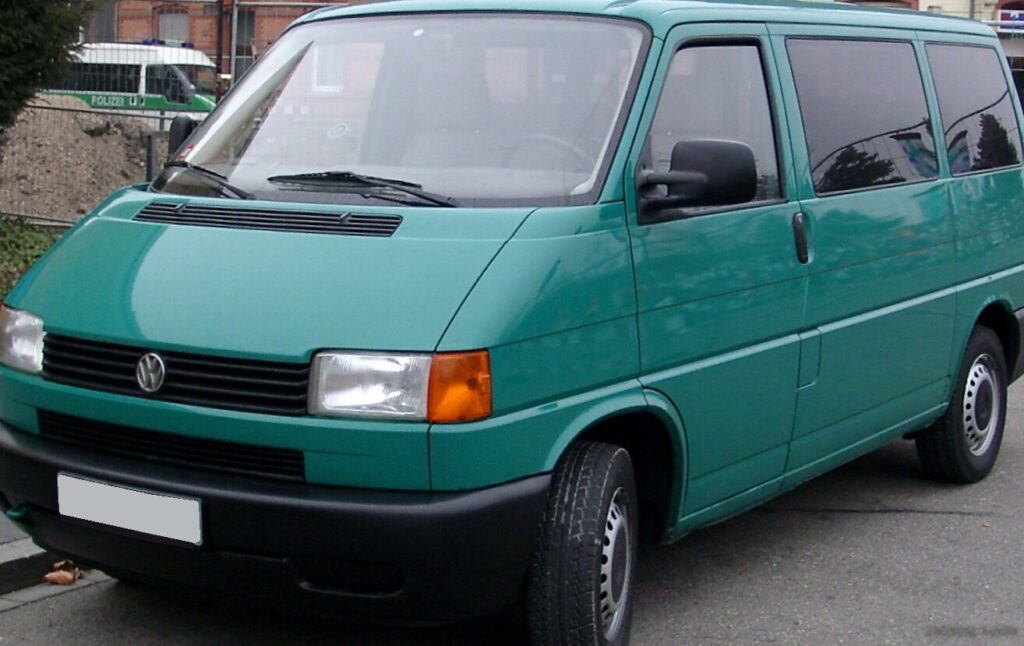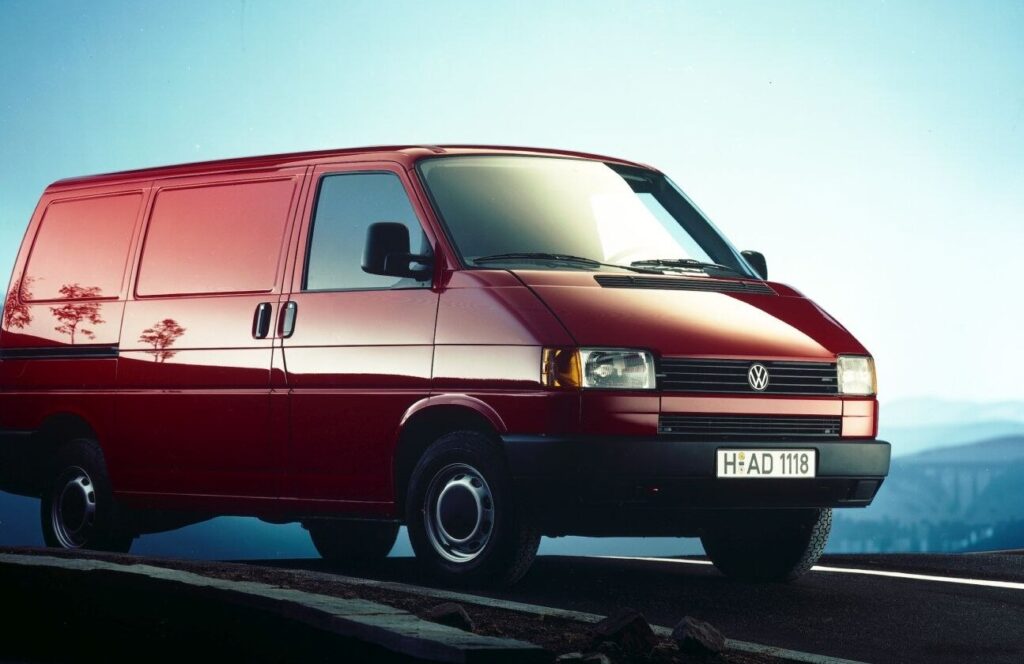
The Volkswagen Transporter (T4), produced from 1990 to 2003, represented a significant leap forward in the popular van’s evolution. The 2.5-liter (110 hp) L2H2 Panel Van variant, specifically manufactured between 1990 and 1995, occupied a middle ground within the T4 lineup, offering a balance between affordability, practicality, and reasonable performance for commercial and personal use. The “L2H2” designation refers to the vehicle’s body length (L2 – long wheelbase) and roof height (H2 – high roof), maximizing cargo capacity. This version was primarily aimed at businesses and tradespeople needing a versatile and reliable work vehicle, but also found favor with camper conversions and family transport.
Technical Specifications
| Brand | Volkswagen |
| Model | Transporter |
| Generation | Transporter (T4) Panel Van |
| Type (Engine) | 2.5 (110 Hp) L2H2 |
| Start of production | 1990 year |
| End of production | 1995 year |
| Powertrain Architecture | Internal Combustion engine |
| Body type | Van |
| Seats | 2 |
| Doors | 4-5 |
| Fuel consumption (combined) | 14.8 l/100 km (15.9 US mpg, 19.1 UK mpg, 6.8 km/l) |
| Fuel Type | Petrol (Gasoline) |
| Maximum speed | 151 km/h (93.83 mph) |
| Weight-to-power ratio | 15.4 kg/Hp, 64.9 Hp/tonne |
| Weight-to-torque ratio | 8.9 kg/Nm, 112.1 Nm/tonne |
| Power | 110 Hp @ 4500 rpm |
| Power per litre | 44.7 Hp/l |
| Torque | 190 Nm @ 2200 rpm (140.14 lb.-ft. @ 2200 rpm) |
| Engine layout | Front, Transverse |
| Engine Model/Code | AAF, ACU |
| Engine displacement | 2461 cm3 (150.18 cu. in.) |
| Number of cylinders | 5 |
| Engine configuration | Inline |
| Cylinder Bore | 81 mm (3.19 in.) |
| Piston Stroke | 95.5 mm (3.76 in.) |
| Compression ratio | 8.5:1 |
| Number of valves per cylinder | 2 |
| Fuel injection system | Multi-port manifold injection |
| Engine aspiration | Naturally aspirated engine |
| Valvetrain | SOHC |
| Engine oil capacity | 5.5 l (5.81 US qt | 4.84 UK qt) |
| Coolant | 11.5 l (12.15 US qt | 10.12 UK qt) |
| Kerb Weight | 1695 kg (3736.84 lbs.) |
| Max. weight | 2640-2800 kg (5820.2 – 6172.94 lbs.) |
| Max load | 945-1105 kg (2083.37 – 2436.11 lbs.) |
| Trunk (boot) space – maximum | 7800 l (275.45 cu. ft.) |
| Fuel tank capacity | 80 l (21.13 US gal | 17.6 UK gal) |
| Max. roof load | 100 kg (220.46 lbs.) |
| Permitted trailer load with brakes (12%) | 2000 kg (4409.25 lbs.) |
| Permitted trailer load without brakes | 700 kg (1543.24 lbs.) |
| Permitted towbar download | 100 kg (220.46 lbs.) |
| Length | 5055 mm (199.02 in.) |
| Width | 1840 mm (72.44 in.) |
| Height | 2400 mm (94.49 in.) |
| Wheelbase | 3320 mm (130.71 in.) |
| Front track | 1575 mm (62.01 in.) |
| Rear (Back) track | 1540 mm (60.63 in.) |
| Front overhang | 860 mm (33.86 in.) |
| Rear overhang | 875 mm (34.45 in.) |
| Ride height (ground clearance) | 180 mm (7.09 in.) |
| Minimum turning circle (turning diameter) | 12.9 m (42.32 ft.) |
| Drivetrain Architecture | The Internal combustion engine (ICE) drives the front wheels of the vehicle. |
| Drive wheel | Front wheel drive |
| Number of gears and type of gearbox | 5 gears, manual transmission |
| Front suspension | Independent torsion bar, double wishbone, Transverse stabilizer |
| Rear suspension | Independent coil spring, Trailing arm |
| Front brakes | Disc |
| Rear brakes | Drum |
| Assisting systems | ABS (Anti-lock braking system) |
| Steering type | Steering rack and pinion |
| Power steering | Hydraulic Steering |
| Tires size | 195/70 R15; 205/65 R15; 215/65 R15 |
| Wheel rims size | 6J x 15; 7J x 15 |
INTRODUCTION
The Volkswagen Transporter T4, launched in 1990, represented a significant redesign of Volkswagen’s iconic commercial vehicle. Moving away from the rear-engine, rear-wheel-drive layout of the T3, the T4 adopted a front-engine, front-wheel-drive configuration, offering improved space utilization and handling. The 2.5-liter petrol engine, producing 110 horsepower, was a popular choice, particularly in the European market, where diesel engines dominated. The L2H2 configuration, denoting a long wheelbase and high roof, provided a substantial cargo area, making it ideal for a wide range of commercial applications. This variant sat comfortably in the middle of the T4 range, offering a compromise between the more affordable, lower-powered engines and the more expensive, higher-performance options.
Powertrain & Engine Architecture
The 2.5-liter inline five-cylinder engine, designated AAF or ACU depending on minor variations, was a key feature of this Transporter variant. This engine utilized a single overhead camshaft (SOHC) valvetrain and multi-port fuel injection. The five-cylinder configuration provided a smoother power delivery compared to a four-cylinder, and the 8.5:1 compression ratio was typical for the era. The engine’s transverse mounting allowed for a more compact engine bay, maximizing interior space. The five-speed manual transmission was the standard offering, providing adequate gear ratios for both city driving and highway cruising. While an automatic transmission was available, it was less common and often criticized for its sluggish performance and reduced fuel economy.
Driving Characteristics
The 110 hp 2.5-liter engine, coupled with the five-speed manual transmission, provided adequate, though not exhilarating, performance. Acceleration was reasonable, but the van’s weight (approximately 1695 kg / 3736.84 lbs) meant that it wasn’t particularly quick. The engine’s torque peak of 190 Nm (140.14 lb.-ft.) at 2200 rpm provided sufficient pulling power for loaded operation. Compared to the more powerful 1.9 TDI diesel variants, the 2.5-liter petrol engine felt less responsive at lower speeds, but offered a more linear power delivery. The manual transmission allowed for greater driver control, while the optional automatic transmission resulted in noticeable performance degradation. The front-wheel-drive configuration provided predictable handling, but could suffer from torque steer under hard acceleration.
Equipment & Trim Levels
The T4 Panel Van 2.5 L2H2 was typically equipped with basic, utilitarian features. Standard equipment included a driver’s airbag, power steering, and a basic stereo system. The interior was typically finished with durable, hard-wearing plastics and cloth upholstery. Optional extras included air conditioning, electric windows, and upgraded stereo systems. The trim level was relatively basic, focusing on functionality rather than luxury. The van’s interior was designed to be easily cleaned and maintained, reflecting its commercial purpose.
Chassis & Braking
The T4 utilized an independent suspension system on both the front and rear axles. The front suspension featured a torsion bar and double wishbone setup, while the rear suspension employed coil springs and trailing arms. This configuration provided a comfortable ride, even when the van was fully loaded. The braking system consisted of disc brakes on the front wheels and drum brakes on the rear wheels. Anti-lock braking system (ABS) was standard, enhancing safety and stability. The steering was rack and pinion, providing precise and responsive handling.
Market Reception & Comparison
The T4 2.5-liter petrol variant received mixed reviews. Critics praised its spacious interior, comfortable ride, and improved handling compared to the T3. However, the petrol engine was often criticized for its relatively high fuel consumption and lower torque compared to the diesel alternatives. The 1.9 TDI diesel models were generally preferred by those prioritizing fuel economy and load-carrying capacity. The 2.5-liter petrol engine was seen as a good option for those who preferred the smoother power delivery and quieter operation of a petrol engine, but were willing to accept the higher running costs.
Legacy
The Volkswagen Transporter T4 remains a popular choice in the used vehicle market, particularly among those seeking a reliable and versatile van for work or leisure. The 2.5-liter petrol engine, while not the most fuel-efficient option, is generally considered to be reliable, provided it is properly maintained. Common issues include oil leaks and wear on the timing belt. Parts availability is generally good, and the T4’s relatively simple mechanical design makes it relatively easy to repair. Today, the T4 is often sought after for camper conversions, thanks to its spacious interior and robust construction. The 2.5-liter variant, while less common than the diesel models, continues to offer a viable and affordable option for those seeking a classic Volkswagen van.