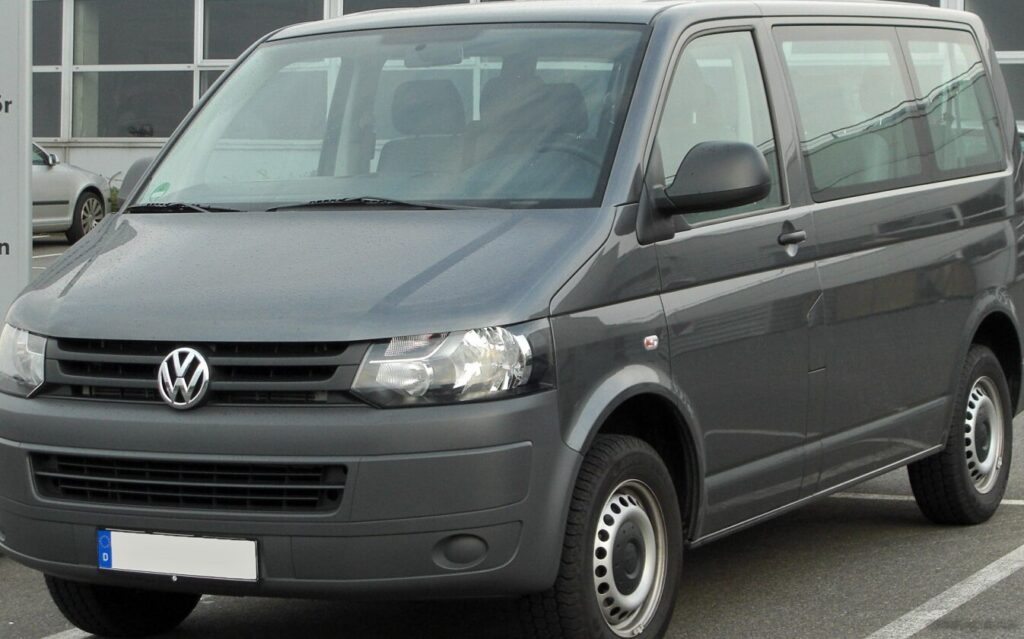
The Volkswagen Transporter (T5) facelift, produced from 2009 to 2013, represented a significant refresh of the fifth-generation Transporter line. Within this generation, the “Kombi” designation denoted a passenger-oriented configuration, bridging the gap between a pure cargo van and a full-fledged multi-purpose vehicle (MPV). The 2.0 (116 hp) L1H2 variant, powered by the EA113 engine and paired with a five-speed manual transmission, occupied a mid-range position in the T5 lineup, offering a balance of affordability, practicality, and reasonable performance for families and commercial users alike. The “L1H2” designation refers to the vehicle’s body length (L1 – short wheelbase) and roof height (H2 – high roof), providing a generous interior space.
Technical Specifications
| Brand | Volkswagen |
| Model | Transporter |
| Generation | Transporter (T5, facelift 2009) Kombi |
| Type (Engine) | 2.0 (116 Hp) L1H2 |
| Start of production | 2009 |
| End of production | 2013 |
| Powertrain Architecture | Internal Combustion engine |
| Body type | Van |
| Seats | 4-9 |
| Doors | 4-5 |
| Fuel consumption (economy) – urban (NEDC) | 13.6 l/100 km (20.8 UK mpg, 17.3 US mpg) |
| Fuel consumption (economy) – extra urban (NEDC) | 8.6 l/100 km (32.8 UK mpg, 27.4 US mpg) |
| Fuel consumption (economy) – combined (NEDC) | 10.4 l/100 km (27.2 UK mpg, 22.6 US mpg) |
| CO2 emissions (NEDC) | 243 g/km |
| Fuel Type | Petrol (Gasoline) |
| Acceleration 0 – 100 km/h | 16.6 sec |
| Acceleration 0 – 62 mph | 16.6 sec |
| Acceleration 0 – 60 mph | 15.8 sec |
| Maximum speed | 158 km/h (98.18 mph) |
| Emission standard | Euro 5 |
| Weight-to-power ratio | 16.4 kg/Hp |
| Weight-to-torque ratio | 11.2 kg/Nm |
| Power | 116 Hp @ 5200 rpm |
| Torque | 170 Nm @ 2700-4700 rpm (125.39 lb.-ft. @ 2700-4700 rpm) |
| Engine layout | Front, Transverse |
| Engine Model/Code | EA113 / AXA |
| Engine displacement | 1984 cm3 (121.07 cu. in.) |
| Number of cylinders | 4 |
| Engine configuration | Inline |
| Cylinder Bore | 82.5 mm (3.25 in.) |
| Piston Stroke | 92.8 mm (3.65 in.) |
| Compression ratio | 10.5:1 |
| Number of valves per cylinder | 2 |
| Fuel injection system | Multi-port manifold injection |
| Engine aspiration | Naturally aspirated engine |
| Valvetrain | SOHC |
| Engine oil capacity | 5 l (5.28 US qt | 4.4 UK qt) |
| Coolant | 7.1 l (7.5 US qt | 6.25 UK qt) |
| Kerb Weight | 1901-2029 kg (4190.99 – 4473.18 lbs.) |
| Max. weight | 2850 kg (6283.17 lbs.) |
| Max load | 821-949 kg (1810 – 2092.19 lbs.) |
| Trunk (boot) space – maximum | 6700 l (236.61 cu. ft.) |
| Fuel tank capacity | 80 l (21.13 US gal | 17.6 UK gal) |
| Permitted trailer load with brakes (12%) | 2000 kg (4409.25 lbs.) |
| Permitted trailer load without brakes | 750 kg (1653.47 lbs.) |
| Permitted towbar download | 100 kg (220.46 lbs.) |
| Length | 4892 mm (192.6 in.) |
| Width | 1904 mm (74.96 in.) |
| Width including mirrors | 2283 mm (89.88 in.) |
| Height | 2176 mm (85.67 in.) |
| Wheelbase | 3000 mm (118.11 in.) |
| Front overhang | 896 mm (35.28 in.) |
| Rear overhang | 996 mm (39.21 in.) |
| Ride height (ground clearance) | 201 mm (7.91 in.) |
| Minimum turning circle (turning diameter) | 11.9 m (39.04 ft.) |
| Approach angle | 21° |
| Departure angle | 17° |
| Ramp-over (brakeover) angle | 14° |
| Wading depth | 300 mm (11.81 in.) |
| Drivetrain Architecture | The Internal combustion engine (ICE) drives the front wheels of the vehicle. |
| Drive wheel | Front wheel drive |
| Number of gears and type of gearbox | 5 gears, manual transmission |
| Front suspension | Independent, type McPherson with coil spring and anti-roll bar |
| Rear suspension | Independent coil spring, Transverse stabilizer, Trailing arm |
| Front brakes | Ventilated discs, 308×29.5 mm |
| Rear brakes | Ventilated discs, 294×22 mm |
| Assisting systems | ABS (Anti-lock braking system) |
| Steering type | Steering rack and pinion |
| Power steering | Hydraulic Steering |
| Tires size | 215/65 R16 |
| Wheel rims size | 6.5J x 16 |
Powertrain & Engine Architecture
The heart of this Transporter variant is the 2.0-liter, naturally aspirated inline-four cylinder engine, identified by the EA113 engine code, specifically the AXA variant. This engine, a mainstay in various Volkswagen Group vehicles of the era, utilizes a multi-port fuel injection system for precise fuel delivery. The engine features a single overhead camshaft (SOHC) valvetrain operating two valves per cylinder. The 10.5:1 compression ratio contributes to a reasonable balance between power and fuel efficiency. The five-speed manual transmission provides a relatively conventional gear selection, optimized for everyday driving rather than outright performance. The transmission’s gear ratios are geared towards maximizing fuel economy and providing adequate acceleration for typical load-carrying scenarios.
Driving Characteristics
The 116 horsepower and 170 Nm (125 lb-ft) of torque produced by the 2.0-liter engine translate to a practical, if not exhilarating, driving experience. Acceleration from 0-60 mph takes around 15.8 seconds, and top speed is limited to 158 km/h (98 mph). Compared to higher-output versions of the T5, such as those equipped with the 1.9 TDI diesel or the 2.0-liter turbocharged petrol engines, the 2.0-liter naturally aspirated engine feels noticeably less powerful, particularly when fully loaded. However, the linear power delivery and predictable nature of the engine make it easy to drive in urban environments and on winding roads. The five-speed manual transmission allows for reasonable control over engine speed, but the relatively wide gear spacing can sometimes require frequent shifting, especially when climbing hills.
Equipment & Trim Levels
The Kombi trim level, even in its base configuration with the 2.0-liter engine, offered a decent level of standard equipment. Typically, this included power windows, central locking, an adjustable steering wheel, and a basic audio system. Interior upholstery was usually cloth, with durable plastic trim throughout the cabin. Optional extras included air conditioning, upgraded audio systems, alloy wheels, and parking sensors. The L1H2 body style provided ample headroom and cargo space, making it suitable for both passenger and light commercial applications. The rear seats could be configured in various layouts, including a bench seat or individual seats, to accommodate different passenger and cargo needs.
Chassis & Braking
The T5 Transporter utilized an independent suspension setup on both the front and rear axles. The front suspension employed McPherson struts with coil springs and an anti-roll bar, while the rear suspension featured a trailing arm configuration with coil springs and a transverse stabilizer. This setup provided a comfortable ride quality, even when the vehicle was loaded. Braking duties were handled by ventilated discs on all four wheels, providing adequate stopping power for the vehicle’s weight. An Anti-lock Braking System (ABS) was standard, enhancing safety during emergency braking maneuvers.
Market Reception & Comparison
The 2.0-liter (116 hp) Kombi variant was generally well-received as a practical and affordable option within the T5 range. Critics acknowledged its reasonable fuel economy (around 22.6 US mpg combined) and its suitability for everyday use. However, it was often criticized for its lack of outright performance, particularly when compared to the more powerful diesel and turbocharged petrol alternatives. The 1.9 TDI, for example, offered significantly better fuel economy and torque, making it a more popular choice for commercial users. The petrol engine was often favored by those who preferred a smoother, quieter engine and were less concerned about fuel costs.
Legacy
The EA113 engine, while generally reliable, is known to have some potential weaknesses, including oil consumption issues in some cases. Regular maintenance, including oil changes and timing belt replacements, is crucial for ensuring the longevity of this powertrain. Today, the 2.0-liter (116 hp) T5 Kombi can be found on the used car market at relatively affordable prices. Its simplicity and practicality continue to appeal to buyers seeking a versatile and reliable van for family or commercial use. While not the most powerful or fuel-efficient option in the T5 lineup, it remains a viable choice for those prioritizing affordability and ease of maintenance.