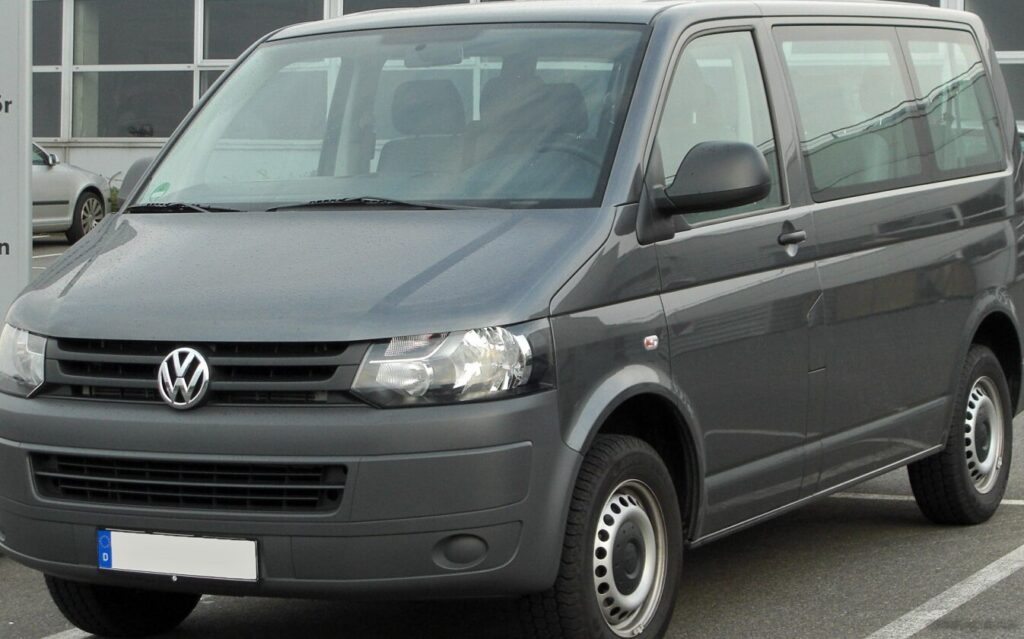
The Volkswagen Transporter (T5) facelift, produced from 2009 to 2015, represented a significant update to the fifth generation of Volkswagen’s iconic commercial vehicle. Within this generation, the Kombi variant offered a versatile blend of cargo and passenger capacity, catering to both commercial and family needs. The 2.0 TDI (140 hp) 4MOTION L2H1 configuration was a popular choice, particularly in European markets, offering a balance of fuel efficiency, all-wheel-drive capability, and practical space. The “L2H1” designation refers to the vehicle’s body length (long wheelbase) and roof height (standard). This specific variant occupied a mid-range position in the T5 lineup, slotting between the lower-powered, more economical base models and the higher-performance, more expensive variants.
Technical Specifications
| Brand | Volkswagen |
| Model | Transporter |
| Generation | Transporter (T5, facelift 2009) Kombi |
| Type (Engine) | 2.0 TDI (140 Hp) 4MOTION L2H1 |
| Start of production | 2009 |
| End of production | 2015 |
| Powertrain Architecture | Internal Combustion engine |
| Body type | Van |
| Seats | 4-9 |
| Doors | 4-5 |
| Fuel consumption (economy) – urban (NEDC) | 10.2 l/100 km (23.1 US mpg, 27.7 UK mpg, 9.8 km/l) |
| Fuel consumption (economy) – extra urban (NEDC) | 6.9 l/100 km (34.1 US mpg, 40.9 UK mpg, 14.5 km/l) |
| Fuel consumption (economy) – combined (NEDC) | 8.1 l/100 km (29 US mpg, 34.9 UK mpg, 12.3 km/l) |
| CO2 emissions (NEDC) | 214 g/km |
| Fuel Type | Diesel |
| Acceleration 0 – 100 km/h | 13.6 sec |
| Acceleration 0 – 62 mph | 13.6 sec |
| Acceleration 0 – 60 mph | 12.9 sec |
| Maximum speed | 170 km/h (105.63 mph) |
| Emission standard | Euro 5 |
| Weight-to-power ratio | 13.9 kg/Hp, 71.7 Hp/tonne |
| Weight-to-torque ratio | 5.7 kg/Nm, 174.2 Nm/tonne |
| Power | 140 Hp @ 3500 rpm |
| Power per litre | 71.1 Hp/l |
| Torque | 340 Nm @ 1750-2500 rpm (250.77 lb.-ft. @ 1750-2500 rpm) |
| Engine layout | Front, Transverse |
| Engine Model/Code | EA189 / CAAC |
| Engine displacement | 1968 cm3 (120.09 cu. in.) |
| Number of cylinders | 4 |
| Engine configuration | Inline |
| Cylinder Bore | 81 mm (3.19 in.) |
| Piston Stroke | 95.5 mm (3.76 in.) |
| Compression ratio | 16.5:1 |
| Number of valves per cylinder | 4 |
| Fuel injection system | Diesel Commonrail |
| Engine aspiration | Turbocharger, Intercooler |
| Valvetrain | DOHC |
| Engine oil capacity | 7 l (7.4 US qt | 6.16 UK qt) |
| Coolant | 11 l (11.62 US qt | 9.68 UK qt) |
| Kerb Weight | 1952-2350 kg (4303.42 – 5180.86 lbs.) |
| Max. weight | 3000-3200 kg (6613.87 – 7054.79 lbs.) |
| Max load | 850-1048 kg (1873.93 – 2310.44 lbs.) |
| Trunk (boot) space – maximum | 6700 l (236.61 cu. ft.) |
| Fuel tank capacity | 80 l (21.13 US gal | 17.6 UK gal) |
| Max. roof load | 100 kg (220.46 lbs.) |
| Permitted trailer load with brakes (12%) | 2500 kg (5511.56 lbs.) |
| Permitted trailer load without brakes | 750 kg (1653.47 lbs.) |
| Permitted towbar download | 100 kg (220.46 lbs.) |
| Length | 5292 mm (208.35 in.) |
| Width | 1904 mm (74.96 in.) |
| Width including mirrors | 2283 mm (89.88 in.) |
| Height | 1990 mm (78.35 in.) |
| Wheelbase | 3400 mm (133.86 in.) |
| Front overhang | 896 mm (35.28 in.) |
| Rear overhang | 996 mm (39.21 in.) |
| Ride height (ground clearance) | 201 mm (7.91 in.) |
| Minimum turning circle (turning diameter) | 13.2 m (43.31 ft.) |
| Approach angle | 21° |
| Departure angle | 17° |
| Ramp-over (brakeover) angle | 12° |
| Drivetrain Architecture | The Internal combustion engine (ICE) drives the front wheels permanently, and the rear wheels are driven through an electrically or mechanically operated clutch if necessary. |
| Drive wheel | All wheel drive (4×4) |
| Number of gears and type of gearbox | 6 gears, manual transmission |
| Front suspension | Independent, type McPherson with coil spring and anti-roll bar |
| Rear suspension | Independent coil spring, Transverse stabilizer, Trailing arm |
| Front brakes | Ventilated discs, 308×29.5 mm |
| Rear brakes | Ventilated discs, 294×22 mm |
| Assisting systems | ABS (Anti-lock braking system) |
| Steering type | Steering rack and pinion |
| Power steering | Hydraulic Steering |
| Tires size | 215/65 R16 |
| Wheel rims size | 6.5J x 16 |
Powertrain & Engine Architecture
The heart of this Transporter variant is the 2.0-liter inline-four cylinder diesel engine, identified by the EA189 engine code, specifically the CAAC variant. This engine utilizes a common rail direct injection system, delivering fuel directly into the combustion chamber at extremely high pressure for improved efficiency and reduced emissions. The engine is turbocharged and intercooled, enhancing power output and torque. The DOHC (Double Overhead Camshaft) valvetrain, with four valves per cylinder, optimizes gas flow for increased performance. The 140 horsepower peak is achieved at 3500 rpm, while the 340 Nm (250.77 lb-ft) of torque is available from 1750 to 2500 rpm, providing ample pulling power for hauling cargo or towing. The engine also incorporates a diesel particulate filter (DPF) to further reduce harmful emissions, meeting Euro 5 standards. The 6-speed manual transmission was standard, offering a good balance between fuel economy and driver control.
Driving Characteristics
The 2.0 TDI 140 hp engine, coupled with the manual transmission, provided a practical and capable driving experience. Acceleration was adequate, with a 0-60 mph time of around 12.9 seconds, but it wasn’t designed for outright speed. The strength of this powertrain lay in its mid-range torque, making it well-suited for everyday driving and carrying loads. The 4MOTION all-wheel-drive system significantly enhanced traction, particularly in adverse weather conditions or on slippery surfaces. Compared to the more powerful TDI variants, this engine offered better fuel economy, but at the expense of performance. The gear ratios were tuned for efficiency and usability, rather than sporty driving. The manual transmission allowed for greater driver engagement compared to the optional automatic, and provided better control when towing.
Equipment & Trim Levels
The Kombi trim level typically included features such as air conditioning, power windows, central locking, and an adjustable steering wheel. Interior upholstery was generally durable cloth, with options for upgraded materials. The dashboard layout was functional and straightforward, prioritizing practicality over luxury. Optional extras included features like a CD player with MP3 compatibility, parking sensors, and upgraded seating configurations. The Kombi offered flexible seating arrangements, with options for multiple rows of seats to accommodate up to nine passengers. Safety features included ABS (Anti-lock Braking System) and driver and passenger airbags.
Chassis & Braking
The T5 Transporter utilized an independent suspension setup, with McPherson struts at the front and a trailing arm arrangement at the rear. This provided a comfortable ride quality, even when carrying a load. A stabilizer bar was fitted to both axles to reduce body roll during cornering. The braking system consisted of ventilated discs on all four wheels, providing ample stopping power. The hydraulic power steering offered a good balance between assistance and feedback. The 4MOTION system added to the vehicle’s stability and handling, particularly on loose surfaces.
Market Reception & Comparison
The 2.0 TDI 140 hp 4MOTION Kombi was well-received in the market as a versatile and practical vehicle. Critics praised its fuel efficiency, all-wheel-drive capability, and spacious interior. Compared to the higher-powered TDI variants, it offered a more affordable entry point into the T5 range. The 1.9 TDI models, while more economical, lacked the refinement and power of the 2.0 TDI. The petrol engine options were generally less popular due to their higher fuel consumption. The combination of the 2.0 TDI engine and 4MOTION system proved to be a popular choice for businesses and families alike.
Legacy
The EA189 engine family, while generally reliable, has been subject to scrutiny regarding emissions compliance. However, the 2.0 TDI 140 hp variant, when properly maintained, has proven to be a durable and long-lasting powertrain. Today, these vehicles can be found on the used car market, often with high mileage but still offering good value for money. Regular maintenance, including oil changes and DPF servicing, is crucial for ensuring the continued reliability of these engines. The T5 Transporter remains a popular choice for those seeking a practical and versatile commercial vehicle, and the 2.0 TDI 140 hp 4MOTION Kombi continues to be a sought-after variant.