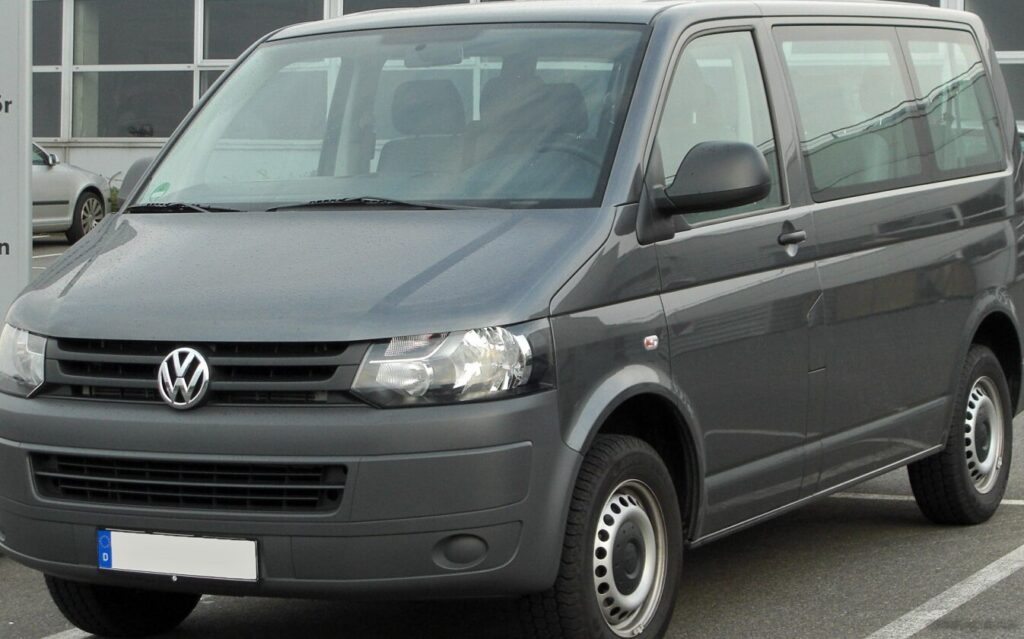
The Volkswagen Transporter (T5), particularly the facelifted version introduced in 2009, represented a significant evolution of Volkswagen’s iconic commercial vehicle. The Kombi variant, designed for both passenger and light commercial duties, offered a versatile platform for families and businesses alike. Among the engine options available, the 2.0 TDI with 140 horsepower coupled with a 7-speed Dual Clutch Gearbox (DSG) and configured in the L1H2 body style (standard roof height, short wheelbase) proved to be a popular choice, especially in European markets. Production of this specific configuration ran from 2009 to 2015, bridging the gap between practicality, efficiency, and a relatively refined driving experience for a commercial vehicle.
Technical Specifications
| Brand | Volkswagen |
| Model | Transporter |
| Generation | Transporter (T5, facelift 2009) Kombi |
| Type (Engine) | 2.0 TDI (140 Hp) DSG L1H2 |
| Start of production | 2009 |
| End of production | 2015 |
| Powertrain Architecture | Internal Combustion engine |
| Body type | Van |
| Seats | 4-9 |
| Doors | 4-5 |
| Fuel consumption (economy) – urban (NEDC) | 10.2 l/100 km (23.1 US mpg, 27.7 UK mpg, 9.8 km/l) |
| Fuel consumption (economy) – extra urban (NEDC) | 6.7 l/100 km (35.1 US mpg, 42.2 UK mpg, 14.9 km/l) |
| Fuel consumption (economy) – combined (NEDC) | 8 l/100 km (29.4 US mpg, 35.3 UK mpg, 12.5 km/l) |
| CO2 emissions (NEDC) | 211 g/km |
| Fuel Type | Diesel |
| Acceleration 0 – 100 km/h | 13.1 sec |
| Acceleration 0 – 62 mph | 13.1 sec |
| Acceleration 0 – 60 mph | 12.4 sec |
| Maximum speed | 166 km/h (103.15 mph) |
| Emission standard | Euro 5 |
| Weight-to-power ratio | 13.6 kg/Hp, 73.6 Hp/tonne |
| Weight-to-torque ratio | 5.6 kg/Nm, 178.9 Nm/tonne |
| Power | 140 Hp @ 3500 rpm |
| Power per litre | 71.1 Hp/l |
| Torque | 340 Nm @ 1750-2500 rpm (250.77 lb.-ft. @ 1750-2500 rpm) |
| Engine layout | Front, Transverse |
| Engine Model/Code | EA189 / CAAC |
| Engine displacement | 1968 cm3 (120.09 cu. in.) |
| Number of cylinders | 4 |
| Engine configuration | Inline |
| Cylinder Bore | 81 mm (3.19 in.) |
| Piston Stroke | 95.5 mm (3.76 in.) |
| Compression ratio | 16.5:1 |
| Number of valves per cylinder | 4 |
| Fuel injection system | Diesel Commonrail |
| Engine aspiration | Turbocharger, Intercooler |
| Valvetrain | DOHC |
| Engine oil capacity | 7 l (7.4 US qt | 6.16 UK qt) |
| Coolant | 11 l (11.62 US qt | 9.68 UK qt) |
| Kerb Weight | 1901-2113 kg (4190.99 – 4658.37 lbs.) |
| Max. weight | 2800-3200 kg (6172.94 – 7054.79 lbs.) |
| Max load | 899-1087 kg (1981.96 – 2396.42 lbs.) |
| Trunk (boot) space – maximum | 6700 l (236.61 cu. ft.) |
| Fuel tank capacity | 80 l (21.13 US gal | 17.6 UK gal) |
| Permitted trailer load with brakes (12%) | 2500 kg (5511.56 lbs.) |
| Permitted trailer load without brakes | 750 kg (1653.47 lbs.) |
| Permitted towbar download | 100 kg (220.46 lbs.) |
| Length | 4892 mm (192.6 in.) |
| Width | 1904 mm (74.96 in.) |
| Width including mirrors | 2283 mm (89.88 in.) |
| Height | 2176 mm (85.67 in.) |
| Wheelbase | 3000 mm (118.11 in.) |
| Front overhang | 896 mm (35.28 in.) |
| Rear overhang | 996 mm (39.21 in.) |
| Ride height (ground clearance) | 201 mm (7.91 in.) |
| Minimum turning circle (turning diameter) | 11.9 m (39.04 ft.) |
| Front suspension | Independent, type McPherson with coil spring and anti-roll bar |
| Rear suspension | Independent coil spring, Transverse stabilizer, Trailing arm |
| Front brakes | Ventilated discs, 308×29.5 mm |
| Rear brakes | Ventilated discs, 294×22 mm |
| Number of gears and type of gearbox | 7 gears, automatic transmission DSG |
Powertrain & Engine Architecture
The heart of this Transporter variant is the 2.0-liter four-cylinder diesel engine, identified by the EA189 engine code, specifically the CAAC variant. This engine utilizes a common rail direct injection system, delivering fuel at extremely high pressures for optimized combustion. A turbocharger with an intercooler further enhances performance by forcing more air into the cylinders. The engine features a double overhead camshaft (DOHC) valvetrain with four valves per cylinder, contributing to efficient gas exchange. The 140 horsepower output is achieved at 3500 rpm, while the substantial 340 Nm (250.77 lb-ft) of torque is available from 1750 to 2500 rpm, providing strong pulling power. Paired with this engine is the 7-speed DSG (Direct-Shift Gearbox), a dual-clutch transmission known for its quick and smooth gear changes. The DSG allows for both fully automatic operation and manual gear selection via the shift lever or steering wheel-mounted paddles.
Driving Characteristics
The 140 hp TDI with DSG offered a balanced driving experience. While not overtly sporty, the engine provided sufficient power for everyday driving and hauling loads. The DSG transmission contributed to brisk acceleration, especially when utilizing the sport mode. Compared to the lower-powered 1.9 TDI variants, the 2.0 TDI offered noticeably more punch, particularly when overtaking or climbing hills. However, it didn’t possess the outright performance of the more expensive and complex 2.5 TDI or petrol engines. The DSG’s gear ratios were optimized for both fuel efficiency and responsiveness. In typical driving conditions, the transmission would shift smoothly and seamlessly, providing a comfortable ride. The front-wheel-drive configuration, while adequate for most situations, could exhibit some torque steer under hard acceleration.
Equipment & Trim Levels
The Kombi trim level generally included features such as air conditioning, power windows, central locking, and an audio system. The interior typically featured durable cloth upholstery. Optional extras included features like parking sensors, upgraded audio systems, navigation systems, and various comfort and convenience packages. The L1H2 configuration provided a practical cargo area, making it suitable for both passenger and commercial use. The dashboard layout was functional and straightforward, prioritizing usability over aesthetics.
Chassis & Braking
The T5 Transporter utilized an independent suspension setup on both the front and rear axles. The front suspension employed McPherson struts with coil springs and an anti-roll bar, while the rear featured a multi-link setup with coil springs and a transverse stabilizer. This configuration provided a reasonable balance between ride comfort and handling. Braking duties were handled by ventilated disc brakes on all four wheels, offering adequate stopping power. Anti-lock Braking System (ABS) was standard, enhancing safety during emergency braking situations.
Market Reception & Comparison
The 2.0 TDI 140 hp DSG Kombi was well-received in the European market as a versatile and efficient workhorse. Critics praised its fuel economy, comfortable ride, and the responsiveness of the DSG transmission. Compared to the 1.9 TDI, the 2.0 TDI offered a noticeable performance improvement, while remaining relatively affordable. The higher-powered TDI variants were more expensive and often targeted at customers who prioritized performance over fuel efficiency. The 2.0 TDI struck a good balance between these two factors, making it a popular choice for a wide range of buyers.
Legacy
The EA189 engine family, while generally reliable, has been subject to scrutiny regarding emissions compliance, leading to software updates and recalls. However, the 2.0 TDI engine itself, when properly maintained, has proven to be a durable and long-lasting unit. Today, these T5 Transporters are readily available on the used car market, often representing good value for money. The DSG transmission, while sophisticated, requires regular servicing to ensure its continued reliability. Overall, the 2.0 TDI 140 hp DSG Kombi remains a practical and capable vehicle, continuing to serve owners well many years after its production ended.