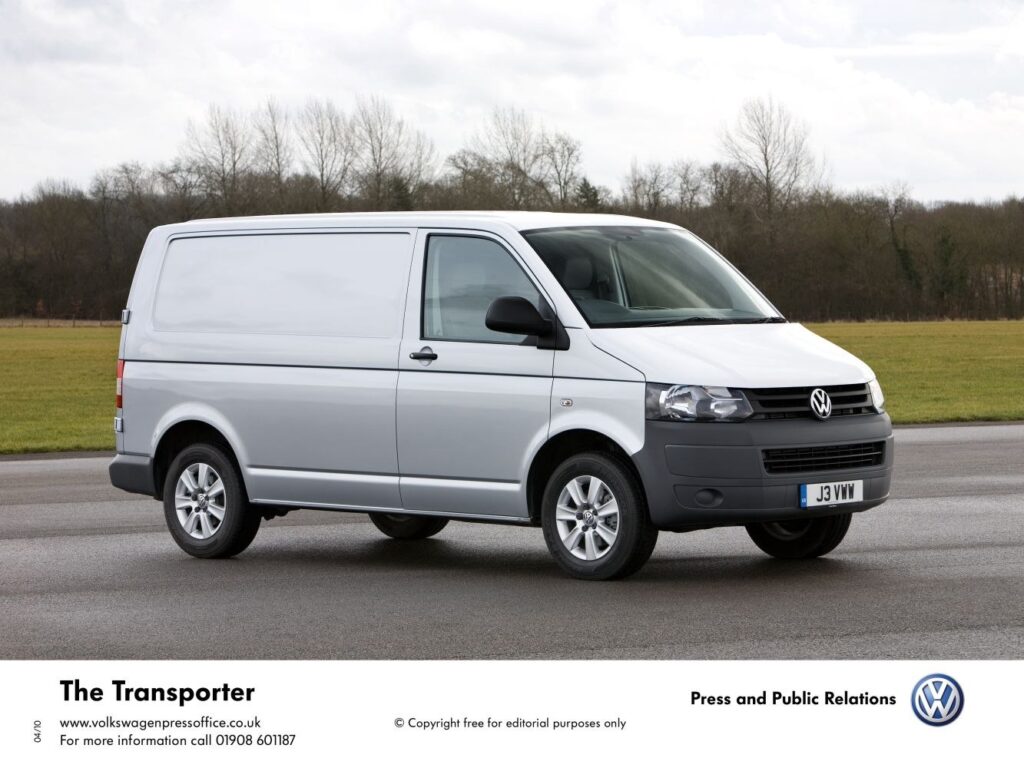
The Volkswagen Transporter (T5, facelift 2009) Panel Van 2.0 TDI (180 Hp) DSG L1H2 represents a significant iteration of Volkswagen’s iconic light commercial vehicle range. Produced between 2009 and 2015, this model belongs to the fifth generation (T5) of the Transporter, specifically featuring the mid-cycle refresh that introduced updated styling, improved powertrains, and enhanced technology. While not a mainstream offering in the United States market in this commercial panel van configuration, the Transporter series is globally recognized as a durable, versatile, and efficient workhorse, particularly dominant in European and Asian markets. The L1H2 designation signifies its specific body configuration: L1 for a standard wheelbase and H2 for a medium-height roof, striking a balance between maneuverability and substantial cargo capacity. This particular variant, equipped with the potent 2.0-liter TDI engine delivering 180 horsepower and paired with a sophisticated DSG automatic transmission, positioned it as a premium choice for businesses requiring both power and efficiency.
Powertrain & Engine Architecture
At the heart of this formidable commercial vehicle lies Volkswagen’s acclaimed EA189 / CFCA 2.0-liter (1968 cm3 or 120.09 cu. in.) inline-four turbocharged direct injection (TDI) diesel engine. This powerplant is a testament to modern diesel engineering, featuring a BiTurbo setup and an intercooler to maximize power output and efficiency. It generates a robust 180 horsepower at 4000 rpm, providing ample thrust for heavy loads and highway cruising. More impressively for a commercial vehicle, the engine delivers a substantial 400 Nm (295.02 lb.-ft.) of torque, available across a broad and usable band from 1500 to 2000 rpm. This low-end torque is crucial for effortless acceleration, climbing grades, and towing capabilities.
The EA189 engine family is known for its robust construction and relatively straightforward maintenance, although it later became subject to scrutiny regarding emissions compliance (addressed with updates during the T5’s lifecycle). The BiTurbo configuration utilizes two turbochargers – a smaller, more responsive unit for low-end torque and a larger unit for high-end power. The intercooler cools the compressed intake air, increasing its density and further enhancing performance. Fuel is delivered via a common rail direct injection system, allowing for precise control over fuel delivery and combustion. The engine utilizes a DOHC (Double Overhead Camshaft) valvetrain with four valves per cylinder, optimizing gas flow and contributing to its power output.
Power is efficiently managed and transferred to the front wheels via a 7-speed DSG (Direct Shift Gearbox) automatic transmission. This advanced dual-clutch gearbox offers rapid and smooth gear changes, contributing significantly to both driving comfort and fuel economy. The DSG transmission operates by pre-selecting the next gear, allowing for near-instantaneous shifts without the torque interruption associated with traditional automatic transmissions. This is particularly beneficial in a commercial vehicle context, where smooth and efficient power delivery is essential.
Driving Characteristics
The combination of the 180 hp TDI engine and the 7-speed DSG transmission provides a surprisingly refined driving experience for a commercial van. Compared to lower-powered Transporter variants, such as those equipped with the 102 hp or 140 hp engines, the 2.0 TDI 180 Hp offers significantly more responsive acceleration and effortless highway cruising. While not a sports van, it can achieve a respectable 0 to 60 mph acceleration in a calculated 9.6 seconds, with a top speed of 114.33 mph (184 km/h). This performance is more than adequate for most commercial applications and allows the van to keep pace with traffic on motorways.
The DSG transmission plays a crucial role in optimizing the engine’s power delivery. The close gear ratios ensure that the engine is always operating within its optimal torque band, maximizing efficiency and responsiveness. The transmission can be operated in both automatic and manual modes, allowing the driver to take greater control when needed. Compared to a manual transmission, the DSG offers smoother shifts and reduces driver fatigue, particularly in stop-and-go traffic. However, some drivers may prefer the more direct feel of a manual gearbox. The 180 hp variant also handles heavier loads and inclines with considerably more ease than its lower-powered counterparts, making it ideal for businesses that frequently transport bulky or heavy goods.
Equipment & Trim Levels
The Volkswagen Transporter (T5, facelift 2009) Panel Van 2.0 TDI (180 Hp) DSG L1H2 typically occupied a mid-to-high trim level within the Transporter range. Standard equipment generally included features such as air conditioning, power windows, central locking, an adjustable steering wheel, and a basic audio system. Safety features included ABS (Anti-lock Braking System), driver and passenger airbags, and electronic stability control. The interior was typically finished with durable, hard-wearing materials designed to withstand the rigors of commercial use. Upholstery was usually a practical cloth material, although leather upholstery was available as an optional extra.
Optional extras could significantly enhance the van’s comfort and functionality. These included features such as a navigation system, parking sensors, a rearview camera, upgraded audio systems, heated seats, and cruise control. Additional cargo area lighting, shelving systems, and load securing equipment were also popular options for commercial customers. The L1H2 configuration itself was a key feature, providing a balance between cargo capacity and maneuverability. The medium-height roof allowed for standing room for most users, while the standard wheelbase made it easier to navigate tight urban streets.
Chassis & Braking
The Volkswagen Transporter (T5, facelift 2009) Panel Van 2.0 TDI (180 Hp) DSG L1H2 utilizes an independent McPherson strut front suspension with coil springs and an anti-roll bar. This setup provides a comfortable ride and stable handling, even when the van is fully loaded. The rear suspension consists of an independent coil spring setup with trailing arms and a transverse stabilizer. This configuration helps to minimize body roll and improve ride quality. The suspension is tuned to prioritize load-carrying capacity and stability over outright sportiness.
Braking is handled by ventilated discs on all four wheels – 340×32.5 mm at the front and 294×22 mm at the rear – complemented by the aforementioned ABS (Anti-lock Braking System) for enhanced stopping power and control. The braking system is designed to handle the van’s substantial weight and payload. Hydraulic rack and pinion steering provides precise control, while the turning circle of 39.04 ft (11.9 m) offers decent maneuverability for urban environments. The ground clearance of 7.91 inches (201 mm) and a wading depth of 11.81 inches (300 mm) provide capability for varied terrains and conditions.
Market Reception & Comparison
Critics generally praised the Volkswagen Transporter (T5, facelift 2009) Panel Van 2.0 TDI (180 Hp) DSG L1H2 for its refined driving experience, robust build quality, and efficient powertrain. The 180 hp TDI engine was considered a strong performer, offering ample power for most commercial applications. The DSG transmission was also lauded for its smooth and rapid gear changes. Fuel economy was another strong point, with the combined NEDC cycle rating showing figures between 7.8-8.1 liters per 100 kilometers (30.2 – 29 US mpg). This efficiency was particularly appealing to businesses looking to minimize operating costs.
Compared to other trims in the Transporter lineup, the 180 hp variant commanded a premium price. However, the added performance and refinement were often considered worth the extra cost for those who needed a more capable and comfortable van. Compared to rivals like the Ford Transit Custom and Mercedes-Benz Vito, the Transporter was often seen as offering a more refined driving experience and a higher level of build quality. However, some competitors offered lower prices or greater cargo capacity. Reliability was generally good, although the EA189 engine family was later affected by the diesel emissions scandal, leading to software updates and potential long-term issues for some vehicles.
Technical Specifications
| General Information | |
| Brand | Volkswagen |
| Model | Transporter |
| Generation | Transporter (T5, facelift 2009) Panel Van |
| Type (Engine) | 2.0 TDI (180 Hp) DSG L1H2 |
| Start of Production | 2009 year |
| End of Production | 2015 year |
| Powertrain Architecture | Internal Combustion engine |
| Body type | Van |
| Seats | 2-3 |
| Doors | 4-5 |
| Performance Specifications | |
| Fuel Consumption (Urban, NEDC) | 9.9-10.2 l/100 km (23.8 – 23.1 US mpg) |
| Fuel Consumption (Extra Urban, NEDC) | 6.6-6.9 l/100 km (35.6 – 34.1 US mpg) |
| Fuel Consumption (Combined, NEDC) | 7.8-8.1 l/100 km (30.2 – 29 US mpg) |
| CO2 Emissions (NEDC) | 205-214 g/km |
| Fuel Type | Diesel |
| Acceleration 0-60 mph | 9.6 sec |
| Maximum Speed | 114.33 mph (184 km/h) |
| Emission Standard | Euro 5 |
| Weight-to-Power Ratio | 9.9 kg/Hp (101.1 Hp/tonne) |
| Weight-to-Torque Ratio | 4.5 kg/Nm (224.6 Nm/tonne) |
| Engine Specifications | |
| Power | 180 Hp @ 4000 rpm |
| Power per liter | 91.5 Hp/l |
| Torque | 400 Nm (295.02 lb.-ft.) @ 1500-2000 rpm |
| Engine Layout | Front, Transverse |
| Engine Model/Code | EA189 / CFCA |
| Engine Displacement | 1968 cm3 (120.09 cu. in.) |
| Number of Cylinders | 4 |
| Engine Configuration | Inline |
| Cylinder Bore | 81 mm (3.19 in.) |
| Piston Stroke | 95.5 mm (3.76 in.) |
| Compression Ratio | 16.5:1 |
| Number of Valves per Cylinder | 4 |
| Fuel Injection System | Diesel Commonrail |
| Engine Aspiration | BiTurbo, Intercooler |
| Valvetrain | DOHC |
| Engine Oil Capacity | 7 l (7.4 US qt) |
| Coolant Capacity | 11 l (11.62 US qt) |
| Engine Systems | Particulate filter |
| Space, Volume and Weights | |
| Kerb Weight | 1781-2170 kg (3926.43 – 4784.03 lbs.) |
| Max. Weight | 2800-3200 kg (6172.94 – 7054.79 lbs.) |
| Max Load | 1019-1030 kg (2246.51 – 2270.76 lbs.) |
| Trunk (Boot) Space – Maximum | 6700 l (236.61 cu. ft.) |
| Fuel Tank Capacity | 80 l (21.13 US gal) |
| Permitted Trailer Load with Brakes (12%) | 2500 kg (5511.56 lbs.) |
| Permitted Trailer Load without Brakes | 750 kg (1653.47 lbs.) |
| Permitted Towbar Download | 100 kg (220.46 lbs.) |
| Dimensions | |
| Length | 4892 mm (192.6 in.) |
| Width | 1904 mm (74.96 in.) |
| Width Including Mirrors | 2283 mm (89.88 in.) |
| Height | 2176 mm (85.67 in.) |
| Wheelbase | 3000 mm (118.11 in.) |
| Front Overhang | 896 mm (35.28 in.) |
| Rear Overhang | 996 mm (39.21 in.) |
| Ride Height (Ground Clearance) | 201 mm (7.91 in.) |
| Minimum Turning Circle (Turning Diameter) | 11.9 m (39.04 ft.) |
| Approach Angle | 21° |
| Departure Angle | 17° |
| Ramp-over (Brakeover) Angle | 14° |
| Wading Depth | 300 mm (11.81 in.) |
Legacy
The Volkswagen Transporter series, and particularly the T5 generation, holds an almost legendary status in many parts of the world. Its legacy is built upon decades of reliability, durability, and a reputation as an indispensable tool for businesses and families alike. The Volkswagen Transporter (T5, facelift 2009) Panel Van 2.0 TDI (180 Hp) DSG L1H2 continued this tradition, solidifying its position as a benchmark in the light commercial vehicle segment.
In its primary markets, such as Europe, Australia, and parts of Asia, the T5 Transporter was a ubiquitous sight. It competed fiercely with rivals like the Ford Transit Custom, Mercedes-Benz Vito, Renault Trafic, and Opel Vivaro. What often set the Transporter apart was its car-like driving dynamics, superior refinement, and the perceived quality associated with the Volkswagen brand. The introduction of the advanced 2.0 TDI BiTurbo engine and the smooth-shifting 7-speed DSG transmission in the facelifted model further enhanced its appeal, offering a combination of power, efficiency, and driving ease that was hard for competitors to match.
Today, well-maintained T5 Transporters with the 2.0 TDI 180 Hp engine continue to command reasonable prices in the used car market. While the EA189 engine’s emissions issues are a known concern, many owners have had the necessary software updates performed. The DSG transmission, if properly serviced, is generally reliable. Overall, this variant remains a popular choice for businesses and individuals seeking a durable, capable, and relatively refined light commercial vehicle. Its enduring popularity is a testament to the quality of engineering and the practicality of the T5 platform.