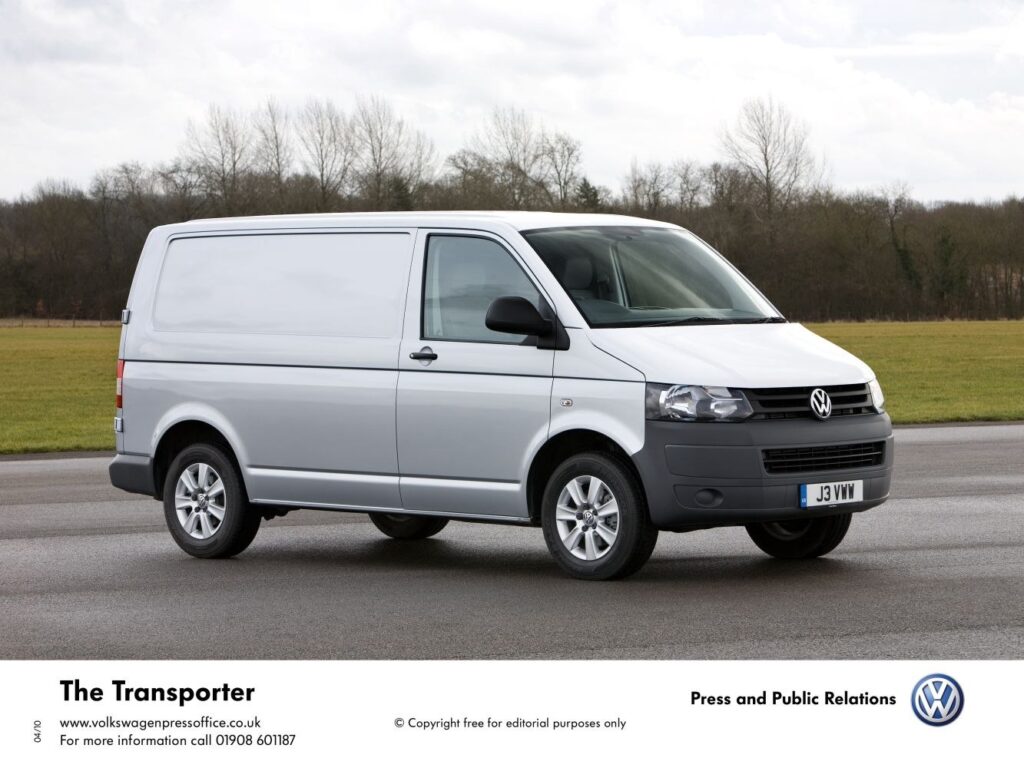
The Volkswagen Transporter (T5, facelift 2009) Panel Van represents a significant iteration of Volkswagen’s iconic commercial vehicle line, a mainstay in European and international markets. Produced between 2011 and 2015, this specific model is part of the fifth generation (T5) of the Transporter, having undergone a substantial facelift in 2009 that introduced refreshed styling, updated interiors, and critically, a new range of more efficient powertrains. While not a direct offering in the North American market in this specific commercial panel van configuration, the Transporter series is globally renowned for its versatility, durability, and practical design, serving as the backbone for countless businesses, trades, and logistics operations across Europe, Asia, and beyond. This particular variant, equipped with the 2.0 TDI BlueMotion Technology (BMT) engine delivering 114 horsepower and featuring the L2H2 designation (long wheelbase, high roof), exemplifies the blend of efficiency, utility, and robust engineering that defines the Transporter’s enduring appeal.
Powertrain & Engine Architecture
At the heart of this Volkswagen Transporter (T5, facelift 2009) Panel Van is a sophisticated 2.0-liter (1968 cm3 or 120.09 cu. in.) inline four-cylinder TDI (Turbocharged Direct Injection) diesel engine, specifically the EA189 / CAAD code. This powerplant is characterized by its modern common-rail fuel injection system, a turbocharger, and an intercooler, all working in concert to deliver a balance of power and efficiency crucial for commercial applications. The engine produces a respectable 114 horsepower at 3500 rpm, translating to a power output of 57.9 horsepower per liter. More importantly for a commercial vehicle, it generates a robust 184.39 lb.-ft. of torque, available across a broad and usable rev range from 1500 to 2750 rpm. This low-end torque is vital for hauling heavy loads and navigating urban environments with ease.
The EA189 engine family is known for its relatively simple design, contributing to its reliability. The CAAD code specifically denotes a version optimized for commercial vehicle applications, prioritizing durability and fuel economy over outright performance. The common-rail direct injection system, utilizing piezo injectors, allows for precise fuel delivery and optimized combustion, contributing to both power and efficiency. The engine features a DOHC (Double Overhead Camshaft) valvetrain with four valves per cylinder, further enhancing its breathing and overall performance. The 16.5:1 compression ratio is relatively high for a diesel engine, contributing to thermal efficiency but also requiring high-quality fuel.
Power is sent to the front wheels via a 5-speed manual transmission, a choice that emphasizes driver engagement and control while offering proven reliability. This transmission is a standard unit found across various Volkswagen Group vehicles of the era. While not a performance-oriented vehicle, the Transporter manages a 0-60 mph acceleration in a calculated 14.2 seconds, with a maximum speed of 98.18 mph (158 km/h), more than adequate for its intended purpose as a utility van.
Driving Characteristics
The 114 horsepower 2.0 TDI engine, paired with the 5-speed manual transmission, delivers a driving experience geared towards practicality and efficiency rather than spirited performance. The broad torque curve is the defining characteristic, providing ample pulling power from low engine speeds. This makes the van surprisingly easy to drive in urban environments and when fully loaded. However, the relatively low horsepower output means that acceleration is modest, particularly when carrying a heavy payload or climbing steep inclines.
Compared to higher-output versions of the 2.0 TDI engine available in the T5 range (such as the 140 hp or 180 hp variants), this 114 hp version feels noticeably less responsive. The gear ratios in the 5-speed manual transmission are optimized for fuel economy and load-carrying capacity, rather than quick acceleration. The first gear is relatively short, aiding in getting the van moving from a standstill, while the higher gears are spaced to maximize fuel efficiency at cruising speeds. Compared to a gasoline engine of similar horsepower, the diesel offers significantly more low-end torque, making it easier to maintain speed uphill or when towing. The manual transmission provides greater driver control compared to the optional automatic transmission, allowing for precise gear selection to optimize fuel economy and performance.
Equipment & Trim Levels
The Volkswagen Transporter (T5, facelift 2009) Panel Van, in this 2.0 TDI BMT L2H2 configuration, was typically positioned as a mid-range offering within the broader Transporter lineup. It aimed to strike a balance between affordability, fuel efficiency, and practicality. Standard equipment generally included features essential for commercial use, such as a driver’s airbag, Anti-lock Braking System (ABS), power steering, and a basic audio system. The interior was typically finished with durable, hard-wearing plastics designed to withstand the rigors of daily commercial use. Upholstery was typically cloth, with a focus on practicality rather than luxury.
Optional extras were plentiful, allowing businesses to customize the van to their specific needs. These included air conditioning, a passenger airbag, electric windows, central locking, upgraded audio systems with Bluetooth connectivity, and parking sensors. Cargo area features, such as load securing rails, additional lighting, and wood or composite flooring, were also commonly specified. The L2H2 designation itself – long wheelbase and high roof – was a key feature, providing a substantial cargo volume of 7800 liters (275.45 cubic feet). The van was often purchased with minimal trim to keep costs down, with businesses prioritizing functionality over aesthetics.
Chassis & Braking
The Transporter (T5) employs an independent McPherson strut front suspension with coil springs and an anti-roll bar, paired with an independent coil spring rear suspension featuring a transverse stabilizer and trailing arms. This setup provides a comfortable ride for a commercial vehicle and stable handling, even when fully loaded. The suspension is tuned to prioritize load-carrying capacity and stability over sporty handling. The anti-roll bars help to reduce body roll during cornering, improving stability and driver confidence.
Braking is handled by ventilated discs at both the front (308×29.5 mm) and rear (294×22 mm), complemented by an Anti-lock Braking System (ABS) for enhanced safety. The ventilated discs provide excellent heat dissipation, preventing brake fade during prolonged use. The ABS system helps to maintain steering control during emergency braking situations. The hydraulic power steering, combined with a relatively tight turning circle of 43.31 feet (13.2 meters), makes maneuvering this large van surprisingly manageable in tight urban spaces. The standard tire size is 215/65 R16 on 6.5J x 16 wheels, a common and cost-effective choice for commercial vehicles.
Market Reception & Comparison
Critics generally viewed the 1.8L Automatic Transporter as a sensible and practical choice for businesses prioritizing fuel economy and reliability over outright performance. It was praised for its comfortable ride, spacious interior, and robust build quality. However, some reviewers noted that the engine felt underpowered when fully loaded or climbing steep hills. Compared to the higher-output TDI engines, the 114 hp version was considered less refined and offered a less engaging driving experience.
In terms of fuel economy, the 2.0 TDI BMT L2H2 variant consistently outperformed its gasoline-powered counterparts, offering significant savings on running costs. Reliability was also a strong point, with the EA189 engine family generally proving to be durable and long-lasting. Compared to rivals such as the Ford Transit Custom and Mercedes-Benz Vito, the Transporter was often seen as offering a more refined driving experience and a higher level of build quality, although it typically came at a slightly higher price point.
Technical Specifications
| Category | Specification |
| General Information | |
| Brand | Volkswagen |
| Model | Transporter |
| Generation | Transporter (T5, facelift 2009) Panel Van |
| Type (Engine) | 2.0 TDI BMT (114 Hp) L2H2 |
| Production Start | 2011 |
| Production End | 2015 |
| Powertrain Architecture | Internal Combustion Engine |
| Body Type | Van |
| Seats | 2-3 |
| Doors | 4-5 |
| Performance Specs | |
| Fuel Consumption (Urban, NEDC) | 28.3 – 27.4 US mpg (8.3-8.6 l/100 km) |
| Fuel Consumption (Extra Urban, NEDC) | 40.6 – 38.6 US mpg (5.8-6.1 l/100 km) |
| Fuel Consumption (Combined, NEDC) | 35.1 – 33.6 US mpg (6.7-7 l/100 km) |
| CO2 Emissions (NEDC) | 176-184 g/km |
| Fuel Type | Diesel |
| Acceleration 0-60 mph | 14.2 sec |
| Acceleration 0-62 mph (0-100 km/h) | 14.9 sec |
| Maximum Speed | 98.18 mph (158 km/h) |
| Emission Standard | Euro 5 |
| Weight-to-Power Ratio | 15.2 kg/Hp, 65.6 Hp/tonne |
| Weight-to-Torque Ratio | 7 kg/Nm, 143.8 Nm/tonne |
| Engine Specs | |
| Power | 114 Hp @ 3500 rpm |
| Power per liter | 57.9 Hp/l |
| Torque | 184.39 lb.-ft. @ 1500-2750 rpm (250 Nm) |
| Engine Layout | Front, Transverse |
| Engine Model/Code | EA189 / CAAD |
| Engine Displacement | 120.09 cu. in. (1968 cm3) |
| Number of Cylinders | 4 |
| Engine Configuration | Inline |
| Cylinder Bore | 3.19 in. (81 mm) |
| Piston Stroke | 3.76 in. (95.5 mm) |
| Compression Ratio | 16.5:1 |
| Valves per Cylinder | 4 |
| Fuel Injection System | Diesel Commonrail |
| Engine Aspiration | Turbocharger, Intercooler |
| Valvetrain | DOHC |
Legacy
The Volkswagen Transporter (T5, facelift 2009) Panel Van, particularly in its 2.0 TDI BMT L2H2 guise, solidified the Transporter’s reputation as a segment leader in its primary European and international markets. For decades, the Transporter series has been synonymous with reliability, practicality, and excellent residual values. The T5 generation, and especially the facelifted models, continued this tradition by offering a compelling package for businesses of all sizes. Its robust build quality and proven mechanicals ensured longevity, a critical factor for commercial vehicles that often face demanding daily usage.
Today, well-maintained T5 facelift models with the 2.0 TDI engine continue to be a popular choice in the used commercial vehicle market. Their relatively low running costs, combined with their proven reliability, make them an attractive option for small businesses and tradespeople. While some earlier EA189 engines were affected by the diesel emissions scandal, the 114 hp version was generally less impacted than higher-output variants. Regular maintenance, including oil changes and filter replacements, is crucial for ensuring the long-term reliability of these engines. The availability of spare parts remains good, and the Transporter’s widespread popularity means that there is a large network of mechanics familiar with servicing these vehicles.
The T5 Transporter’s legacy is one of continuous evolution and adaptation. It served as a bridge between the classic, utilitarian Transporters of old and the more modern, technologically advanced T6 that followed. Its robust chassis, powerful yet efficient diesel engines, and extensive cargo capacity made it an indispensable tool for countless enterprises. Even today, many T5 facelift models remain in active service, a testament to their inherent durability and the quality of Volkswagen engineering.