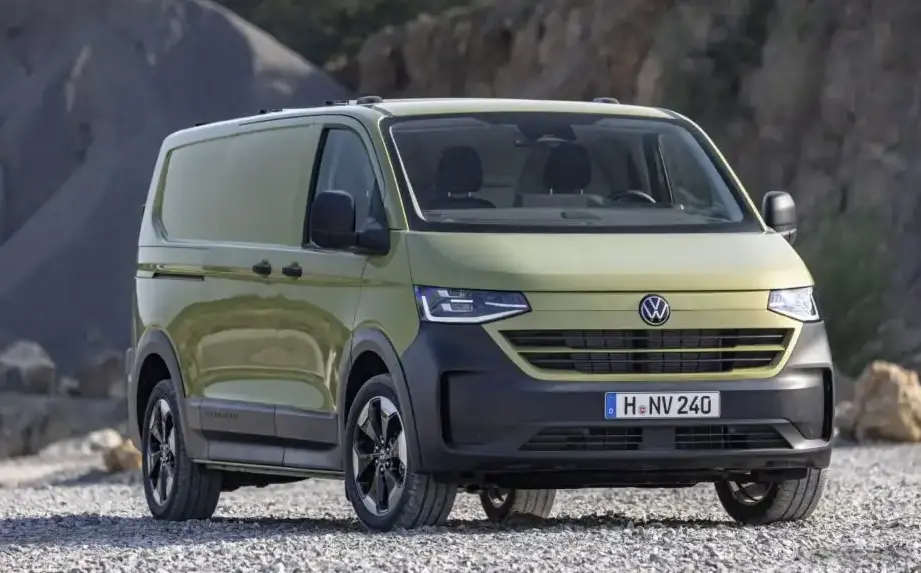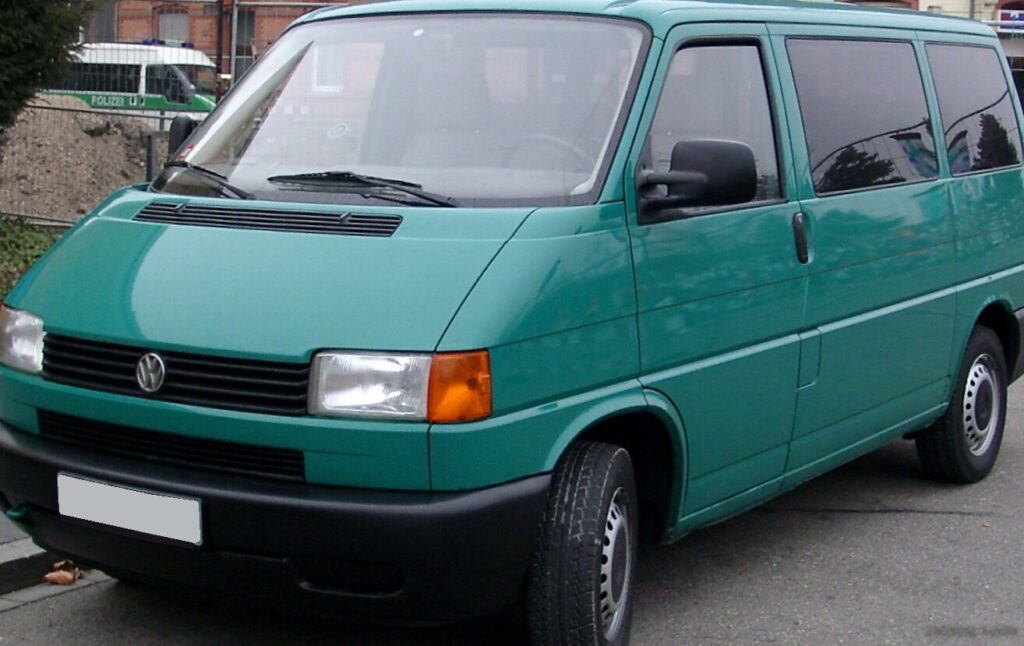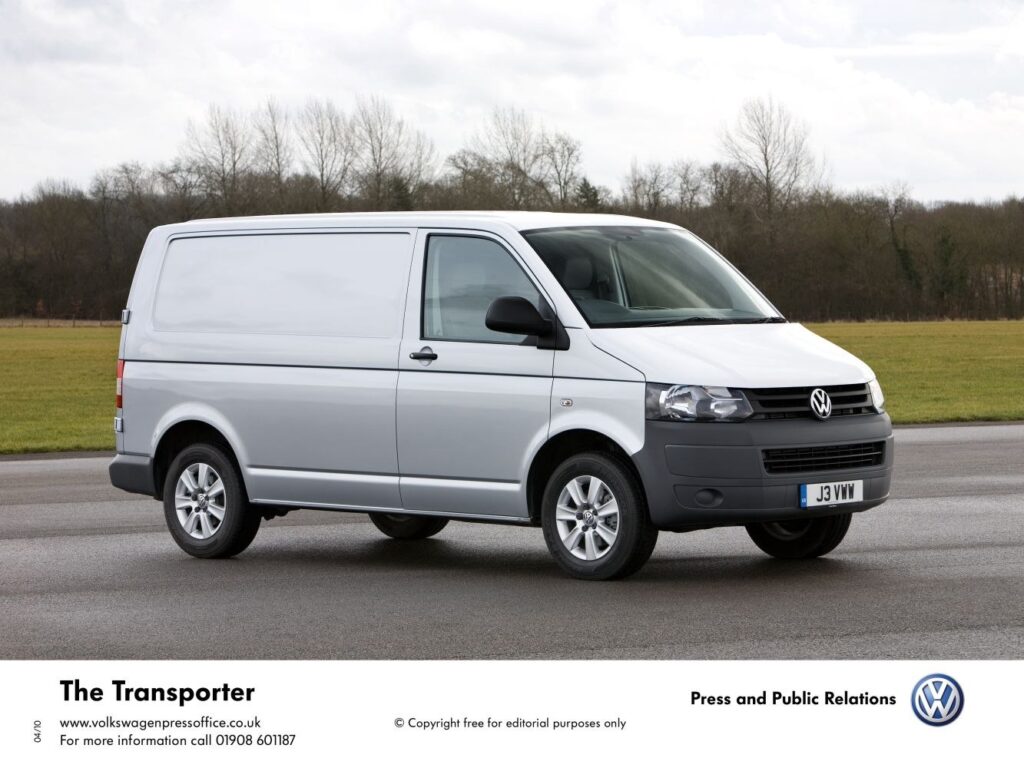
The Volkswagen Transporter (T5, facelift 2009) Panel Van represents a significant iteration of Volkswagen’s iconic light commercial vehicle series, a lineage stretching back to the original Type 2 “Bus.” This particular variant, produced between 2012 and 2015, is a facelifted version of the fifth-generation Transporter (T5), specifically configured as a panel van with a 2.0-liter TDI BlueMotion Technology (BMT) engine, delivering 140 horsepower, paired with a Direct Shift Gearbox (DSG) automatic transmission. Designated as L2H2, it signifies a long-wheelbase and high-roof configuration, maximizing cargo capacity for commercial applications.
While the Volkswagen Transporter series holds an almost legendary status in Europe and other international markets as a versatile workhorse and popular platform for camper conversions, it was not officially sold in the United States during this generation. In the U.S., Volkswagen’s commercial vehicle offerings have historically been different, with larger vans like the Mercedes-Benz Sprinter (rebadged as a Freightliner or Dodge Sprinter) or domestic full-size vans dominating the market. Nonetheless, understanding the T5 facelift’s engineering and market role provides valuable insight into global automotive trends and Volkswagen’s prowess in the light commercial vehicle segment. This model combined robust utility with advanced powertrain technology, setting a benchmark for efficiency and driveability in its class.
The 2.0 TDI BMT Powertrain & Engine Architecture
At the heart of this particular Volkswagen Transporter (T5, facelift 2009) Panel Van is a sophisticated 2.0-liter (1968 cm3, or 120.09 cu. in.) inline-four turbo diesel engine, identified by the EA189 / CAAC engine code. This powerplant is a testament to Volkswagen’s commitment to diesel efficiency and performance, featuring a double overhead camshaft (DOHC) valvetrain with 4 valves per cylinder, a common rail direct fuel injection system, and boosted by a turbocharger with an intercooler. This configuration allows the engine to produce a respectable 140 horsepower at 3500 rpm, translating to a power output of 71.1 horsepower per liter.
More critically for a commercial vehicle, the engine generates a substantial 250.77 lb.-ft. (340 Nm) of torque, available across a broad and usable range from 1750 to 2500 rpm. This ample torque at low engine speeds is crucial for hauling heavy loads and providing confident acceleration even when fully laden. Power is sent to the front wheels through an advanced 7-speed DSG automatic transmission. This dual-clutch gearbox is renowned for its rapid, smooth shifts and contributes significantly to both the vehicle’s fuel efficiency and driving comfort, a notable upgrade over traditional manual or torque-converter automatics in commercial vans of the era.
The EA189 engine family, while widely used, later became subject to scrutiny regarding emissions compliance (Dieselgate). However, the CAAC code specifically, while part of the broader EA189 family, generally exhibited fewer issues than some other variants. The common rail direct injection system utilized piezo injectors for precise fuel delivery, optimizing combustion efficiency and reducing particulate matter. The turbocharger, a variable geometry turbo (VGT), further enhanced low-end torque and responsiveness. The 7-speed DSG transmission (DQ250) is a sophisticated unit featuring two separate clutches, one for odd gears and one for even gears, allowing for seamless and incredibly quick gear changes. This transmission is known for its efficiency and responsiveness, but requires regular maintenance, including fluid changes, to ensure longevity.
Driving Characteristics of the 140 hp Automatic
The 140 horsepower and 250.77 lb-ft of torque configuration in the T5 Transporter L2H2 provides a practical, rather than sporty, driving experience. Acceleration from 0 to 60 mph takes approximately 12 seconds, and the top speed is around 103.15 mph (166 km/h). Compared to the higher-output 180 hp TDI versions, this variant feels noticeably less powerful, particularly when fully loaded or climbing inclines. However, the broad torque band of the 2.0 TDI ensures that it remains capable and responsive in most everyday driving situations.
The 7-speed DSG transmission plays a crucial role in maximizing the engine’s usability. The close gear ratios keep the engine within its optimal torque range, providing smooth and efficient acceleration. Compared to a manual transmission, the DSG offers convenience and reduces driver fatigue, especially in stop-and-go traffic. However, some drivers may prefer the more direct control offered by a manual gearbox. The automatic transmission also contributes to improved fuel economy compared to a manual, particularly in urban driving. The gear ratios are tuned for maximizing fuel efficiency and load-carrying capability, rather than outright performance. The emphasis is on providing a comfortable and predictable driving experience, even under heavy loads.
Equipment & Trim Levels
The Volkswagen Transporter (T5, facelift 2009) Panel Van in this L2H2, 2.0 TDI BMT 140 hp DSG configuration typically sat in the mid-range of the T5 lineup. It was positioned above the base-level models with lower horsepower engines and fewer features, but below the more premium trims with higher power outputs, upgraded interiors, and additional equipment. Standard features included power steering (hydraulic), ABS (Anti-lock Braking System), driver and passenger airbags, and a basic audio system. The cabin was typically finished with durable, hard-wearing plastics and cloth upholstery.
Optional extras commonly included air conditioning, a more advanced audio system with Bluetooth connectivity, parking sensors, cruise control, and upgraded seating. Many Transporters were also equipped with additional security features, such as an alarm system and immobilizer. The L2H2 configuration itself was a key feature, providing a substantial cargo volume of up to 7800 liters (275.45 cu. ft.). The interior layout was typically focused on practicality, with minimal trim and a focus on durability. The driver’s seat was often adjustable for height and lumbar support to enhance comfort during long journeys.
Chassis & Braking
The T5 Transporter utilizes an independent front suspension (McPherson with coil spring and anti-roll bar) and an independent rear suspension (coil spring, transverse stabilizer, trailing arm). This suspension setup provides a good balance of ride comfort and handling, even when the vehicle is heavily loaded. The suspension components are robustly engineered to withstand the demands of commercial use. The front suspension features a stabilizer bar to reduce body roll during cornering.
Braking is provided by ventilated disc brakes on all four wheels (front: 308×29.5 mm, rear: 294×22 mm), ensuring strong and reliable stopping power. The ABS (Anti-lock Braking System) prevents wheel lockup during emergency braking, enhancing stability and control. The braking system is designed to handle the vehicle’s maximum gross weight of 6172.94 – 7054.79 lbs. (2800-3200 kg). The steering is a hydraulic power-assisted rack and pinion system, providing precise and responsive steering feel.
Market Reception & Comparison
Critics generally praised the Volkswagen Transporter (T5, facelift 2009) for its robust build quality, comfortable ride, and refined driving experience. The 2.0 TDI BMT engine with 140 hp and the DSG transmission were considered a good compromise between performance and fuel efficiency. However, some reviewers noted that the 140 hp engine could feel underpowered when fully loaded or climbing steep hills.
Compared to other trims in the T5 lineup, the 140 hp Automatic offered a more affordable entry point while still providing a capable and practical workhorse. The higher-output 180 hp TDI versions offered more performance but came at a higher price. Fuel economy was a key strength of the 140 hp BMT model, achieving between 31.8 and 30.5 US mpg (7.4-7.7 l/100 km) in combined driving. Reliability was generally good, although the DSG transmission required regular maintenance to prevent issues. The T5 Transporter consistently ranked highly in reliability surveys, making it a popular choice for businesses and fleet operators.
Technical Specifications
| Category | Specification |
| General Information | |
| Brand | Volkswagen |
| Model | Transporter |
| Generation | Transporter (T5, facelift 2009) Panel Van |
| Type (Engine) | 2.0 TDI BMT (140 Hp) DSG L2H2 |
| Production Start | 2012 |
| Production End | 2015 |
| Body Type | Van |
| Seats | 2-3 |
| Doors | 4-5 |
| Performance Specs | |
| Fuel Consumption (Urban, NEDC) | 25.6 – 24.8 US mpg (9.2-9.5 l/100 km) |
| Fuel Consumption (Extra Urban, NEDC) | 36.8 – 35.1 US mpg (6.4-6.7 l/100 km) |
| Fuel Consumption (Combined, NEDC) | 31.8 – 30.5 US mpg (7.4-7.7 l/100 km) |
| CO2 Emissions (NEDC) | 195-203 g/km |
| Fuel Type | Diesel |
| Acceleration 0-60 mph (Calculated) | 12 seconds |
| Maximum Speed | 103.15 mph (166 km/h) |
| Emission Standard | Euro 5 |
| Weight-to-power ratio | 12.8 kg/Hp, 78.4 Hp/tonne |
| Engine Specs | |
| Power | 140 Hp @ 3500 rpm |
| Torque | 250.77 lb.-ft. (340 Nm) @ 1750-2500 rpm |
| Engine Layout | Front, Transverse |
| Engine Model/Code | EA189 / CAAC |
| Engine Displacement | 2.0 liters (1968 cm3 / 120.09 cu. in.) |
| Number of Cylinders | 4 |
| Engine Configuration | Inline |
| Compression Ratio | 16.5:1 |
| Valves per Cylinder | 4 |
| Fuel Injection System | Diesel Commonrail |
| Engine Aspiration | Turbocharger, Intercooler |
| Valvetrain | DOHC |
| Engine Oil Capacity | 7.4 US qt (7 l) |
| Coolant Capacity | 11.62 US qt (11 l) |
| Engine Systems | Start & Stop System, Particulate filter |
| Space, Volume and Weights | |
| Kerb Weight | 3935.25 – 4914.1 lbs. (1785-2229 kg) |
| Max. Weight | 6172.94 – 7054.79 lbs. (2800-3200 kg) |
| Max. Load | 2140.69 – 2237.69 lbs. (971-1015 kg) |
| Trunk (Boot) Space – Maximum | 275.45 cu. ft. (7800 l) |
| Fuel Tank Capacity | 21.13 US gal (80 l) |
| Permitted Trailer Load (with brakes) | 5511.56 lbs. (2500 kg) |
| Permitted Trailer Load (without brakes) | 1653.47 lbs. (750 kg) |
| Dimensions | |
| Length | 208.35 in. (5292 mm) |
| Width | 74.96 in. (1904 mm) |
| Width (including mirrors) | 89.88 in. (2283 mm) |
| Height | 85.67 in. (2176 mm) |
| Wheelbase | 133.86 in. (3400 mm) |
| Front Overhang | 35.28 in. (896 mm) |
| Rear Overhang | 39.21 in. (996 mm) |
| Ride Height (Ground Clearance) | 7.91 in. (201 mm) |
| Minimum Turning Circle | 43.31 ft. (13.2 m) |
| Approach Angle | 21° |
| Departure Angle | 17° |
| Ramp-over (Brakeover) Angle | 12° |
| Drivetrain, Brakes and Suspension | |
| Drivetrain Architecture | Front-wheel drive |
| Drive Wheel | Front wheel drive |
| Gearbox | 7 gears, automatic transmission DSG |
| Front Suspension | Independent, McPherson with coil spring and anti-roll bar |
| Rear Suspension | Independent coil spring, Transverse stabilizer, Trailing arm |
| Front Brakes | Ventilated discs, 308×29.5 mm |
| Rear Brakes | Ventilated discs, 294×22 mm |
| Assisting Systems | ABS (Anti-lock braking system) |
| Steering Type | Steering rack and pinion |
| Power Steering | Hydraulic Steering |
| Tires Size | 215/65 R16 |
| Wheel Rims Size | 6.5J x 16 |
Legacy
The Volkswagen Transporter series, including the T5 facelift, enjoys a formidable reputation as a cornerstone of the light commercial vehicle market across Europe and many other parts of the world. It is celebrated for its exceptional reliability, robust build quality, and remarkable versatility. The Volkswagen Transporter (T5, facelift 2009) Panel Van, with its 2.0 TDI BMT (140 Hp) DSG L2H2 configuration, perfectly encapsulated these attributes during its production run from 2012 to 2015.
On the used car market today, well-maintained T5 Transporters with the 2.0 TDI engine and DSG transmission remain highly sought after. Their durability and relatively low running costs make them an attractive option for businesses and individuals alike. However, potential buyers should be aware of the need for regular DSG transmission servicing and should carefully inspect the vehicle for any signs of wear and tear. The CAAC engine code, while generally reliable, should be checked for any history of emissions-related issues. Overall, the T5 Transporter continues to be a respected and capable vehicle, offering a compelling blend of practicality, reliability, and value.