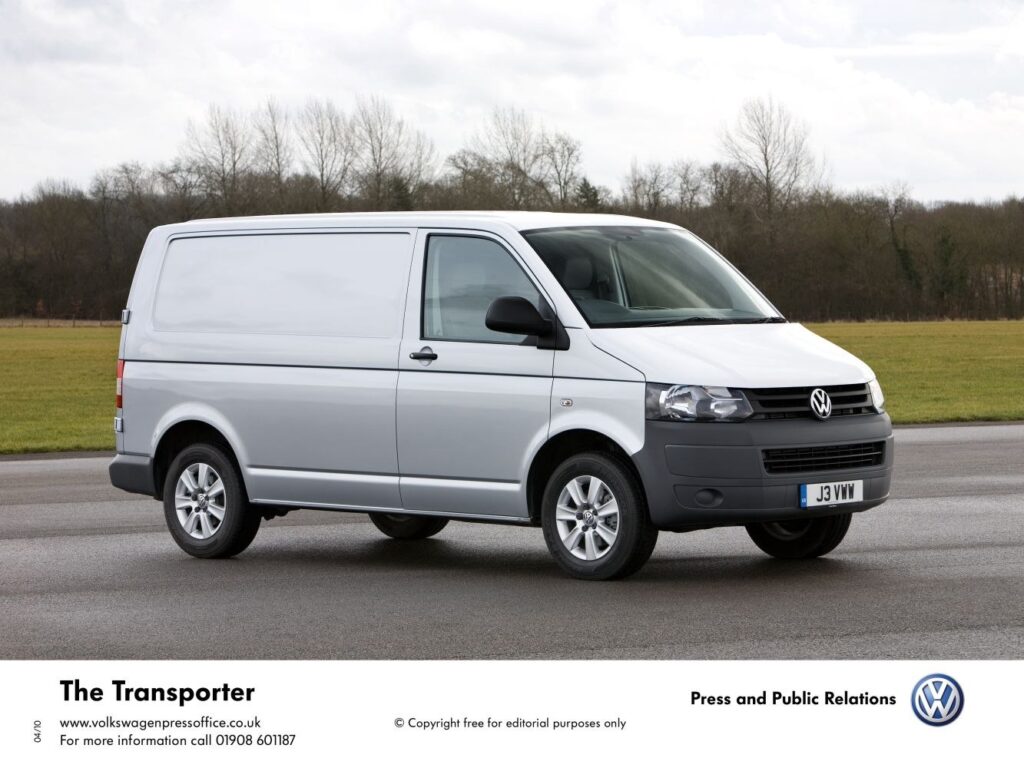
The Volkswagen Transporter (T5, facelift 2009) Panel Van 2.0 TDI BMT (140 Hp) L2H1 represents a significant chapter in the storied history of Volkswagen’s iconic commercial vehicle line. Produced from 2012 to 2015, this particular variant was a key offering within the T5 generation, which ran from 2003 to 2015. The “T5” designation refers to the fifth generation of the Transporter, while “facelift 2009” indicates the mid-cycle refresh that brought updated styling, improved engines, and enhanced technology. As a panel van, it was engineered primarily for utilitarian purposes, serving as a versatile and reliable workhorse across Europe and other international markets. While not officially sold in the United States, the Transporter series holds a legendary status globally, known for its durability, practicality, and efficiency, embodying Volkswagen’s engineering prowess in the light commercial vehicle segment. The L2H1 designation signifies a long wheelbase (L2) and a standard roof height (H1), optimizing cargo capacity without compromising maneuverability.
Powertrain & Engine Architecture
Powering this Volkswagen Transporter (T5, facelift 2009) Panel Van variant is a 2.0-liter (1968 cm3) inline-four turbo-diesel engine. Coded EA189 / CAAC, this powerplant exemplifies Volkswagen’s commitment to efficient diesel technology. It generates 140 horsepower at 3500 rpm, delivering a power-per-liter figure of 71.1 hp/liter. More importantly for a van, the torque output is substantial, peaking at 340 Nm (250.77 lb-ft) across a broad range of 1750-2500 rpm. This low-end torque is crucial for hauling heavy loads and providing confident acceleration, even when fully laden.
The engine’s architecture features a front, transverse layout with a DOHC (Double Overhead Camshaft) valvetrain and 4 valves per cylinder, ensuring optimal airflow and combustion. Fuel is delivered via a common rail diesel injection system, enhancing efficiency and reducing emissions. A turbocharger with an intercooler boosts performance, providing crisp throttle response. The engine is mated to a 6-speed manual transmission, sending power to the front wheels.
Driving Characteristics
The 2.0 TDI 140 hp engine, paired with the 6-speed manual transmission, offered a practical and efficient driving experience. While not designed for rapid acceleration, the van provided adequate power for everyday use and highway cruising. The broad torque curve meant that strong pulling power was available from relatively low engine speeds, making it easy to maintain momentum even when loaded. Compared to the higher-output TDI variants (like the 180 hp version), this engine prioritized fuel economy and reduced running costs over outright performance. The gear ratios were tuned for efficiency, with a relatively long final drive to maximize fuel mileage. Drivers accustomed to the more responsive feel of the higher-powered engines might find the 140 hp version slightly less engaging, but the trade-off in fuel efficiency was often considered worthwhile for commercial applications.
Equipment & Trim Levels
The Volkswagen Transporter (T5, facelift 2009) Panel Van 2.0 TDI BMT (140 Hp) L2H1 typically served as a base or mid-range offering within the T5 lineup. Standard equipment generally included features like power windows, central locking, an adjustable steering column, and a basic audio system. The interior upholstery was typically hard-wearing cloth, designed to withstand the rigors of commercial use. The dashboard layout was functional and straightforward, prioritizing ergonomics and ease of use. Optional extras included air conditioning, upgraded audio systems, parking sensors, and various cargo area enhancements such as shelving and load securing systems. Higher trim levels added features like alloy wheels, upgraded interior trim, and more advanced infotainment systems.
Chassis & Braking
The Transporter T5 employed an independent suspension system both front and rear, featuring McPherson struts with coil springs and an anti-roll bar at the front, and independent coil springs with a transverse stabilizer and trailing arms at the rear. This setup provided a comfortable ride quality even when unladen, while also offering excellent stability and handling under heavy loads. Braking was handled by ventilated discs all around (308×29.5 mm front, 294×22 mm rear), complemented by an Anti-lock Braking System (ABS) for enhanced safety and control. Hydraulic power steering ensured ease of maneuverability. The robust construction and thoughtful engineering contributed to a substantial payload capacity and a permitted trailer load with brakes of 2500 kg (5511.56 lbs).
Market Reception & Comparison
Critics generally viewed the 2.0 TDI 140 hp engine as a sensible and practical choice for the Transporter T5. It was praised for its fuel efficiency, reliability, and ample torque. Compared to the more powerful TDI variants, it offered a lower purchase price and reduced running costs, making it attractive to budget-conscious operators. Fuel economy was a key strength, with combined figures around 34 mpg (US) being highly competitive in its class. Reliability was generally good, although like all diesel engines, it was susceptible to issues related to the diesel particulate filter (DPF) if not properly maintained. Compared to gasoline-powered vans, the TDI offered significantly better fuel economy and a longer lifespan, making it a popular choice for high-mileage applications.
Volkswagen Transporter 2.0 TDI BMT (140 Hp) L2H1 Technical Specifications
| Category | Specification |
| General Information | |
| Brand | Volkswagen |
| Model | Transporter |
| Generation | Transporter (T5, facelift 2009) Panel Van |
| Type (Engine) | 2.0 TDI BMT (140 Hp) L2H1 |
| Start of Production | 2012 |
| End of Production | 2015 |
| Powertrain Architecture | Internal Combustion engine |
| Body type | Van |
| Seats | 2-3 |
| Doors | 4-5 |
| Performance Specs | |
| Fuel consumption (economy) – urban (NEDC) | 8.8-9.1 l/100 km |
| Fuel consumption (economy) – extra urban (NEDC) | 5.8-6.1 l/100 km |
| Fuel consumption (economy) – combined (NEDC) | 6.9-7.2 l/100 km |
| CO2 emissions (NEDC) | 182-189 g/km |
| Fuel Type | Diesel |
| Acceleration 0 – 60 mph | 11.6 sec |
| Acceleration 0 – 100 km/h | 12.2 sec |
| Maximum speed | 173 km/h (107.5 mph) |
| Emission standard | Euro 5 |
| Engine Specs | |
| Power | 140 Hp @ 3500 rpm |
| Power per liter | 71.1 Hp/l |
| Torque | 340 Nm @ 1750-2500 rpm (250.77 lb.-ft.) |
| Engine layout | Front, Transverse |
| Engine Model/Code | EA189 / CAAC |
| Engine displacement | 1968 cm3 (120.09 cu. in.) |
| Number of cylinders | 4 |
| Engine configuration | Inline |
| Fuel injection system | Diesel Commonrail |
| Engine aspiration | Turbocharger, Intercooler |
| Valvetrain | DOHC |
| Space, Volume and Weights | |
| Kerb Weight | 1773-2217 kg (3908.8 – 4887.65 lbs.) |
| Max. weight | 2800-3200 kg (6172.94 – 7054.79 lbs.) |
| Max load | 983-1027 kg (2167.14 – 2264.15 lbs.) |
| Trunk (boot) space – maximum | 6700 l (236.61 cu. ft.) |
| Fuel tank capacity | 80 l (21.13 US gal) |
| Dimensions | |
| Length | 5292 mm (208.35 in.) |
| Width | 1904 mm (74.96 in.) |
| Height | 1990 mm (78.35 in.) |
| Wheelbase | 3400 mm (133.86 in.) |
Legacy
The Volkswagen Transporter T5, including the 2.0 TDI BMT (140 Hp) L2H1 variant, has proven to be a durable and reliable workhorse. The EA189 engine, while subject to some scrutiny regarding emissions in later years, generally offered good longevity when properly maintained. On the used car market today, these vans remain popular due to their practicality, affordability, and relatively low running costs. Common issues include wear and tear on the turbocharger, potential problems with the DPF, and occasional issues with the dual-mass flywheel. However, with regular servicing and preventative maintenance, these vans can continue to provide years of reliable service. The T5’s enduring popularity is a testament to its robust design and its ability to meet the diverse needs of commercial operators.