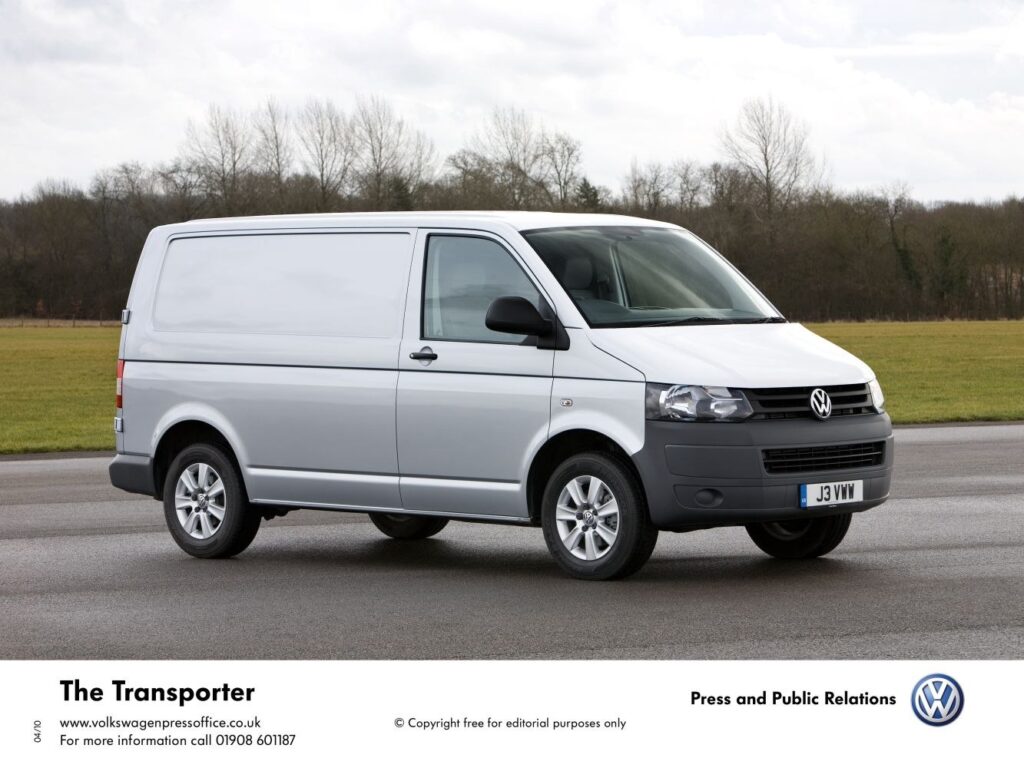
The Volkswagen Transporter (T5, facelift 2009) Panel Van 2.0 TDI BMT (180 Hp) DSG L1H2 represents a significant iteration of Volkswagen’s iconic commercial vehicle, produced from 2013 to 2015. This variant, part of the T5 generation which received a substantial facelift in 2009, combined a robust and practical design with a powerful and efficient powertrain. While not officially sold in the United States in panel van configuration, the Transporter series is a mainstay in Europe and many other global markets, serving as a crucial vehicle for businesses and tradespeople. The L1H2 designation indicates a short wheelbase and high roof, optimizing cargo capacity for urban and suburban environments. This specific model aimed to deliver a balance of performance, economy, and practicality for commercial users.
Powertrain & Engine Architecture
The Volkswagen Transporter (T5, facelift 2009) Panel Van 2.0 TDI BMT (180 Hp) DSG L1H2 is powered by Volkswagen’s 2.0-liter TDI (Turbocharged Direct Injection) engine, specifically the “BlueMotion Technology” (BMT) variant. The engine code for this configuration is EA189 / CFCA. This is a four-cylinder, inline diesel engine featuring Double Overhead Camshafts (DOHC) and four valves per cylinder. The engine utilizes a common rail fuel injection system, delivering fuel directly into the combustion chamber at extremely high pressure for optimized combustion. A sophisticated BiTurbo setup, employing two turbochargers of differing sizes, works in conjunction with an intercooler to maximize power and torque output. The smaller turbocharger provides boost at lower engine speeds, eliminating turbo lag and delivering immediate response, while the larger turbocharger takes over at higher speeds for sustained power. This configuration allows the engine to generate 180 horsepower at 4000 rpm and a substantial 295.02 lb.-ft. of torque between 1500 and 2000 rpm.
Power is transmitted to the front wheels via a 7-speed DSG (Direct Shift Gearbox) automatic transmission. This dual-clutch transmission is renowned for its quick and smooth gear changes, enhancing both driving comfort and fuel efficiency. The DSG operates by pre-selecting the next gear, allowing for near-instantaneous shifts without the power interruption associated with traditional automatic transmissions. BlueMotion Technology further enhances efficiency with features like a Start & Stop system, which automatically shuts off the engine when the vehicle is stationary, and a diesel particulate filter, reducing harmful emissions.
Driving Characteristics
The 2.0 TDI BMT (180 Hp) DSG powertrain delivers a surprisingly agile driving experience for a commercial vehicle. Acceleration from 0 to 60 mph is achieved in approximately 9.6 seconds, with a top speed of 114.33 mph. The broad torque curve, peaking at 295.02 lb.-ft., provides strong pulling power from low engine speeds, making it well-suited for hauling heavy loads and navigating challenging terrain. Compared to lower-powered versions of the T5, such as those with the 102 hp or 140 hp engines, this variant offers significantly improved acceleration and overall performance. While a manual transmission was available on other T5 models, the DSG automatic provides a more refined and convenient driving experience, particularly in stop-and-go traffic. Compared to the higher-output 180 hp TDI with a manual transmission, the DSG offers smoother shifts and potentially slightly improved fuel economy, though the manual may provide a more direct connection to the engine.
The 7-speed DSG transmission’s gear ratios are optimized for both fuel efficiency and performance. Lower gears provide strong acceleration, while higher gears allow for relaxed cruising at highway speeds. The transmission’s ability to quickly shift between gears ensures that the engine remains within its optimal power band, maximizing efficiency and responsiveness. The overall driving experience is characterized by a balance of power, smoothness, and efficiency, making it a capable and comfortable work vehicle.
Equipment & Trim Levels
The Volkswagen Transporter (T5, facelift 2009) Panel Van 2.0 TDI BMT (180 Hp) DSG L1H2 was typically equipped with a functional and durable interior focused on practicality. Standard features included power steering, air conditioning, an adjustable steering wheel, and a driver’s seat with height adjustment. The cabin typically featured a 2- or 3-seat configuration, with the central seat often folding to create a useful workspace. Upholstery was typically hard-wearing fabric, designed to withstand the rigors of commercial use. The dashboard layout was straightforward and ergonomic, with intuitive controls and ample storage compartments for documents and tools.
Optional extras available for this trim level included features such as a navigation system, upgraded audio system, parking sensors, cruise control, and heated seats. Additional cargo area features, such as load securing rails and interior lighting, were also commonly specified. Exterior options included different paint colors, alloy wheels, and upgraded lighting packages. The level of equipment varied depending on the specific market and customer preferences.
Chassis & Braking
The T5 Transporter’s chassis is designed to provide a comfortable ride and stable handling, even when fully loaded. The front suspension utilizes independent McPherson struts with coil springs and an anti-roll bar, while the rear suspension employs independent coil springs with a transverse stabilizer and trailing arm. This configuration provides a good balance between ride comfort and handling precision. The L1H2 configuration, with its shorter wheelbase and higher center of gravity, requires a carefully tuned suspension to maintain stability.
The braking system consists of ventilated disc brakes on all four wheels, providing ample stopping power. ABS (Anti-lock Braking System) is standard, preventing wheel lockup during hard braking and maintaining steering control. The braking system is designed to handle the vehicle’s maximum gross vehicle weight (GVWR) safely and effectively. Stabilizer bars (anti-roll bars) are fitted to both the front and rear axles to reduce body roll during cornering, enhancing stability and handling.
Market Reception & Comparison
The Volkswagen Transporter (T5, facelift 2009) Panel Van 2.0 TDI BMT (180 Hp) DSG L1H2 received generally positive reviews from critics, who praised its robust build quality, refined powertrain, and comfortable driving experience. The 2.0 TDI engine was lauded for its power, efficiency, and low-end torque, making it well-suited for commercial applications. The DSG automatic transmission was also highly regarded for its smooth and quick gear changes. Fuel economy was a strong point, with combined cycle figures ranging from 32.2 to 30.9 US mpg, making it competitive with other vans in its class.
Compared to other trims in the T5 lineup, the 180 hp TDI BMT DSG offered a significant performance upgrade over the lower-powered engines. While the 140 hp TDI provided adequate performance for many applications, the 180 hp version offered more power for hauling heavier loads or driving on hilly terrain. The 180 hp engine also provided a more relaxed driving experience at highway speeds. Compared to the petrol (gasoline) engine options, the TDI offered significantly better fuel economy and torque. Reliability was generally good, although some owners reported issues with the DSG transmission, particularly early versions. However, these issues were often addressed through software updates and improved maintenance procedures.
Technical Specifications
| General Information | |
| Brand | Volkswagen |
| Model | Transporter |
| Generation | Transporter (T5, facelift 2009) Panel Van |
| Type (Engine) | 2.0 TDI BMT (180 Hp) DSG L1H2 |
| Start of production | 2013 year |
| End of production | 2015 year |
| Powertrain Architecture | Internal Combustion engine |
| Body type | Van |
| Seats | 2-3 |
| Doors | 4-5 |
| Performance Specs | |
| Fuel consumption (economy) – urban (NEDC) | 27.7 – 26.7 US mpg (8.5-8.8 l/100 km) |
| Fuel consumption (economy) – extra urban (NEDC) | 35.6 – 34.1 US mpg (6.6-6.9 l/100 km) |
| Fuel consumption (economy) – combined (NEDC) | 32.2 – 30.9 US mpg (7.3-7.6 l/100 km) |
| CO2 emissions (NEDC) | 192-199 g/km |
| Fuel Type | Diesel |
| Acceleration 0 – 60 mph | 9.6 sec |
| Acceleration 0 – 100 km/h | 10.1 sec |
| Maximum speed | 114.33 mph (184 km/h) |
| Emission standard | Euro 5 |
| Weight-to-power ratio | 9.9 kg/Hp, 101.1 Hp/tonne |
| Weight-to-torque ratio | 4.5 kg/Nm, 224.6 Nm/tonne |
| Engine Specs | |
| Power | 180 Hp @ 4000 rpm |
| Power per liter | 91.5 Hp/l |
| Torque | 295.02 lb.-ft. @ 1500-2000 rpm (400 Nm) |
| Engine layout | Front, Transverse |
| Engine Model/Code | EA189 / CFCA |
| Engine displacement | 2.0 liters (1968 cm3 / 120.09 cu. in.) |
| Number of cylinders | 4 |
| Engine configuration | Inline |
| Cylinder Bore | 3.19 in. (81 mm) |
| Piston Stroke | 3.76 in. (95.5 mm) |
| Compression ratio | 16.5:1 |
| Number of valves per cylinder | 4 |
| Fuel injection system | Diesel Commonrail |
| Engine aspiration | BiTurbo, Intercooler |
| Valvetrain | DOHC |
| Engine oil capacity | 7.4 US qt (7 l) |
| Coolant | 11.62 US qt (11 l) |
| Engine systems | Start & Stop System, Particulate filter |
| Space, Volume and Weights | |
| Kerb Weight | 3926.43 – 4784.03 lbs. (1781-2170 kg) |
| Max. weight (GVWR) | 6172.94 – 7054.79 lbs. (2800-3200 kg) |
| Max load | 2246.51 – 2270.76 lbs. (1019-1030 kg) |
| Trunk (boot) space – maximum | 236.61 cu. ft. (6700 l) |
| Fuel tank capacity | 21.13 US gal (80 l) |
| Permitted trailer load with brakes (12%) | 5511.56 lbs. (2500 kg) |
| Permitted trailer load without brakes | 1653.47 lbs. (750 kg) |
| Permitted towbar download | 220.46 lbs. (100 kg) |
| Dimensions | |
| Length | 192.6 in. (4892 mm) |
| Width | 74.96 in. (1904 mm) |
| Width including mirrors | 89.88 in. (2283 mm) |
| Height | 85.67 in. (2176 mm) |
| Wheelbase | 118.11 in. (3000 mm) |
| Front overhang | 35.28 in. (896 mm) |
| Rear overhang | 39.21 in. (996 mm) |
| Ride height (ground clearance) | 7.91 in. (201 mm) |
| Minimum turning circle (turning diameter) | 39.04 ft. (11.9 m) |
| Approach angle | 21° |
| Departure angle | 17° |
| Ramp-over (brakeover) angle | 14° |
| Wading depth | 11.81 in. (300 mm) |
Legacy
The Volkswagen Transporter T5, and specifically the 2.0 TDI BMT (180 Hp) DSG L1H2 variant, has proven to be a durable and reliable workhorse. The EA189 engine, while subject to some emissions-related recalls in later years, is generally considered a robust and long-lasting unit when properly maintained. The DSG transmission, while potentially requiring more frequent servicing than a traditional automatic, offers smooth and efficient operation. On the used car market, these vans continue to command reasonable prices, reflecting their reputation for reliability and practicality.
The T5 generation laid the groundwork for the subsequent T6 and T6.1 models, continuing Volkswagen’s tradition of producing high-quality light commercial vehicles. The 2.0 TDI engine remains a popular choice in modern Transporters, albeit with updated technology to meet stricter emissions standards. The legacy of the T5, and the 180 hp TDI BMT DSG variant in particular, is one of enduring quality, efficiency, and a commitment to meeting the needs of commercial users.