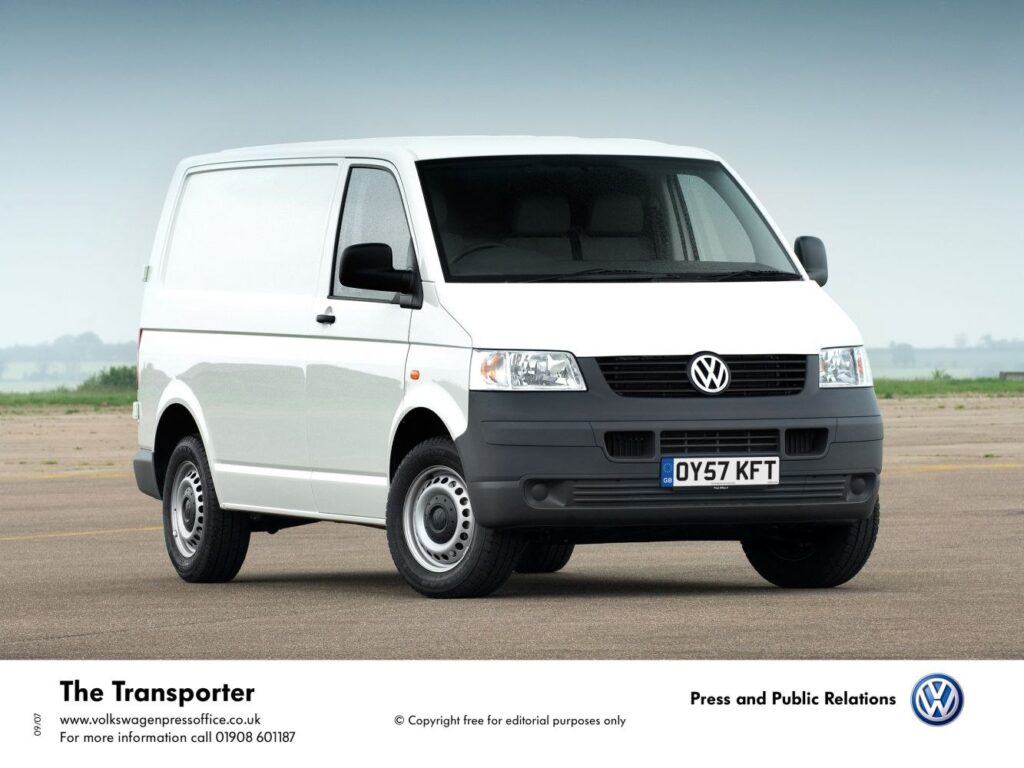
The Volkswagen Transporter (T5) Panel Van 1.9 TDI (86 Hp) L2H2 is an iconic light commercial vehicle synonymous with robust utility and versatile design. Introduced in 2003 as the fifth generation of the Transporter lineage, this specific model stood out as a particularly practical and efficient variant, engineered to meet the demanding needs of businesses and trades across Europe. Produced from 2003 to 2009, it embodied Volkswagen’s commitment to durability, low running costs, and functional design in the light commercial vehicle (LCV) segment. While the Transporter family has a storied history and a cult following worldwide, the T5 Panel Van, especially with its diesel powertrain and specific L2H2 (long wheelbase, high roof) dimensions, was primarily a cornerstone of the European market, offering a compelling package of cargo capacity and operational economy that was not officially available in the United States.
Volkswagen Transporter (T5) Panel Van: A European Workhorse
As a direct successor to the highly successful T4, the T5 built upon a legacy of front-engine, front-wheel-drive vans, moving away from the rear-engine layout of its earliest ancestors. The 1.9 TDI engine variant, though modest in horsepower, was strategically chosen for its exceptional fuel efficiency and prodigious low-end torque, making it an ideal choice for urban deliveries and hauling heavy loads. This article delves into the technical prowess, design philosophy, and market impact of this specific iteration of the T5, contextualizing its significance within the European automotive landscape.
Engine & Performance
At the heart of the Volkswagen Transporter (T5) Panel Van 1.9 TDI (86 Hp) L2H2 was Volkswagen’s venerable 1.9-liter (1896 cm3 or 115.7 cu. in.) TDI inline-four engine, designated with the code EA188 / AXC. This powerplant was a testament to the era’s focus on diesel technology for commercial applications, prioritizing torque and fuel economy over outright speed. It delivered a respectable 86 horsepower at 3500 rpm, which, while not groundbreaking, was perfectly adequate for the van’s intended purpose of hauling goods and navigating diverse European road conditions.
More crucial than its horsepower was the engine’s torque output: 200 Nm (147.51 lb.-ft.) available across a broad and usable rev range of 1600-2400 rpm. This characteristic low-end torque, facilitated by a turbocharger and intercooler, was essential for moving heavy loads from a standstill and maintaining momentum without constantly downshifting. The power was efficiently transmitted to the front wheels via a robust 5-speed manual transmission, a common and reliable setup for commercial vehicles of the time.
The 1.9 TDI engine utilized a pump-nozzle (unit injector) fuel injection system, a sophisticated technology for its time that allowed for precise fuel delivery and improved combustion efficiency. With a compression ratio of 18:1 and a SOHC valvetrain featuring two valves per cylinder, the engine was engineered for reliability and longevity, critical factors for commercial operators. Fuel economy was a strong suit, with an extra-urban consumption figure of 6.3 liters per 100 km, translating to an impressive 37.3 US mpg. This efficiency was a significant cost-saver for businesses relying on the van for daily operations.
Performance figures reflected its utilitarian nature rather than outright sportiness. The Volkswagen Transporter (T5) Panel Van 1.9 TDI (86 Hp) L2H2 could accelerate from 0 to 60 mph in a leisurely 22.9 seconds, with a maximum speed of 88.23 mph (142 km/h). These numbers underscore its design as a work tool, where consistent, dependable performance and economical operation were paramount. The engine met the Euro 3 emission standard, aligning with the environmental regulations of its early production years in Europe.
Design & Features
The design of the T5 Transporter, specifically the Panel Van variant, was driven by functionality and practicality. The L2H2 designation is key to understanding this particular model’s utility: ‘L2’ denotes the long wheelbase, measuring 133.86 inches (3400 mm), providing enhanced stability and a significantly larger cargo area. ‘H2’ refers to the high roof, which allowed for increased vertical cargo space, making it suitable for transporting taller items or for tradespeople who required ample standing room when working inside the van. With an overall length of 208.27 inches (5290 mm) and a height of 85.04 inches (2160 mm), this was a substantial vehicle designed to maximize load-carrying capability.
The body type was a classic panel van, featuring 4-5 doors, typically including a sliding side door for easy access to the cargo area and rear barn doors. The interior was configured for 2-3 occupants, with durable materials chosen to withstand the rigors of commercial use. The primary focus was on the cargo bay, which offered a cavernous maximum volume of 7800 liters (275.45 cu. ft.). This immense space, combined with a maximum payload capacity ranging from 2065.73 to 2072.35 lbs (937-940 kg), made the L2H2 variant an incredibly versatile platform for various commercial applications, from parcel delivery to mobile workshops.
Underneath its practical exterior, the T5 featured an advanced chassis for a commercial vehicle. It utilized an independent McPherson strut front suspension with coil springs and an anti-roll bar, paired with an independent coil spring rear suspension featuring a transverse stabilizer and trailing arms. This sophisticated setup, uncommon for many heavy-duty vans of its time, contributed to better ride comfort and more car-like handling, reducing driver fatigue on long routes. Braking was handled by ventilated discs both front (308×29.5 mm) and rear (294×22 mm), ensuring reliable stopping power, complemented by an Anti-lock Braking System (ABS) for enhanced safety.
The steering system was a hydraulic rack and pinion setup, providing direct feedback and ease of maneuverability, especially important in urban environments despite the vehicle’s considerable size. Standard tire sizes were 205/65 R16 or 215/65 R16 on 6.5J x 16 wheel rims, designed for durability and load carrying. The T5 also offered a generous ground clearance of 6.5 inches (165 mm) and a respectable wading depth of 11.81 inches (300 mm), hinting at its capability beyond paved roads, though primarily remaining a road-going vehicle. Its robust construction and thoughtful design made it a highly adaptable and dependable partner for businesses across Europe.
Technical Specifications
| Category | Specification |
| General Information | |
| Brand | Volkswagen |
| Model | Transporter |
| Generation | Transporter (T5) Panel Van |
| Type (Engine) | 1.9 TDI (86 Hp) L2H2 |
| Production Start | 2003 year |
| Production End | 2009 year |
| Powertrain Architecture | Internal Combustion engine |
| Body type | Van |
| Seats | 2-3 |
| Doors | 4-5 |
| Performance Specifications | |
| Fuel consumption (extra urban) | 6.3 l/100 km |
| Fuel Type | Diesel |
| Acceleration 0 – 60 mph | 22.9 sec |
| Maximum speed | 142 km/h |
| Emission standard | Euro 3 |
| Engine Specifications | |
| Power | 86 Hp @ 3500 rpm |
| Torque | 200 Nm @ 1600-2400 rpm |
| Engine displacement | 1896 cm3 |
| Number of cylinders | 4 |
| Compression ratio | 18:1 |
| Space, Volume and Weights | |
| Max load (Payload) | 937-940 kg |
| Trunk (boot) space – maximum | 7800 l |
| Dimensions | |
| Length | 5290 mm |
| Height | 2160 mm |
| Wheelbase | 3400 mm |
Legacy and Market Impact
The Volkswagen Transporter T5 generation, and particularly its Panel Van configurations like the Volkswagen Transporter (T5) Panel Van 1.9 TDI (86 Hp) L2H2, continued the venerable lineage of Volkswagen’s highly successful light commercial vehicles. In Europe, the Transporter is more than just a van; it’s an institution, a symbol of reliability and versatility that has served countless businesses, tradespeople, and adventurers since the original Type 2 “Bus.” The T5, specifically this 1.9 TDI variant, solidified its reputation as a dependable workhorse, often seen performing duties ranging from local deliveries and construction site support to long-haul logistics.
Its primary market was undeniably Europe, where diesel engines were, and largely remain, the preferred choice for commercial vehicles due to their superior fuel economy and torque characteristics. Competitors in this fiercely contested segment included the Ford Transit, Mercedes-Benz Vito, Renault Trafic, and Fiat Ducato. The T5, however, often distinguished itself with its superior build quality, more refined driving dynamics (thanks to its independent suspension setup), and strong brand image, which translated into excellent resale values.
The 1.9 TDI (86 Hp) L2H2 model’s impact stemmed from its perfect balance of practicality and economy. The combination of its long wheelbase and high roof provided a massive cargo volume, making it exceptionally well-suited for a wide range of commercial tasks. Its enduring popularity and widespread use across Europe cemented its place as a vital component of the continent’s commercial transportation infrastructure.