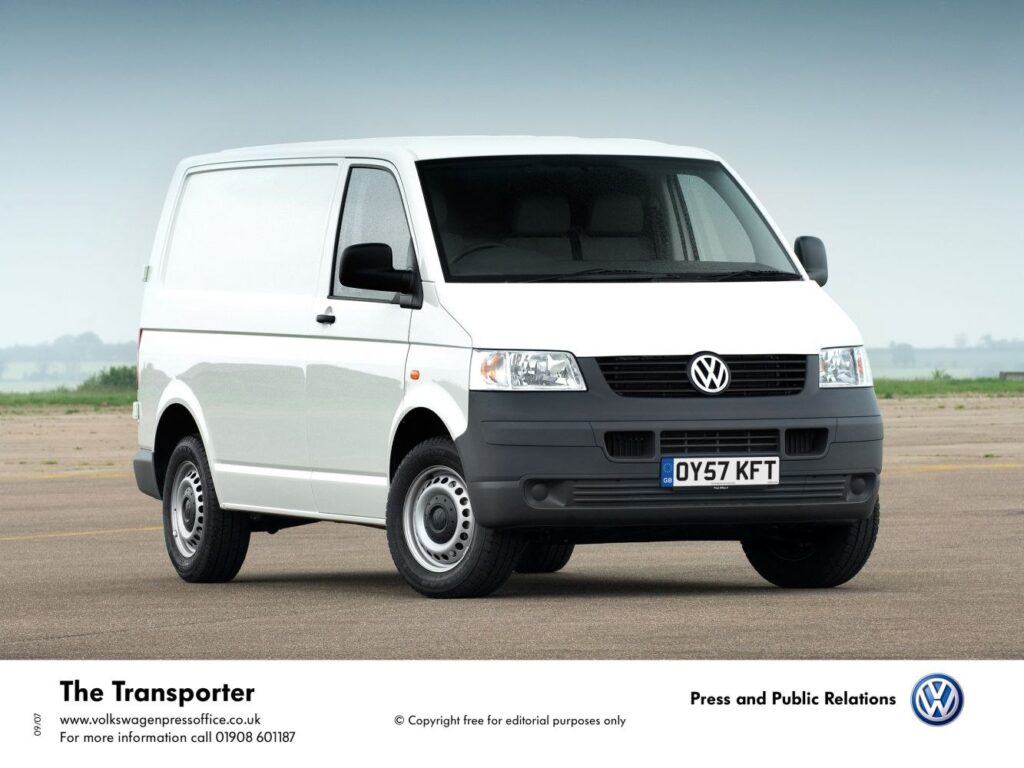
The Volkswagen Transporter (T5) Panel Van 2.5 TDI (130 Hp) Tiptronic L2H1 represents the fifth generation of Volkswagen’s highly successful and globally recognized Transporter series. Produced between 2003 and 2006 in this specific configuration, the T5 generation continued the Transporter’s legacy as a versatile and robust light commercial vehicle (LCV), primarily dominating the European market. While not officially sold in the United States, the Transporter has been an indispensable part of businesses and fleets across Europe, Asia, and other international markets for decades. This particular variant, the L2H1, signifies a long wheelbase (L2) and a standard roof height (H1) panel van, optimized for significant cargo capacity while maintaining a manageable exterior profile, making it an ideal choice for urban deliveries and trades alike. Its 2.5-liter TDI engine, coupled with a Tiptronic automatic transmission, offered a blend of power, efficiency, and driving convenience crucial for commercial applications.
Engineering and Performance of the Volkswagen Transporter (T5) Panel Van
Powertrain: The Robust 2.5 TDI and Tiptronic Transmission
At the heart of the Volkswagen Transporter (T5) Panel Van is its formidable 2.5-liter, five-cylinder TDI (Turbocharged Direct Injection) engine, designated by the code EA153 / AXD. This powerplant, renowned for its durability and strong low-end torque, delivered a robust 130 horsepower at 3500 rpm. More critically for a commercial vehicle, it produced an impressive 250.77 lb.-ft. of torque across a broad and usable range of 2000-2300 rpm. This torque profile ensured excellent pulling power, essential for hauling heavy loads or navigating challenging terrain, a common requirement for panel vans.
The engine’s architecture featured an inline five-cylinder configuration with a single overhead camshaft (SOHC) and two valves per cylinder, utilizing a pump-nozzle (unit injector) fuel injection system for precise fuel delivery. A turbocharger with an intercooler further enhanced performance and efficiency by compressing and cooling the intake air. With a compression ratio of 18.5:1, the engine was designed for optimal diesel combustion efficiency, contributing to its Euro 3 emission standard compliance. Its front, transverse layout, combined with front-wheel drive, provided good traction and maximized interior space.
Power was transferred to the front wheels via a sophisticated 6-speed Tiptronic automatic transmission. This automatic gearbox offered the convenience of clutch-free driving, a significant advantage in stop-and-go urban traffic, reducing driver fatigue over long shifts. The Tiptronic function also allowed for manual gear selection, providing drivers with greater control, particularly when towing or descending steep grades. This combination of a potent diesel engine and a smooth automatic transmission enabled the Transporter to achieve a top speed of 101.9 mph (164 km/h) and accelerate from 0 to 60 mph in a respectable 14.6 seconds, or 0 to 62 mph (0-100 km/h) in 15.4 seconds, which was competitive for a vehicle of its size and purpose during its production years.
Fuel efficiency was a key consideration for commercial operators. The 2.5 TDI engine, with its advanced diesel technology, achieved an extra-urban fuel economy of approximately 36.2 US mpg (6.5 l/100 km), demonstrating its capability for economical long-distance hauling. An 80-liter (21.13 US gallon) fuel tank provided a substantial range between refueling stops, enhancing operational efficiency.
Design and Features: The L2H1 Panel Van Configuration
The Volkswagen Transporter (T5) Panel Van was engineered from the ground up to be a highly functional and durable commercial vehicle. The L2H1 designation indicates a specific body configuration: “L2” for a long wheelbase of 133.86 inches (3400 mm), and “H1” for a standard roof height of 77.13 inches (1959 mm). This combination struck an excellent balance between interior volume and exterior maneuverability.
As a panel van, its primary purpose was cargo transport, and it excelled in this regard. The maximum trunk (cargo) space was an impressive 236.61 cubic feet (6700 liters), providing ample room for a wide variety of goods, tools, or equipment. With 4-5 doors, typically including sliding side doors and rear barn doors or a tailgate, loading and unloading were made convenient and efficient. The interior was designed for practical use, offering 2-3 seats in the cabin, suitable for a driver and one or two crew members.
The exterior dimensions of 208.27 inches (5290 mm) in length and 74.96 inches (1904 mm) in width (88.27 inches or 2242 mm including mirrors) gave the L2H1 a significant road presence without being overly cumbersome. Its ground clearance of 6.5 inches (165 mm) allowed it to handle various road conditions, while a minimum turning diameter of 43.31 feet (13.2 m) ensured reasonable maneuverability in tighter urban environments or loading docks. The robust body structure was designed to handle substantial loads, with a maximum payload capacity ranging from 1973.14 to 2387.61 lbs. (895-1083 kg), depending on the specific configuration and gross vehicle weight rating.
Safety features for the era included standard ABS (Anti-lock Braking System) and a capable braking system comprising ventilated discs on both the front (308×29.5 mm) and rear (294×22 mm) wheels, providing strong stopping power even under load. The suspension system, featuring independent McPherson struts with coil springs and an anti-roll bar up front, and an independent coil spring setup with a transverse stabilizer and trailing arm at the rear, was tuned to offer a balance of ride comfort and load stability. Hydraulic power steering, along with 215/65 R16 tires on 6.5J x 16 wheels, contributed to a stable and predictable driving experience.
Volkswagen Transporter (T5) Panel Van Technical Specifications
| Category | Specification |
| General Information | |
| Brand | Volkswagen |
| Model | Transporter |
| Generation | Transporter (T5) Panel Van |
| Type (Engine) | 2.5 TDI (130 Hp) Tiptronic L2H1 |
| Start of production | 2003 year |
| End of production | 2006 year |
| Powertrain Architecture | Internal Combustion engine |
| Body type | Van |
| Seats | 2-3 |
| Doors | 4-5 |
| Performance Specs | |
| Fuel consumption (economy) – extra urban | 6.5 l/100 km |
| Fuel Type | Diesel |
| Acceleration 0 – 100 km/h | 15.4 sec |
| Acceleration 0 – 62 mph | 15.4 sec |
| Acceleration 0 – 60 mph (Calculated) | 14.6 sec |
| Maximum speed | 164 km/h |
| Emission standard | Euro 3 |
| Engine Specs | |
| Power | 130 Hp @ 3500 rpm. |
| Power per liter | 52.8 Hp/l |
| Torque | 340 Nm @ 2000-2300 rpm. |
| Engine layout | Front, Transverse |
| Engine Model/Code | EA153 / AXD |
| Engine displacement | 2460 cm3 |
| Number of cylinders | 5 |
| Cylinder Bore | 81 mm |
| Piston Stroke | 95.5 mm |
| Compression ratio | 18.5:1 |
| Number of valves per cylinder | 2 |
| Fuel injection system | Pump-nozzle (Unit Injector) |
| Engine aspiration | Turbocharger, Intercooler |
| Space, Volume and Weights | |
| Curb Weight | 1905-2117 kg |
| Max. weight (GVWR) | 2800-3200 kg |
| Max load (Payload) | 895-1083 kg |
| Trunk (cargo) space – maximum | 6700 l |
| Fuel tank capacity | 80 l |
| Dimensions | |
| Length | 5290 mm |
| Width | 1904 mm |
| Wheelbase | 3400 mm |
Legacy and Market Impact of the Volkswagen Transporter (T5) Panel Van
The Volkswagen Transporter T5, and specifically the Volkswagen Transporter (T5) Panel Van 2.5 TDI (130 Hp) Tiptronic L2H1 variant, carved out a significant niche in the highly competitive European light commercial vehicle market during its production run from 2003 to 2006. Building on the formidable reputation of its predecessors (T1, T2, T3, T4), the T5 continued to be a benchmark for versatility, reliability, and robust engineering.
In its primary markets, the T5 Transporter was not merely a means of transport but a mobile office and workshop for countless tradespeople, delivery services, and small businesses. Its reputation for durability meant that many units accumulated hundreds of thousands of miles, proving their worth as long-term investments. The 2.5 TDI engine, in particular, was lauded for its strong torque, which was crucial for hauling heavy loads without compromising performance or fuel economy, a critical factor for commercial operators looking to minimize running costs.
Competitors in the European LCV segment included strong contenders like the Mercedes-Benz Vito, Ford Transit, Renault Trafic, and Opel Vivaro. Against these rivals, the Transporter T5 distinguished itself with its more car-like driving dynamics, superior build quality, and a premium feel that was often associated with Volkswagen passenger vehicles. This made it a popular choice for businesses that valued driver comfort and a professional image, alongside raw utility.
The L2H1 configuration, offering a long wheelbase and standard roof, was particularly popular for its balance of spacious cargo volume and practical dimensions that allowed for easier navigation in urban environments compared to taller or longer variants. The Tiptronic automatic transmission further enhanced its appeal, especially in congested city driving, where manual gear changes could become tiresome over a full workday.
Historically, the Transporter series has achieved iconic status, evolving from the original “Bus” or “Microbus” into a sophisticated and adaptable commercial platform. The T5 generation, with its more modern design, improved ergonomics, and advanced diesel powertrains, played a crucial role in cementing this legacy in the 21st century. Even after its production ceased, the T5 maintained strong residual values, a testament to its enduring quality and desirability in the used vehicle market. Its impact is still felt today, as many T5s continue to serve faithfully across Europe, underscoring its design and engineering excellence as a true workhorse of the automotive world.