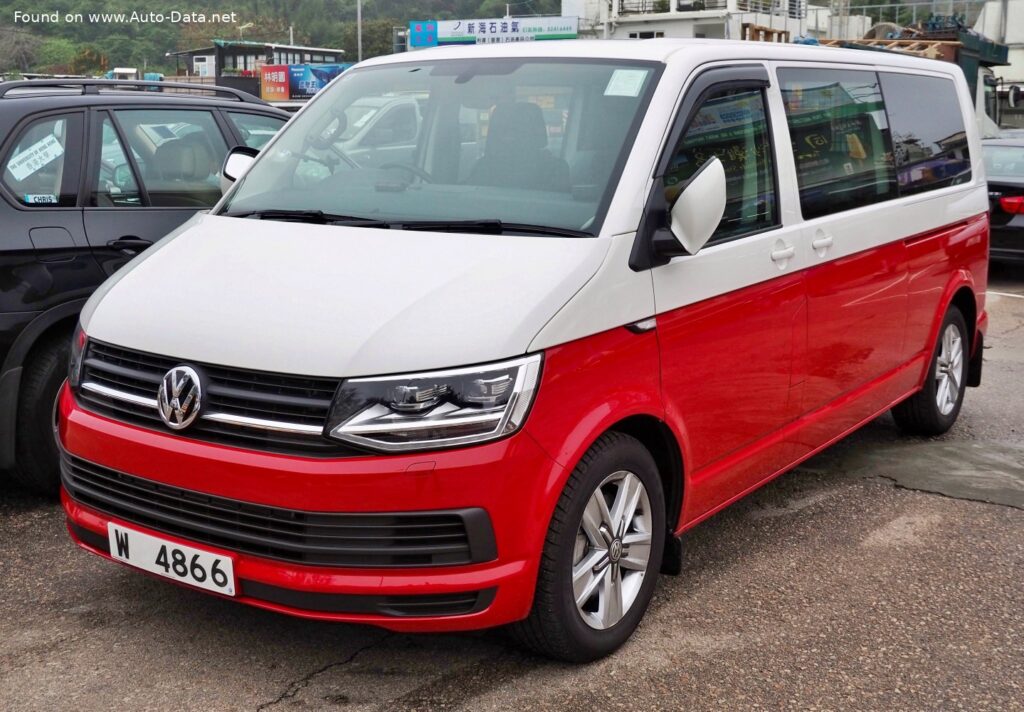
The Volkswagen Transporter, known as the T6 generation from 2015 to 2018, represents a significant evolution in Volkswagen’s long-running commercial vehicle line. Specifically, the Kombi variant, equipped with the 2.0 TDI engine producing 204 horsepower and featuring 4MOTION all-wheel drive and a DSG dual-clutch transmission, was a popular choice in European markets. While not widely sold in the United States due to the preference for larger vans and pickup trucks, the T6 Transporter Kombi served as a versatile platform for both commercial and passenger applications, bridging the gap between a cargo van and a multi-passenger vehicle. The “L1H1” designation refers to the vehicle’s body length and roof height, indicating a standard wheelbase and a lower roof configuration.
Volkswagen Transporter (T6) Kombi 2.0 TDI: An Overview
The T6 Transporter Kombi built upon the success of its predecessors, offering improved fuel efficiency, enhanced safety features, and a more refined driving experience. The Kombi trim level specifically catered to users needing a flexible interior layout, capable of carrying both passengers and cargo. The 2.0 TDI engine, a mainstay of Volkswagen’s diesel lineup, provided a balance of power and economy, while the 4MOTION system ensured all-weather capability. The DSG transmission offered smooth and rapid gear changes, contributing to both performance and efficiency.
Engine & Performance
At the heart of the T6 Kombi 2.0 TDI is a 1968 cc (120.09 cu. in.) inline four-cylinder diesel engine, designated EA288 / CXEB. This engine utilizes a bi-turbocharger setup with an intercooler, delivering 204 horsepower at 4000 rpm and a substantial 450 Nm (331.9 lb.-ft.) of torque between 1400 and 2400 rpm. This broad torque curve provides strong pulling power and responsive acceleration. The engine features a diesel commonrail fuel injection system and a double overhead camshaft (DOHC) valvetrain with four valves per cylinder. The engine’s power-to-weight ratio is 9.6 kg/Hp, and its torque-to-weight ratio is 4.4 kg/Nm. Performance figures include a 0-100 km/h (0-62 mph) acceleration time of 9.6 seconds and a maximum speed of 199 km/h (123.65 mph). The inclusion of a Start & Stop system and a particulate filter demonstrates Volkswagen’s commitment to reducing emissions, meeting Euro 6 standards with CO2 emissions ranging from 167 to 197 g/km. Fuel economy, measured using the NEDC cycle, ranges from 6.4 to 7.5 l/100 km (36.8 – 31.4 US mpg, 44.1 – 37.7 UK mpg).
Design & Features
The T6 Transporter Kombi is a front-engine, front-wheel-drive (with 4MOTION all-wheel drive in this configuration) van, available with 4 or 5 doors and seating for 4 to 9 passengers. Its body style is characterized by a practical and functional design, prioritizing interior space and usability. The L1H1 configuration indicates a standard wheelbase and a lower roof height, making it relatively easy to maneuver in urban environments. The interior is designed for versatility, with configurable seating arrangements and ample cargo space, up to 5800 liters (204.83 cu. ft.) with the rear seats folded. Key features include a robust chassis, independent suspension on both front and rear axles (McPherson strut front, wishbone rear), and ventilated disc brakes on all wheels. The 4MOTION all-wheel-drive system provides enhanced traction and stability in challenging conditions. The vehicle’s dimensions are 4904 mm (193.07 in.) in length, 1904 mm (74.96 in.) in width, and 1990 mm (78.35 in.) in height. Ground clearance is a respectable 201 mm (7.91 in.), and the minimum turning circle is 11.9 meters (39.04 ft.).
Technical Specifications
| Brand | Volkswagen |
| Model | Transporter |
| Generation | Transporter (T6) Kombi |
| Type | 2.0 TDI (204 Hp) 4MOTION DSG L1H1 |
| Start of production | 2015 |
| End of production | 2018 |
| Powertrain Architecture | Internal Combustion engine |
| Body type | Van |
| Seats | 4-9 |
| Doors | 4-5 |
| Fuel consumption (urban) | 7.3-9 l/100 km (32.2 – 26.1 US mpg) |
| Fuel consumption (extra urban) | 5.9-6.7 l/100 km (39.9 – 35.1 US mpg) |
| Fuel consumption (combined) | 6.4-7.5 l/100 km (36.8 – 31.4 US mpg) |
| CO2 emissions | 167-197 g/km |
| Fuel Type | Diesel |
| Acceleration 0-100 km/h | 9.6 sec |
| Acceleration 0-62 mph | 9.6 sec |
| Acceleration 0-60 mph | 9.1 sec |
| Maximum speed | 199 km/h (123.65 mph) |
| Emission standard | Euro 6 |
| Weight-to-power ratio | 9.6 kg/Hp |
| Weight-to-torque ratio | 4.4 kg/Nm |
| Power | 204 Hp @ 4000 rpm |
| Torque | 450 Nm @ 1400-2400 rpm (331.9 lb.-ft.) |
| Engine layout | Front, Transverse |
| Engine Model/Code | EA288 / CXEB |
| Engine displacement | 1968 cm3 (120.09 cu. in.) |
| Number of cylinders | 4 |
| Engine configuration | Inline |
| Cylinder Bore | 81 mm (3.19 in.) |
| Piston Stroke | 95.5 mm (3.76 in.) |
| Compression ratio | 15.5:1 |
| Number of valves per cylinder | 4 |
| Fuel injection system | Diesel Commonrail |
| Engine aspiration | BiTurbo, Intercooler |
| Valvetrain | DOHC |
| Engine oil capacity | 7.4 l (7.82 US qt | 6.51 UK qt) |
| Kerb Weight | 1968-2274 kg (4338.7 – 5013.31 lbs.) |
| Max. weight | 2800-3200 kg (6172.94 – 7054.79 lbs.) |
| Max load | 832-926 kg (1834.25 – 2041.48 lbs.) |
| Trunk (boot) space – maximum | 5800 l (204.83 cu. ft.) |
| Fuel tank capacity | 70 l (18.49 US gal | 15.4 UK gal) |
| AdBlue tank | 13 l (3.43 US gal | 2.86 UK gal) |
| Max. roof load | 100 kg (220.46 lbs.) |
| Permitted trailer load with brakes (12%) | 2500 kg (5511.56 lbs.) |
| Permitted trailer load without brakes | 750 kg (1653.47 lbs.) |
| Permitted towbar download | 100 kg (220.46 lbs.) |
| Length | 4904 mm (193.07 in.) |
| Width | 1904 mm (74.96 in.) |
| Width including mirrors | 2297 mm (90.43 in.) |
| Height | 1990 mm (78.35 in.) |
| Wheelbase | 3000 mm (118.11 in.) |
| Drivetrain Architecture | All wheel drive (4×4). Internal Combustion engine. |
| Number of gears and type of gearbox | 7 gears, automatic transmission DSG |
The Volkswagen Transporter T6 Kombi 2.0 TDI 4MOTION DSG L1H1, while not a common sight on American roads, represents a well-engineered and versatile vehicle that served a significant role in the European commercial vehicle market. Its combination of power, efficiency, practicality, and all-weather capability made it a popular choice for businesses and families alike.