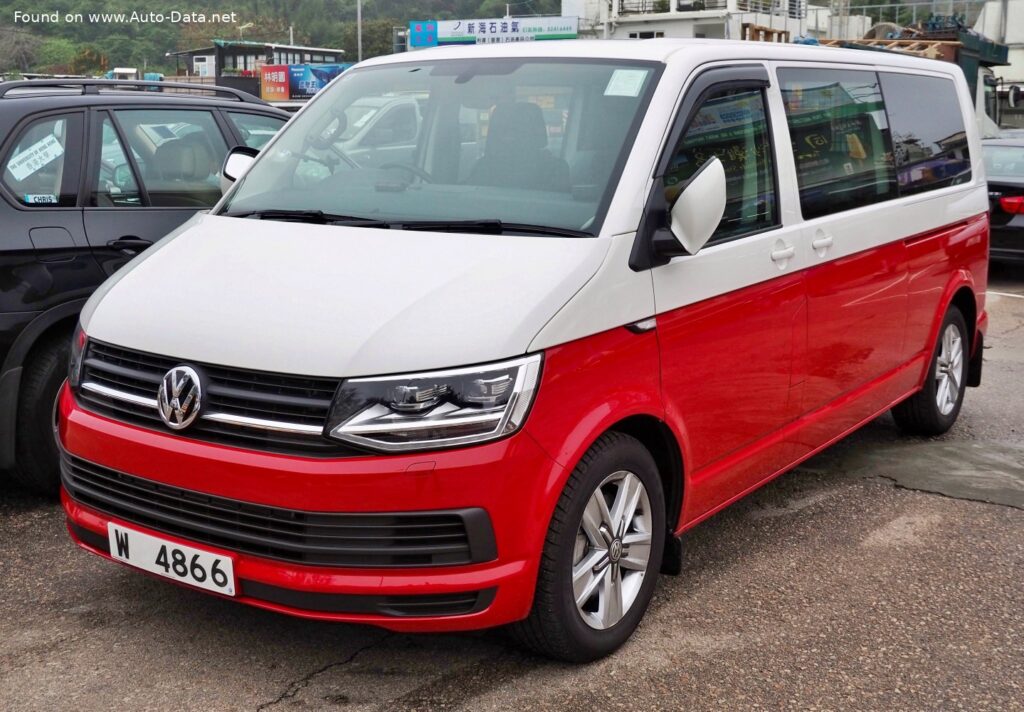
The Volkswagen Transporter (T6) Kombi 2.0 TDI, produced from 2015 to 2018, represents the sixth generation of Volkswagen’s iconic commercial vehicle. The T6, and specifically the Kombi variant, served as a versatile platform for both commercial and passenger applications, particularly popular in Europe where it filled a crucial niche for small businesses, families, and tradespeople. This model, equipped with a 2.0-liter turbocharged diesel engine producing 204 horsepower, combined practicality with relatively modern performance and efficiency for its class. The “L2H3” designation refers to the vehicle’s body length and height configuration, indicating a longer wheelbase and higher roof for increased cargo and passenger space. While not officially sold in the United States during this generation, the Transporter has a long and storied history, and earlier generations were imported and enjoyed by enthusiasts.
Volkswagen Transporter (T6) Kombi 2.0 TDI: An Overview
The T6 generation of the Transporter marked a significant evolution in terms of technology, safety, and refinement compared to its predecessors. It built upon the legacy of the original Type 2 (often referred to as the “Bus” or “Kombi” in the US), which became synonymous with counterculture and freedom in the 1960s and 70s. The T6 Kombi specifically targeted users needing a flexible vehicle capable of carrying both passengers and cargo, offering configurations ranging from multi-passenger shuttles to more utilitarian van setups. The 2.0 TDI engine, coupled with the DSG (Direct-Shift Gearbox) automatic transmission, aimed to deliver a balance of power, fuel economy, and driving comfort.
Engine & Performance
The heart of the Transporter T6 Kombi 2.0 TDI is a 1968 cc (120.09 cu. in.) inline four-cylinder diesel engine, identified by the EA288 / CXEB engine code. This engine utilizes a bi-turbocharger system with an intercooler, allowing it to produce 204 horsepower at 4000 rpm and a substantial 450 Nm (331.9 lb.-ft.) of torque between 1400 and 2400 rpm. This broad torque curve provides strong pulling power and responsive acceleration, making it well-suited for carrying loads or navigating varied terrain. The engine features a diesel commonrail fuel injection system and a compression ratio of 15.5:1. Paired with the 7-speed DSG automatic transmission, the Kombi achieves a 0-100 km/h (0-62 mph) acceleration time of 9.5 seconds and a maximum speed of 189 km/h (117.44 mph). Fuel economy, measured using the NEDC standard, ranges from 6.1 to 7.3 l/100 km (38.6 – 32.2 US mpg, 46.3 – 38.7 UK mpg), depending on driving conditions. The vehicle also incorporates a Start & Stop system and a particulate filter to reduce emissions, meeting Euro 6 emission standards.
Design & Features
The Volkswagen Transporter T6 Kombi is a front-engine, front-wheel-drive van with a body-on-frame construction. The L2H3 configuration signifies a long wheelbase (3400 mm / 133.86 in.) and a high roof (2477 mm / 97.52 in.), maximizing interior space. The van typically accommodates 4 to 9 passengers, depending on the seating arrangement. It features 4 or 5 doors for easy access. Key design elements include a functional and robust exterior, with a focus on practicality and durability. The interior is designed for versatility, with modular seating and a large cargo area. Safety features, typical for a modern European van, include ABS (Anti-lock Braking System). The Kombi’s design prioritizes functionality and adaptability, making it suitable for a wide range of applications, from family transport to commercial use. The vehicle’s dimensions are 5304 mm (208.82 in.) in length, 1904 mm (74.96 in.) in width, and 2477 mm (97.52 in.) in height.
Technical Specifications
| Brand | Volkswagen |
| Model | Transporter |
| Generation | Transporter (T6) Kombi |
| Type (Engine) | 2.0 TDI (204 Hp) DSG L2H3 |
| Start of production | 2015 |
| End of production | 2018 |
| Powertrain Architecture | Internal Combustion engine |
| Body type | Van |
| Seats | 4-9 |
| Doors | 4-5 |
| Fuel consumption (economy) – urban (NEDC) | 7.1-8.6 l/100 km (33.1 – 27.4 US mpg, 39.8 – 32.8 UK mpg, 14.1 – 11.6 km/l) |
| Fuel consumption (economy) – extra urban (NEDC) | 5.5-6.6 l/100 km (42.8 – 35.6 US mpg, 51.4 – 42.8 UK mpg, 18.2 – 15.2 km/l) |
| Fuel consumption (economy) – combined (NEDC) | 6.1-7.3 l/100 km (38.6 – 32.2 US mpg, 46.3 – 38.7 UK mpg, 16.4 – 13.7 km/l) |
| CO2 emissions (NEDC) | 159-191 g/km |
| Fuel Type | Diesel |
| Acceleration 0 – 100 km/h | 9.5 sec |
| Acceleration 0 – 62 mph | 9.5 sec |
| Acceleration 0 – 60 mph | 9 sec |
| Maximum speed | 189 km/h (117.44 mph) |
| Emission standard | Euro 6 |
| Weight-to-power ratio | 9.4 kg/Hp, 105.9 Hp/tonne |
| Weight-to-torque ratio | 4.3 kg/Nm, 233.5 Nm/tonne |
| Power | 204 Hp @ 4000 rpm |
| Power per litre | 103.7 Hp/l |
| Torque | 450 Nm @ 1400-2400 rpm (331.9 lb.-ft. @ 1400-2400 rpm) |
| Engine layout | Front, Transverse |
| Engine Model/Code | EA288 / CXEB |
| Engine displacement | 1968 cm3 (120.09 cu. in.) |
| Number of cylinders | 4 |
| Engine configuration | Inline |
| Cylinder Bore | 81 mm (3.19 in.) |
| Piston Stroke | 95.5 mm (3.76 in.) |
| Compression ratio | 15.5:1 |
| Number of valves per cylinder | 4 |
| Fuel injection system | Diesel Commonrail |
| Engine aspiration | BiTurbo, Intercooler |
| Valvetrain | DOHC |
| Engine oil capacity | 7.4 l (7.82 US qt | 6.51 UK qt) |
| Kerb Weight | 1927-2274 kg (4248.31 – 5013.31 lbs.) |
| Max. weight | 2800-3200 kg (6172.94 – 7054.79 lbs.) |
| Max load | 873-926 kg (1924.64 – 2041.48 lbs.) |
| Trunk (boot) space – maximum | 9300 l (328.43 cu. ft.) |
| Fuel tank capacity | 70 l (18.49 US gal | 15.4 UK gal) |
| AdBlue tank | 13 l (3.43 US gal | 2.86 UK gal) |
| Max. roof load | 100 kg (220.46 lbs.) |
| Permitted trailer load with brakes (12%) | 2500 kg (5511.56 lbs.) |
| Permitted trailer load without brakes | 750 kg (1653.47 lbs.) |
| Permitted towbar download | 100 kg (220.46 lbs.) |
| Length | 5304 mm (208.82 in.) |
| Width | 1904 mm (74.96 in.) |
| Width including mirrors | 2297 mm (90.43 in.) |
| Height | 2477 mm (97.52 in.) |
| Wheelbase | 3400 mm (133.86 in.) |
| Front overhang | 908 mm (35.75 in.) |
| Rear overhang | 993 mm (39.09 in.) |
| Ride height (ground clearance) | 202 mm (7.95 in.) |
| Minimum turning circle (turning diameter) | 13.2 m (43.31 ft.) |
| Drivetrain Architecture | The Internal combustion engine (ICE) drives the front wheels of the vehicle. |
| Drive wheel | Front wheel drive |
| Number of gears and type of gearbox | 7 gears, automatic transmission DSG |