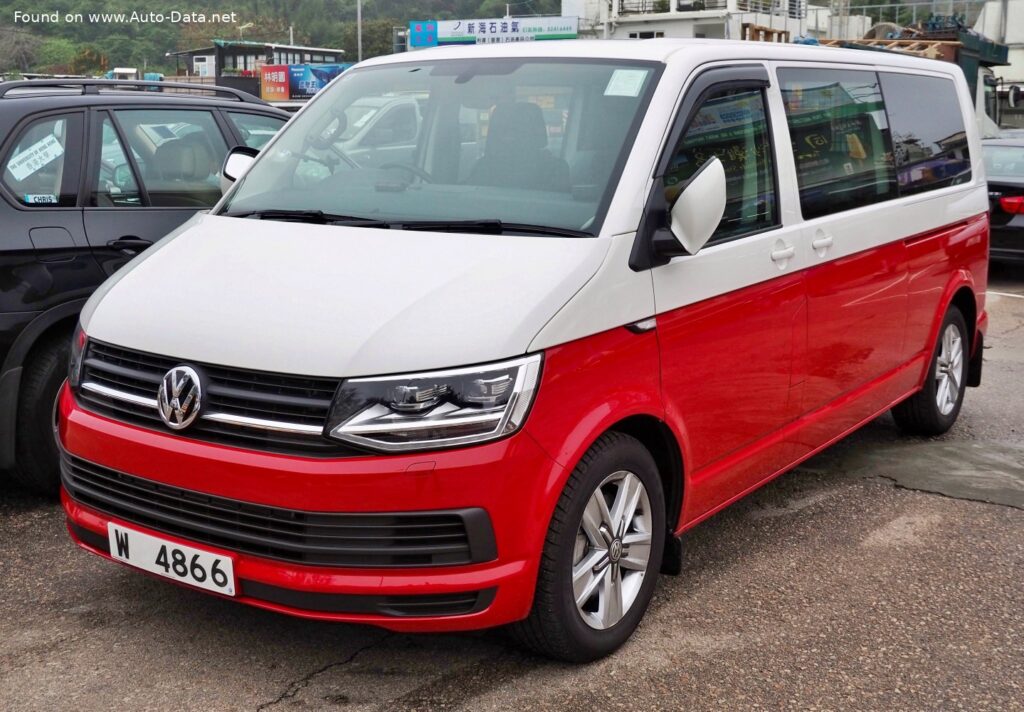
The Volkswagen Transporter, known as the T6 generation from 2015 to 2018, represents a significant evolution in Volkswagen’s long-running commercial vehicle lineage. The T6 Kombi 2.0 TSI, specifically, was a popular configuration offering a balance of practicality, performance, and modern features. Primarily sold in Europe and other international markets, the Transporter served as a versatile vehicle for both commercial and family use, functioning as a van, shuttle, or even a recreational vehicle base. This article details the T6 Kombi 2.0 TSI (204 Hp) DSG L1H1, focusing on its technical specifications and characteristics.
Volkswagen Transporter (T6) Kombi 2.0 TSI: An Overview
The T6 Transporter built upon the success of its predecessors, offering improved fuel efficiency, enhanced safety features, and a more refined driving experience. The “Kombi” designation indicates a passenger-oriented configuration, typically seating between four and nine occupants. The “2.0 TSI” denotes the engine – a turbocharged gasoline direct injection engine producing 204 horsepower. “DSG” signifies the dual-clutch gearbox, and “L1H1” refers to the body configuration: L1 representing the short wheelbase and H1 indicating the standard roof height. The T6 aimed to modernize the Transporter while retaining its core strengths of durability and adaptability.
Engine & Performance
The heart of the T6 Kombi 2.0 TSI is the EA888 2.0-liter inline-four cylinder gasoline engine, specifically the CJKA engine code variant. This engine delivers 204 horsepower at 4,200-6,000 rpm and 350 Nm (258.15 lb.-ft.) of torque between 1,500 and 4,000 rpm. The engine utilizes direct fuel injection and a turbocharger with an intercooler to optimize performance and efficiency. Power is transmitted to the front wheels via a seven-speed dual-clutch transmission (DSG), providing quick and smooth gear changes. This powertrain combination allows for a 0-100 km/h (0-62 mph) acceleration time of 8.7 seconds, and a 0-60 mph time of approximately 8.3 seconds. The maximum speed is electronically limited to 202 km/h (125.52 mph). Fuel economy, measured using the NEDC standard, ranges from 8.9 to 9.1 liters per 100 kilometers (26.4 to 25.8 US mpg) in combined driving, with CO2 emissions between 203 and 210 g/km. The engine also incorporates a Start & Stop system to further improve fuel efficiency.
Design & Features
The T6 Transporter Kombi features a functional and modern design. As a van, its primary focus is practicality and cargo space. The L1H1 configuration offers a substantial 5800 liters (204.83 cu. ft.) of maximum cargo volume with the rear seats folded or removed. The vehicle’s dimensions are 4904 mm (193.07 in.) in length, 1904 mm (74.96 in.) in width, and 1990 mm (78.35 in.) in height. The wheelbase measures 3000 mm (118.11 in.). The T6 incorporated several safety features, including ABS (Anti-lock Braking System) and a robust chassis designed for both passenger comfort and load-carrying capacity. The interior is designed for durability and ease of cleaning, reflecting its commercial vehicle roots. Features like air conditioning, power windows, and a modern infotainment system were often included, depending on the trim level. The T6 also offered a range of customization options, allowing buyers to tailor the vehicle to their specific needs.
Technical Specifications
| Brand | Volkswagen |
| Model | Transporter |
| Generation | Transporter (T6) Kombi |
| Type (Engine) | 2.0 TSI (204 Hp) DSG L1H1 |
| Start of production | 2015 |
| End of production | 2018 |
| Powertrain Architecture | Internal Combustion engine |
| Body type | Van |
| Seats | 4-9 |
| Doors | 4-5 |
| Fuel consumption (economy) – urban (NEDC) | 11.4-11.7 l/100 km (20.6 – 20.1 US mpg) |
| Fuel consumption (economy) – extra urban (NEDC) | 7.4-7.7 l/100 km (31.8 – 30.5 US mpg) |
| Fuel consumption (economy) – combined (NEDC) | 8.9-9.1 l/100 km (26.4 – 25.8 US mpg) |
| CO2 emissions (NEDC) | 203-210 g/km |
| Fuel Type | Petrol (Gasoline) |
| Acceleration 0 – 100 km/h | 8.7 sec |
| Acceleration 0 – 62 mph | 8.7 sec |
| Acceleration 0 – 60 mph | 8.3 sec |
| Maximum speed | 202 km/h (125.52 mph) |
| Emission standard | Euro 6 |
| Weight-to-power ratio | 9 kg/Hp, 111.3 Hp/tonne |
| Weight-to-torque ratio | 5.2 kg/Nm, 190.9 Nm/tonne |
| Power | 204 Hp @ 4200-6000 rpm |
| Power per litre | 102.8 Hp/l |
| Torque | 350 Nm @ 1500-4000 rpm (258.15 lb.-ft. @ 1500-4000 rpm) |
| Engine layout | Front, Transverse |
| Engine Model/Code | EA888 / CJKA |
| Engine displacement | 1984 cm3 (121.07 cu. in.) |
| Number of cylinders | 4 |
| Engine configuration | Inline |
| Cylinder Bore | 82.5 mm (3.25 in.) |
| Piston Stroke | 92.8 mm (3.65 in.) |
| Compression ratio | 9.6:1 |
| Number of valves per cylinder | 4 |
| Fuel injection system | Direct injection |
| Engine aspiration | Turbocharger, Intercooler |
| Valvetrain | DOHC |
| Engine oil capacity | 5.7 l (6.02 US qt | 5.02 UK qt) |
| Kerb Weight | 1833-2199 kg (4041.07 – 4847.97 lbs.) |
| Max. weight | 2800-3200 kg (6172.94 – 7054.79 lbs.) |
| Max load | 967-1001 kg (2131.87 – 2206.83 lbs.) |
| Trunk (boot) space – maximum | 5800 l (204.83 cu. ft.) |
| Fuel tank capacity | 80 l (21.13 US gal | 17.6 UK gal) |
| Max. roof load | 100 kg (220.46 lbs.) |
| Permitted trailer load with brakes (12%) | 2500 kg (5511.56 lbs.) |
| Permitted trailer load without brakes | 750 kg (1653.47 lbs.) |
| Permitted towbar download | 100 kg (220.46 lbs.) |
| Length | 4904 mm (193.07 in.) |
| Width | 1904 mm (74.96 in.) |
| Width including mirrors | 2297 mm (90.43 in.) |
| Height | 1990 mm (78.35 in.) |
| Wheelbase | 3000 mm (118.11 in.) |
| Front overhang | 908 mm (35.75 in.) |
| Rear overhang | 993 mm (39.09 in.) |
| Ride height (ground clearance) | 201 mm (7.91 in.) |
| Minimum turning circle (turning diameter) | 11.9 m (39.04 ft.) |
| Drivetrain Architecture | Front wheel drive |
| Number of gears and type of gearbox | 7 gears, automatic transmission DSG |
| Front suspension | Independent, type McPherson with coil spring and anti-roll bar |
| Rear suspension | Independent coil spring, Wishbone, Transverse stabilizer |
| Front brakes | Ventilated discs, 340×32.5 mm |
| Rear brakes | Ventilated discs, 294×22 mm |
| Tires size | 215/60 R17; 215/65 R17; 235/55 R17; 255/45 R18 |
| Wheel rims size | 7J x 17; 8J x 18 |
The Volkswagen Transporter T6 Kombi 2.0 TSI represented a compelling option in the commercial and passenger vehicle segments, offering a blend of practicality, performance, and modern technology. Its versatility and robust construction ensured its continued popularity in various applications.