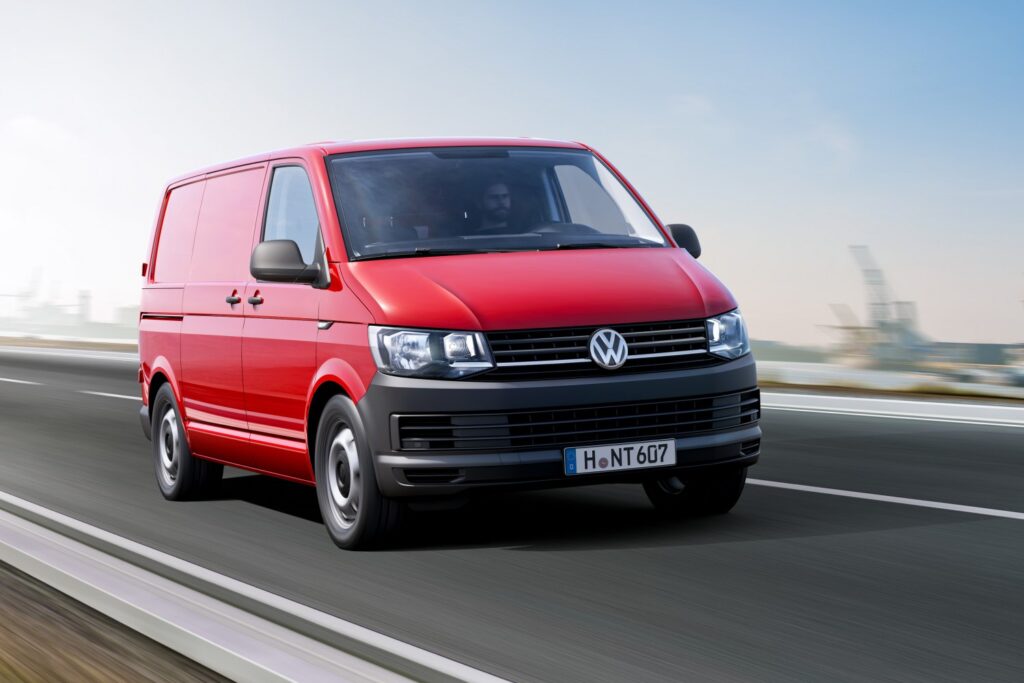
The Volkswagen Transporter, specifically the T6 Panel Van 2.0 TDI (102 Hp) L2H3, represents a significant iteration in Volkswagen’s long-running commercial vehicle lineage. Produced from 2015 to 2016, this variant caters primarily to the European market as a versatile and practical van for businesses and tradespeople. While not widely sold in the United States, the Transporter is globally recognized for its reliability, functionality, and adaptability. The T6 generation brought advancements in technology, safety, and efficiency compared to its predecessors, solidifying its position as a leading light commercial vehicle.
Volkswagen Transporter (T6) Panel Van: An Overview
The T6 Transporter builds upon the legacy of the original Volkswagen Type 2, often referred to as the “Bus” or “Kombi.” Each successive generation (T1 through T6) has refined the formula, adapting to changing market demands and technological advancements. The T6, introduced in 2015, continued this trend, offering a modern and capable van suitable for a wide range of applications. The “L2H3” designation indicates a long wheelbase and high roof, maximizing cargo space and usability. This particular 2.0 TDI model, with its 102 horsepower engine, was a common choice for those prioritizing fuel economy and practicality over outright performance.
Engine & Performance
The heart of the T6 Panel Van 2.0 TDI L2H3 is a 2.0-liter, four-cylinder turbocharged diesel engine, identified by the engine code EA189 / CAAB. This engine produces 102 horsepower at 3000-3750 rpm and 250 Nm (184.39 lb.-ft.) of torque between 1500-2500 rpm. The engine’s inline configuration and common rail direct fuel injection contribute to its efficiency and relatively smooth operation. Power is delivered to the front wheels via a five-speed manual transmission. Acceleration from 0 to 100 km/h (0-62 mph) takes 15.5 seconds, and 0 to 60 mph is achieved in approximately 14.7 seconds. The van has a maximum speed of 145 km/h (90.1 mph). Fuel economy, measured using the NEDC standard, ranges from 6.7 to 7.4 liters per 100 kilometers (35.1 to 31.8 US mpg), with CO2 emissions between 176 and 195 g/km. The engine also incorporates a particulate filter and a Start & Stop system to further reduce emissions.
Design & Features
The T6 Transporter Panel Van is characterized by its functional and utilitarian design. The L2H3 configuration provides a substantial cargo volume of 9300 liters (328.43 cu. ft.), making it ideal for transporting goods. The van typically accommodates 2-3 occupants and features 4-5 doors for easy access. Its dimensions are as follows: length 5304 mm (208.82 in), width 1904 mm (74.96 in), and height 2477 mm (97.52 in). The wheelbase measures 3400 mm (133.86 in). The T6 incorporates independent suspension on both the front (McPherson strut) and rear (Wishbone) axles, providing a reasonable level of ride comfort despite its commercial vehicle focus. Safety features include ABS (Anti-lock Braking System) and ventilated disc brakes on all four wheels (308×29.5 mm front, 294×22 mm rear). The hydraulic power steering provides responsive handling, and the van’s turning circle is 13.2 meters (43.31 ft).
Technical Specifications
| Brand | Volkswagen |
| Model | Transporter |
| Generation | Transporter (T6) Panel Van |
| Type (Engine) | 2.0 TDI (102 Hp) L2H3 |
| Start of production | 2015 |
| End of production | 2016 |
| Powertrain Architecture | Internal Combustion engine |
| Body type | Van |
| Seats | 2-3 |
| Doors | 4-5 |
| Fuel consumption (economy) – urban (NEDC) | 8.3-8.7 l/100 km (28.3 – 27 US mpg, 34 – 32.5 UK mpg, 12 – 11.5 km/l) |
| Fuel consumption (economy) – extra urban (NEDC) | 5.8-6.7 l/100 km (40.6 – 35.1 US mpg, 48.7 – 42.2 UK mpg, 17.2 – 14.9 km/l) |
| Fuel consumption (economy) – combined (NEDC) | 6.7-7.4 l/100 km (35.1 – 31.8 US mpg, 42.2 – 38.2 UK mpg, 14.9 – 13.5 km/l) |
| CO2 emissions (NEDC) | 176-195 g/km |
| Fuel Type | Diesel |
| Acceleration 0 – 100 km/h | 15.5 sec |
| Acceleration 0 – 62 mph | 15.5 sec |
| Acceleration 0 – 60 mph | 14.7 sec |
| Maximum speed | 145 km/h (90.1 mph) |
| Emission standard | Euro 5 |
| Weight-to-power ratio | 17 kg/Hp, 58.7 Hp/tonne |
| Weight-to-torque ratio | 6.9 kg/Nm, 143.9 Nm/tonne |
| Power | 102 Hp @ 3000-3750 rpm |
| Power per litre | 51.8 Hp/l |
| Torque | 250 Nm @ 1500-2500 rpm (184.39 lb.-ft. @ 1500-2500 rpm) |
| Engine layout | Front, Transverse |
| Engine Model/Code | EA189 / CAAB |
| Engine displacement | 1968 cm3 (120.09 cu. in.) |
| Number of cylinders | 4 |
| Engine configuration | Inline |
| Cylinder Bore | 81 mm (3.19 in.) |
| Piston Stroke | 95.5 mm (3.76 in.) |
| Compression ratio | 16.5:1 |
| Number of valves per cylinder | 4 |
| Fuel injection system | Diesel Commonrail |
| Engine aspiration | Turbocharger, Intercooler |
| Valvetrain | DOHC |
| Engine oil capacity | 7 l (7.4 US qt | 6.16 UK qt) |
| Kerb Weight | 1737-2054 kg (3829.43 – 4528.29 lbs.) |
| Max. weight | 2800-3200 kg (6172.94 – 7054.79 lbs.) |
| Max load | 1063-1146 kg (2343.51 – 2526.5 lbs.) |
| Trunk (boot) space – maximum | 9300 l (328.43 cu. ft.) |
| Fuel tank capacity | 80 l (21.13 US gal | 17.6 UK gal) |
| Permitted trailer load with brakes (12%) | 2200 kg (4850.17 lbs.) |
| Permitted trailer load without brakes | 750 kg (1653.47 lbs.) |
| Permitted towbar download | 100 kg (220.46 lbs.) |
| Length | 5304 mm (208.82 in.) |
| Width | 1904 mm (74.96 in.) |
| Width including mirrors | 2297 mm (90.43 in.) |
| Height | 2477 mm (97.52 in.) |
| Wheelbase | 3400 mm (133.86 in.) |
| Front overhang | 908 mm (35.75 in.) |
| Rear overhang | 993 mm (39.09 in.) |
| Ride height (ground clearance) | 202 mm (7.95 in.) |
| Minimum turning circle (turning diameter) | 13.2 m (43.31 ft.) |
| Drivetrain Architecture | The Internal combustion engine (ICE) drives the front wheels of the vehicle. |
| Drive wheel | Front wheel drive |
| Number of gears and type of gearbox | 5 gears, manual transmission |
| Front suspension | Independent, type McPherson with coil spring and anti-roll bar |
| Rear suspension | Independent coil spring, Wishbone, Transverse stabilizer |
| Front brakes | Ventilated discs, 308×29.5 mm |
| Rear brakes | Ventilated discs, 294×22 mm |
| Assisting systems | ABS (Anti-lock braking system) |
| Steering type | Steering rack and pinion |
| Power steering | Hydraulic Steering |
| Tires size | 215/65 R16 |
| Wheel rims size | 6.5J x 16 |