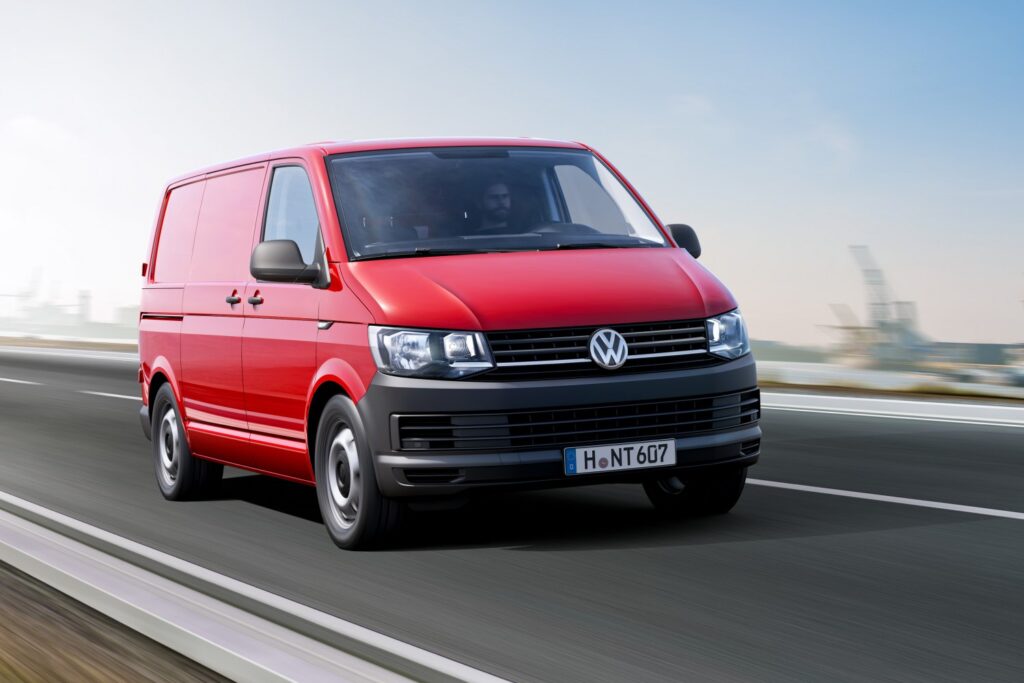
The Volkswagen Transporter, known as the T6 generation from 2015 to 2016, represents a significant evolution in Volkswagen’s long-running commercial vehicle line. This iteration of the Transporter, specifically the Panel Van configuration with the 2.0 TDI 140 horsepower engine and L2H3 body length/height combination, was primarily aimed at the European market as a versatile workhorse for businesses and tradespeople. While not widely sold in the United States due to the popularity of American-style vans, the T6 Transporter offered a compelling blend of practicality, efficiency, and modern technology for its intended audience. It continues the legacy of the original Type 2, often referred to as the “Bus” or “Kombi,” which became iconic for its role in counterculture movements and its robust, utilitarian design.
Volkswagen Transporter (T6) Panel Van 2.0 TDI (140 Hp) L2H3
The T6 Transporter Panel Van, in its 2.0 TDI (140 Hp) L2H3 guise, is a commercial vehicle designed for cargo transport and specialized applications. The “L2H3” designation refers to the vehicle’s body dimensions: L2 indicates a long wheelbase, providing a larger cargo area, while H3 signifies a high roof, maximizing interior space. This particular model was a mainstay in European fleets, valued for its reliability, fuel efficiency, and adaptability to various commercial needs. It served as a base for campervan conversions, mobile workshops, and general delivery services.
Engine & Performance
Powering the T6 Transporter 2.0 TDI L2H3 is a 2.0-liter four-cylinder diesel engine, designated the EA189 / CAAC. This engine produces 140 horsepower at 3500 rpm and 340 Nm (250.77 lb.-ft.) of torque between 1750 and 2500 rpm. The engine features a turbocharger with intercooling and a diesel common rail fuel injection system, contributing to its efficiency and responsiveness. The engine’s power-to-weight ratio is 12.6 kg/Hp, and its torque-to-weight ratio is 5.2 kg/Nm. Acceleration from 0 to 100 km/h (0-62 mph) takes 12.7 seconds, while 0-60 mph is achieved in approximately 12.1 seconds. The vehicle has a maximum speed of 161 km/h (100.04 mph). Fuel economy, measured using the NEDC standard, ranges from 6.9 to 7.6 liters per 100 kilometers (34.1 to 30.9 US mpg), with CO2 emissions between 182 and 199 g/km. The engine meets Euro 5 emission standards and incorporates a particulate filter and a Start & Stop system to further reduce environmental impact.
Design & Features
The T6 Transporter Panel Van is a traditional van body style, featuring a four or five-door configuration and seating for two to three occupants. Its design prioritizes functionality and cargo capacity. The L2H3 body provides a substantial 9300 liters (328.43 cu. ft.) of maximum cargo space. The vehicle’s dimensions are: length 5304 mm (208.82 in.), width 1904 mm (74.96 in.), height 2477 mm (97.52 in.), and wheelbase 3400 mm (133.86 in.). The front suspension utilizes an independent McPherson strut setup with coil springs and an anti-roll bar, while the rear suspension employs an independent coil spring and wishbone arrangement with a transverse stabilizer. Braking is handled by ventilated discs on all four wheels, assisted by an Anti-lock Braking System (ABS). The T6 incorporated hydraulic power steering for ease of maneuverability. Standard features included a steering rack and pinion system and 215/65 R16 tires mounted on 6.5J x 16 wheels. The vehicle’s approach, departure, and ramp-over angles are 21.2°, 16.2°, and 12.2° respectively, providing reasonable off-road capability for commercial applications.
Technical Specifications
| Brand | Volkswagen |
| Model | Transporter |
| Generation | Transporter (T6) Panel Van |
| Type (Engine) | 2.0 TDI (140 Hp) L2H3 |
| Start of production | 2015 |
| End of production | 2016 |
| Powertrain Architecture | Internal Combustion engine |
| Body type | Van |
| Seats | 2-3 |
| Doors | 4-5 |
| Fuel consumption (economy) – urban (NEDC) | 8.8-9.3 l/100 km (26.7 – 25.3 US mpg) |
| Fuel consumption (economy) – extra urban (NEDC) | 5.8-6.7 l/100 km (40.6 – 35.1 US mpg) |
| Fuel consumption (economy) – combined (NEDC) | 6.9-7.6 l/100 km (34.1 – 30.9 US mpg) |
| CO2 emissions (NEDC) | 182-199 g/km |
| Fuel Type | Diesel |
| Acceleration 0 – 100 km/h | 12.7 sec |
| Acceleration 0 – 62 mph | 12.7 sec |
| Acceleration 0 – 60 mph | 12.1 sec |
| Maximum speed | 161 km/h (100.04 mph) |
| Emission standard | Euro 5 |
| Weight-to-power ratio | 12.6 kg/Hp |
| Weight-to-torque ratio | 5.2 kg/Nm |
| Power | 140 Hp @ 3500 rpm |
| Torque | 340 Nm @ 1750-2500 rpm (250.77 lb.-ft. @ 1750-2500 rpm) |
| Engine layout | Front, Transverse |
| Engine Model/Code | EA189 / CAAC |
| Engine displacement | 1968 cm3 (120.09 cu. in.) |
| Number of cylinders | 4 |
| Engine configuration | Inline |
| Cylinder Bore | 81 mm (3.19 in.) |
| Piston Stroke | 95.5 mm (3.76 in.) |
| Compression ratio | 16.5:1 |
| Number of valves per cylinder | 4 |
| Fuel injection system | Diesel Commonrail |
| Engine aspiration | Turbocharger, Intercooler |
| Valvetrain | DOHC |
| Engine oil capacity | 7 l (7.4 US qt | 6.16 UK qt) |
| Kerb Weight | 1767-2084 kg (3895.57 – 4594.43 lbs.) |
| Max. weight | 2800-3200 kg (6172.94 – 7054.79 lbs.) |
| Max load | 1033-1116 kg (2277.38 – 2460.36 lbs.) |
| Trunk (boot) space – maximum | 9300 l (328.43 cu. ft.) |
| Fuel tank capacity | 80 l (21.13 US gal | 17.6 UK gal) |
| Permitted trailer load with brakes (12%) | 2500 kg (5511.56 lbs.) |
| Permitted trailer load without brakes | 750 kg (1653.47 lbs.) |
| Permitted towbar download | 100 kg (220.46 lbs.) |
| Length | 5304 mm (208.82 in.) |
| Width | 1904 mm (74.96 in.) |
| Width including mirrors | 2297 mm (90.43 in.) |
| Height | 2477 mm (97.52 in.) |
| Wheelbase | 3400 mm (133.86 in.) |
| Front overhang | 908 mm (35.75 in.) |
| Rear overhang | 993 mm (39.09 in.) |
| Ride height (ground clearance) | 202 mm (7.95 in.) |
| Minimum turning circle (turning diameter) | 13.2 m (43.31 ft.) |
| Drive wheel | Front wheel drive |
| Number of gears and type of gearbox | 6 gears, manual transmission |
The Volkswagen Transporter T6, particularly the 2.0 TDI 140 Hp L2H3 variant, represents a practical and efficient solution for commercial transport needs in Europe. Its robust construction, ample cargo space, and fuel-efficient engine made it a popular choice for businesses requiring a reliable and versatile van.