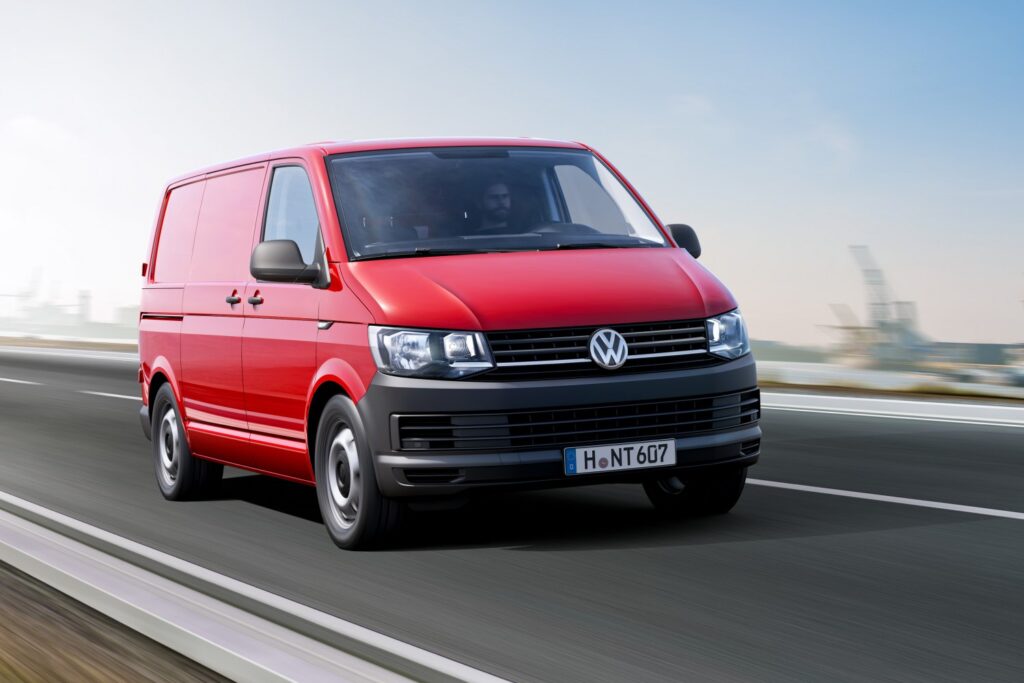
The Volkswagen Transporter, a name synonymous with versatility and robust utility across generations, reached a new pinnacle of refinement and capability with the T6 generation. Specifically, the Volkswagen Transporter (T6) Panel Van 2.0 TDI (180 Hp) L2H3, produced between 2015 and 2016, represents a crucial evolution in the light commercial vehicle segment. While not officially sold in the United States, the Transporter series, known globally as the “Bulli” or “Microbus” in its passenger variants, has an iconic lineage dating back to the 1950s, establishing Volkswagen’s enduring presence in both passenger and commercial vehicle markets worldwide, particularly in Europe and other international markets. The T6 generation, building upon the highly successful T5 platform, introduced enhanced efficiency, improved driving dynamics, and a more contemporary design, all while retaining the legendary practicality that commercial users demand. This particular L2H3 configuration signifies a long-wheelbase and high-roof variant, engineered to maximize cargo capacity and adaptability for a wide array of professional applications, from logistics and delivery services to mobile workshops and specialized transport. It exemplifies Volkswagen’s commitment to delivering purpose-built vehicles that blend advanced engineering with everyday usability, making it a cornerstone of many businesses. The T6 Panel Van with its potent 2.0 TDI engine was designed to offer a compelling balance of power, economy, and load-carrying ability, ensuring it remained a top contender in its competitive class.
Engine & Performance of the Volkswagen Transporter (T6) Panel Van
At the heart of the Volkswagen Transporter (T6) Panel Van 2.0 TDI (180 Hp) L2H3 is a meticulously engineered 2.0-liter (1968 cm3 or 120.09 cu. in.) inline-four turbodiesel engine, specifically designated with the EA189 / CFCA code. This powertrain is a testament to Volkswagen’s expertise in diesel technology, featuring a sophisticated BiTurbo setup combined with an intercooler to optimize air intake and combustion efficiency. The result is a robust output of 180 horsepower, achieved at a flexible 4000 rpm, which is a substantial figure for a commercial van of this class. More critically for a workhorse vehicle, the engine delivers an impressive 295.02 lb.-ft. (400 Nm) of torque, available across a broad and usable rev range from 1500 to 2500 rpm. This wide torque band ensures strong pulling power from low engine speeds, crucial for hauling heavy loads or navigating urban stop-and-go traffic without constant gear changes.
Power is efficiently transmitted to the front wheels via a precise 6-speed manual transmission, offering the driver direct control and contributing to the vehicle’s overall fuel economy. This front-wheel-drive architecture, combined with a transverse engine layout, optimizes interior space for cargo while maintaining predictable handling characteristics. Performance figures for the 2.0 TDI (180 Hp) L2H3 are noteworthy for a commercial van; it can accelerate from 0 to 60 mph in a brisk 9.8 seconds (0-100 km/h in 10.3 seconds) and reach a maximum speed of 109.36 mph (176 km/h). These capabilities allow the Transporter to keep pace with highway traffic and execute overtakes confidently, even when fully loaded.
Despite its performance, the T6 Panel Van maintains a strong focus on fuel efficiency, a critical factor for commercial operators. According to NEDC testing, the combined fuel consumption is rated between 30.9 and 33.6 US mpg (7-7.6 l/100 km). Urban driving yields 26.4 to 27.4 US mpg (8.6-8.9 l/100 km), while extra-urban cycles can achieve an even more impressive 34.1 to 38.6 US mpg (6.1-6.9 l/100 km). This efficiency is aided by modern engine systems, including a Start & Stop System, which automatically shuts off the engine when the vehicle is stationary, and a Particulate filter to reduce emissions. The vehicle complies with Euro 5 emission standards, reflecting its commitment to environmental responsibility during its production years.
Design & Features: The Versatility of the Volkswagen Transporter (T6) Panel Van
The Volkswagen Transporter (T6) Panel Van 2.0 TDI (180 Hp) L2H3 is first and foremost a purpose-built commercial vehicle, and its design reflects an unwavering focus on functionality, durability, and cargo capacity. The “Panel Van” designation indicates a fully enclosed cargo area, ideal for secure transport of goods, tools, and equipment. The “L2H3” specification is particularly significant, denoting a long wheelbase (L2) and a high roof (H3). With an overall length of 208.82 inches (5304 mm), a width of 74.96 inches (1904 mm, or 90.43 inches including mirrors), and a substantial height of 97.52 inches (2477 mm), this configuration offers an expansive and highly adaptable interior.
The extended wheelbase of 133.86 inches (3400 mm) contributes not only to a vast cargo volume but also to enhanced stability, particularly important when carrying heavy loads or traversing varied road conditions. The defining feature, however, is the maximum trunk (boot) space, which reaches an impressive 328.43 cubic feet (9300 liters). This cavernous cargo area is easily accessible through the multiple doors typically found on a panel van (4-5 doors), allowing for flexible loading and unloading operations. The robust construction allows for a maximum payload capacity ranging from 2198.01 to 2380.99 lbs. (997-1080 kg), accommodating a wide range of goods and equipment. Furthermore, the Transporter is engineered for serious towing, with a permitted trailer load of 5511.56 lbs. (2500 kg) with brakes and 1653.47 lbs. (750 kg) without brakes, making it a truly versatile partner for businesses requiring additional towing capability. A maximum roof load of 220.46 lbs. (100 kg) further extends its utility.
Inside, the cabin is designed for practicality and driver comfort, typically seating 2-3 occupants. While primarily a work vehicle, Volkswagen ensures ergonomic controls and durable materials suitable for daily commercial use. The driving experience is enhanced by a hydraulic power steering system, employing a rack and pinion setup for precise control. The suspension system is geared towards handling varying loads and road surfaces, featuring independent McPherson struts with coil springs and an anti-roll bar at the front, complemented by an independent coil spring, wishbone, and transverse stabilizer setup at the rear. This configuration provides a balance of ride comfort and load stability. Stopping power is assured by ventilated disc brakes (308×29.5 mm front, 294×22 mm rear), augmented by an Anti-lock Braking System (ABS) for enhanced safety under demanding conditions. The vehicle’s dimensions, including a ride height of 7.95 inches (202 mm) and approach/departure angles (21.2° and 16.2° respectively), suggest a capability to handle light off-road or uneven terrain often encountered on job sites.
Technical Specifications
| Brand | Volkswagen |
| Model | Transporter |
| Generation | Transporter (T6) Panel Van |
| Type (Engine) | 2.0 TDI (180 Hp) L2H3 |
| Start of production | 2015 year |
| End of production | 2016 year |
| Powertrain Architecture | Internal Combustion engine |
| Body type | Van |
| Seats | 2-3 |
| Doors | 4-5 |
| Fuel consumption (economy) – urban (NEDC) | 8.6-8.9 l/100 km (27.4 – 26.4 US mpg) |
| Fuel consumption (economy) – extra urban (NEDC) | 6.1-6.9 l/100 km (38.6 – 34.1 US mpg) |
| Fuel consumption (economy) – combined (NEDC) | 7-7.6 l/100 km (33.6 – 30.9 US mpg) |
| CO2 emissions (NEDC) | 184-199 g/km |
| Fuel Type | Diesel |
| Acceleration 0 – 100 km/h | 10.3 sec |
| Acceleration 0 – 62 mph | 10.3 sec |
| Acceleration 0 – 60 mph (Calculated) | 9.8 sec |
| Maximum speed | 176 km/h (109.36 mph) |
| Emission standard | Euro 5 |
| Weight-to-power ratio | 10 kg/Hp (99.8 Hp/tonne) |
| Weight-to-torque ratio | 4.5 kg/Nm (221.9 Nm/tonne) |
| Power | 180 Hp @ 4000 rpm |
| Power per litre | 91.5 Hp/l |
| Torque | 400 Nm @ 1500-2500 rpm (295.02 lb.-ft. @ 1500-2500 rpm) |
| Engine layout | Front, Transverse |
| Engine Model/Code | EA189 / CFCA |
| Engine displacement | 1968 cm3 (120.09 cu. in.) |
| Number of cylinders | 4 |
| Engine configuration | Inline |
| Cylinder Bore | 81 mm (3.19 in.) |
| Piston Stroke | 95.5 mm (3.76 in.) |
| Compression ratio | 16.5:1 |
| Number of valves per cylinder | 4 |
| Fuel injection system | Diesel Commonrail |
| Engine aspiration | BiTurbo, Intercooler |
| Valvetrain | DOHC |
| Engine oil capacity | 7 l (7.4 US qt | 6.16 UK qt) |
| Engine oil specification | Log in to see. |
| Engine systems | Start & Stop System, Particulate filter |
| Kerb Weight | 1803-2120 kg (3974.93 – 4673.8 lbs.) |
| Max. weight | 2800-3200 kg (6172.94 – 7054.79 lbs.) |
| Max load | 997-1080 kg (2198.01 – 2380.99 lbs.) |
| Trunk (boot) space – maximum | 9300 l (328.43 cu. ft.) |
| Fuel tank capacity | 80 l (21.13 US gal | 17.6 UK gal) |
| Max. roof load | 100 kg (220.46 lbs.) |
| Permitted trailer load with brakes (12%) | 2500 kg (5511.56 lbs.) |
| Permitted trailer load without brakes | 750 kg (1653.47 lbs.) |
| Permitted towbar download | 100 kg (220.46 lbs.) |
| Length | 5304 mm (208.82 in.) |
| Width | 1904 mm (74.96 in.) |
| Width including mirrors | 2297 mm (90.43 in.) |
| Height | 2477 mm (97.52 in.) |
| Wheelbase | 3400 mm (133.86 in.) |
| Front overhang | 908 mm (35.75 in.) |
| Rear overhang | 993 mm (39.09 in.) |
| Ride height (ground clearance) | 202 mm (7.95 in.) |
| Minimum turning circle (turning diameter) | 13.2 m (43.31 ft.) |
| Approach angle | 21.2° |
| Departure angle | 16.2° |
| Ramp-over (brakeover) angle | 12.2° |
| Drivetrain Architecture | The Internal combustion engine (ICE) drives the front wheels of the vehicle. |
| Drive wheel | Front wheel drive |
| Number of gears and type of gearbox | 6 gears, manual transmission |
| Front suspension | Independent, type McPherson with coil spring and anti-roll bar |
| Rear suspension | Independent coil spring, Wishbone, Transverse stabilizer |
| Front brakes | Ventilated discs, 308×29.5 mm |
| Rear brakes | Ventilated discs, 294×22 mm |
| Assisting systems | ABS (Anti-lock braking system) |
| Steering type | Steering rack and pinion |
| Power steering | Hydraulic Steering |
| Tires size | 215/65 R16; 235/55 R17 |
| Wheel rims size | 6.5J x 16; 7J x 17 |