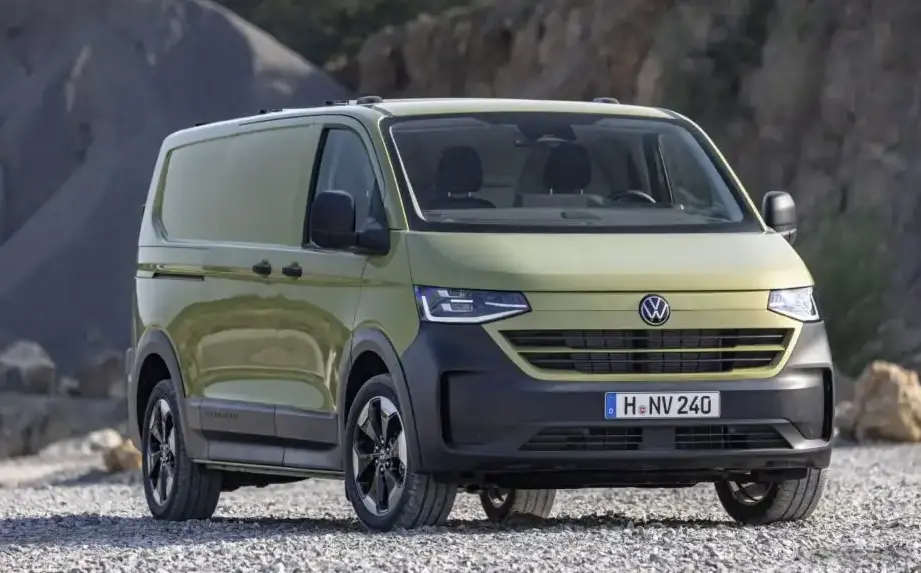
The Volkswagen Transporter (T7) Panel Van 2.0 TDI, specifically the 150 horsepower variant in the L1H1 configuration, represents the latest iteration of Volkswagen’s iconic commercial vehicle. Introduced in August 2024, the T7 builds upon the foundation laid by its predecessors, offering a blend of practicality, technology, and efficiency for businesses and tradespeople. The L1H1 designation indicates a short wheelbase and a standard roof height, making it a versatile option for urban environments and diverse cargo needs. This particular diesel variant occupies a central position within the T7 lineup, offering a balance between performance, fuel economy, and cost, appealing to a broad range of commercial customers.
Technical Specifications
| Brand | Volkswagen |
| Model | Transporter |
| Generation | Transporter (T7) Panel Van |
| Type (Engine) | 2.0 TDI (150 Hp) L1H1 |
| Start of production | August, 2024 |
| Powertrain Architecture | Internal Combustion engine |
| Body type | Van |
| Seats | 2-3 |
| Doors | 4-5 |
| Combined fuel consumption (WLTP) | 7.1 l/100 km |
| Combined fuel consumption (US mpg) | 33.1 US mpg |
| Combined fuel consumption (UK mpg) | 39.8 UK mpg |
| Combined fuel consumption (km/l) | 14.1 km/l |
| CO2 emissions (WLTP) | 185 g/km |
| Fuel Type | Diesel |
| Acceleration 0 – 100 km/h | 13.4 sec |
| Acceleration 0 – 62 mph | 13.4 sec |
| Acceleration 0 – 60 mph | 12.7 sec |
| Maximum speed | 175 km/h (108.74 mph) |
| Emission standard | Euro 6e |
| Weight-to-power ratio | 12 kg/Hp, 83.5 Hp/tonne |
| Weight-to-torque ratio | 5 kg/Nm, 200.3 Nm/tonne |
| Power | 150 Hp |
| Power per litre | 75.2 Hp/l |
| Torque | 360 Nm (265.52 lb.-ft.) |
| Engine layout | Front, Transverse |
| Engine Model/Code | Panther |
| Engine displacement | 1996 cm3 (121.8 cu. in.) |
| Number of cylinders | 4 |
| Engine configuration | Inline |
| Cylinder Bore | 84.01 mm (3.31 in.) |
| Piston Stroke | 90.03 mm (3.54 in.) |
| Compression ratio | 16.5:1 |
| Number of valves per cylinder | 4 |
| Fuel injection system | Diesel Commonrail |
| Engine aspiration | Turbocharger, Intercooler |
| Valvetrain | DOHC |
| Engine systems | Start & Stop System, Particulate filter |
| Kerb Weight | 1797 kg (3961.71 lbs.) |
| Max. weight | 2800 kg (6172.94 lbs.) |
| Max load | 1003 kg (2211.24 lbs.) |
| Trunk (boot) space – maximum | 5800 l (204.83 cu. ft.) |
| Fuel tank capacity | 70 l (18.49 US gal | 15.4 UK gal) |
| AdBlue tank | 20 l (5.28 US gal | 4.4 UK gal) |
| Max. roof load | 170 kg (374.79 lbs.) |
| Permitted trailer load with brakes (12%) | 2800 kg (6172.94 lbs.) |
| Permitted trailer load without brakes | 750 kg (1653.47 lbs.) |
| Permitted towbar download | 112 kg (246.92 lbs.) |
| Length | 5050 mm (198.82 in.) |
| Width | 2032 mm (80 in.) |
| Width including mirrors | 2275 mm (89.57 in.) |
| Height | 1984 mm (78.11 in.) |
| Wheelbase | 3100 mm (122.05 in.) |
| Front overhang | 958 mm (37.72 in.) |
| Rear overhang | 992 mm (39.06 in.) |
| Minimum turning circle (turning diameter) | 12.5 m (41.01 ft.) |
| Approach angle | 16.5° |
| Departure angle | 16.4° |
| Ramp-over (brakeover) angle | 13.1° |
| Drivetrain Architecture | The Internal combustion engine (ICE) drives the front wheels of the vehicle. |
| Drive wheel | Front wheel drive |
| Number of gears and type of gearbox | 6 gears, manual transmission |
| Assisting systems | ABS (Anti-lock braking system) |
| Steering type | Steering rack and pinion |
| Power steering | Electric Steering |
| Tires size | 215/65 R16; 215/60 R17 |
| Wheel rims size | 6.5J x 16; 6.5J x 17 |
INTRODUCTION
The Volkswagen Transporter T7 represents a significant evolution in the brand’s light commercial vehicle range. Launched in 2024, it’s built on an updated version of the MQB platform, offering improved driving dynamics, enhanced safety features, and a more modern interior compared to the outgoing T6.1. The 2.0 TDI 150 hp L1H1 variant is positioned as a workhorse model, designed for businesses requiring a reliable and efficient van for daily operations. It caters to those who prioritize fuel economy and practicality over outright performance, making it a popular choice for delivery services, tradespeople, and small businesses. The L1H1 configuration, denoting a short wheelbase and standard roof, provides a compact footprint for navigating congested urban areas while still offering a substantial cargo capacity.
Powertrain & Engine Architecture
At the heart of the T7 2.0 TDI 150 is Volkswagen’s Panther engine, a four-cylinder, inline diesel engine displacing 1996cc. This engine utilizes a common rail direct injection system, delivering fuel directly into the combustion chamber at extremely high pressure for optimized combustion and reduced emissions. The engine is turbocharged and intercooled, enhancing power output and efficiency. The 150 hp version of the Panther engine employs a single turbocharger, carefully calibrated to provide a balance of power and fuel economy. The engine also features a Diesel Particulate Filter (DPF) and a Selective Catalytic Reduction (SCR) system utilizing AdBlue to minimize harmful emissions, ensuring compliance with stringent Euro 6e emission standards. The standard transmission for this variant is a six-speed manual gearbox, chosen for its robustness and efficiency. While an automatic transmission is available on other T7 models, the 150 hp TDI is primarily offered with the manual to maintain a competitive price point and appeal to drivers who prefer greater control.
Driving Characteristics
The 2.0 TDI 150 hp engine, coupled with the six-speed manual transmission, delivers a practical and usable driving experience. Acceleration is not its strong suit, with a 0-60 mph time of around 12.7 seconds, but it provides sufficient power for everyday driving and carrying moderate loads. The engine’s torque output of 360 Nm (265.52 lb.-ft.) is available from relatively low engine speeds, providing good pulling power for hauling cargo. The gear ratios are well-matched, allowing for comfortable cruising on highways and efficient operation in urban environments. Compared to higher-output TDI variants, the 150 hp model feels less urgent, but it offers improved fuel economy and a more relaxed driving experience. The manual transmission allows drivers to maintain optimal engine speed for the conditions, maximizing efficiency and control. The front-wheel-drive configuration provides predictable handling, although it can exhibit some torque steer under hard acceleration.
Equipment & Trim Levels
The T7 2.0 TDI 150 L1H1 typically comes equipped with a functional and practical interior. Standard features generally include air conditioning, a touchscreen infotainment system with Bluetooth connectivity, a multi-function steering wheel, and basic safety equipment such as ABS, ESP, and driver/passenger airbags. The interior trim is typically durable and designed for ease of cleaning. Optional extras can include features like parking sensors, a rearview camera, upgraded infotainment systems with navigation, and various driver-assistance systems. The base trim level focuses on providing essential functionality for commercial use, while higher trim levels offer increased comfort and convenience features.
Chassis & Braking
The T7 utilizes a robust chassis designed to withstand the demands of commercial use. The front suspension consists of MacPherson struts, while the rear suspension employs a semi-independent trailing arm setup. This configuration provides a good balance of ride comfort and load-carrying capacity. The braking system features disc brakes on the front wheels and drum brakes on the rear wheels, providing adequate stopping power for the vehicle’s weight. Electronic Stability Program (ESP) is standard, enhancing stability and control in challenging driving conditions. The steering is rack and pinion with electric power assistance, providing precise and responsive steering feel.
Market Reception & Comparison
The Volkswagen Transporter T7 2.0 TDI 150 has been generally well-received by critics and commercial vehicle operators. It’s praised for its improved driving dynamics, modern interior, and fuel efficiency. Compared to the outgoing T6.1, the T7 offers a more refined driving experience and a more technologically advanced cabin. The 150 hp TDI variant is often seen as a sweet spot in the lineup, offering a good balance between performance, economy, and price. Compared to the more powerful TDI variants, it provides lower running costs, making it an attractive option for businesses focused on minimizing expenses. However, some critics note that the 150 hp engine can feel underpowered when carrying heavy loads or driving uphill.
Legacy
The Volkswagen Transporter has a long and storied history, dating back to the original Type 2 “Bus” in the 1950s. The T7 continues this legacy, offering a modern and versatile commercial vehicle that meets the evolving needs of businesses. The 2.0 TDI engine, in its various iterations, has proven to be a reliable and durable powerplant, and the T7’s updated chassis and technology are expected to enhance its longevity. In the used car market, the T7 2.0 TDI 150 is likely to hold its value well, due to its reputation for reliability and practicality. Its relatively simple mechanicals, compared to more complex hybrid or electric powertrains, may also make it an attractive option for buyers seeking a straightforward and dependable work van.