
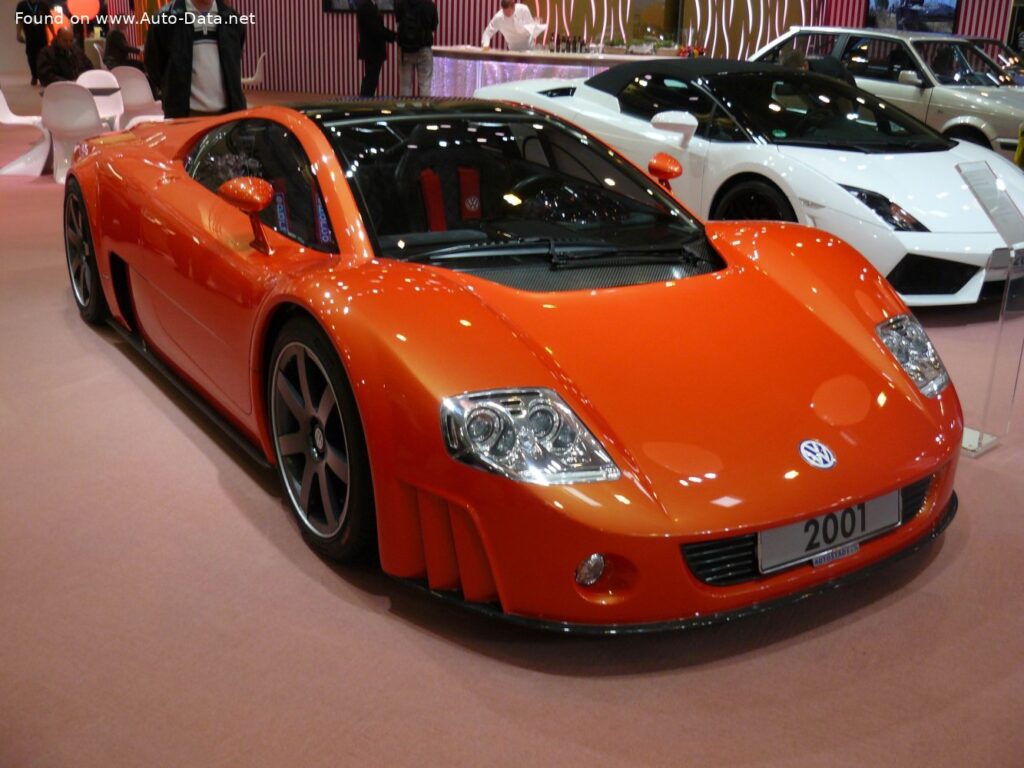
The Volkswagen W12 Nardo concept car, produced between 2001 and 2004, represented a bold engineering statement from the German automaker. This high-performance coupe showcased Volkswagen’s capabilities in engine design and construction, specifically with its unique 6.0-liter W12 engine. The Nardo was not intended for mass production, serving instead as a technology demonstrator and a platform to explore the potential of a flagship performance vehicle. It was based on the A3 platform (1HX0), but heavily modified to accommodate the large W12 engine and achieve its exceptional performance targets. The Nardo’s design and engineering were heavily influenced by Volkswagen’s desire to create a vehicle capable of competing with established grand tourers from brands like Ferrari and Porsche.
The W12 Nardo: A Showcase of Volkswagen Engineering
The W12 Nardo was conceived as a project to push the boundaries of Volkswagen’s engineering prowess. It wasn’t simply about creating a fast car; it was about demonstrating the company’s ability to develop and implement a complex and powerful engine in a relatively lightweight chassis. The concept car’s name derives from the Autodromo Nazionale di Vallelunga near Rome, Italy, where Volkswagen conducted extensive high-speed testing. The Nardo’s development focused on achieving a balance between raw power, sophisticated aerodynamics, and a driver-focused experience.
Powertrain & Engine Architecture
At the heart of the W12 Nardo lies its namesake: a 6.0-liter W12 engine, designated as a naturally aspirated powerplant. This engine produced a formidable 600 horsepower at 7000 rpm and 620 Nm (457.29 lb-ft) of torque at 5800 rpm. The W12 configuration, essentially three VR6 engines combined at a 72-degree angle, offered a compact engine layout for its displacement, contributing to a favorable weight distribution. The engine featured a 12:1 compression ratio, DOHC (Dual Overhead Camshaft) valvetrain with four valves per cylinder, and a multi-port manifold fuel injection system. The engine’s longitudinal placement within the front of the vehicle, coupled with rear-wheel drive, was a deliberate choice to optimize handling and driving dynamics. The engine displacement is 5998 cm3 (366.02 cu. in.), and it boasts a power output of 100 hp per liter.
The W12 Nardo was equipped with a 6-speed manual transmission, chosen to provide the driver with maximum control over the engine’s substantial power. The transmission was specifically tuned to handle the high torque output of the W12 engine and deliver precise gear changes. The drivetrain architecture is a conventional rear-wheel drive setup, with the internal combustion engine directly powering the rear wheels.
Driving Characteristics
The W12 Nardo’s performance figures were truly remarkable for its time. It could accelerate from 0 to 100 km/h (0-62 mph) in just 3.5 seconds, and 0 to 60 mph in a calculated 3.3 seconds. Its top speed was electronically limited to 350 km/h (217.48 mph). The combination of the powerful W12 engine, the lightweight chassis (1200 kg / 2645.55 lbs), and the rear-wheel drive configuration resulted in a car that was both incredibly fast in a straight line and surprisingly agile in corners. The manual transmission allowed for precise control, enabling drivers to fully exploit the engine’s power and torque. The power delivery was smooth and linear, making the car relatively easy to drive despite its immense performance capabilities. The weight-to-power ratio of 2 kg/Hp and weight-to-torque ratio of 1.9 kg/Nm further contributed to its impressive acceleration and responsiveness.
Equipment & Trim Levels
As a concept car, the W12 Nardo was not offered with traditional trim levels or optional extras. It was essentially a one-off prototype designed to showcase Volkswagen’s technological capabilities. However, the interior was meticulously crafted with high-quality materials and a focus on driver ergonomics. The cabin featured two sculpted seats, a minimalist dashboard design, and a range of advanced instrumentation. The interior was designed to create a focused and immersive driving experience. The exterior featured a distinctive aerodynamic body kit, including a large rear wing and a prominent front splitter, designed to enhance stability at high speeds. The car was finished in a striking silver paint scheme, further emphasizing its futuristic and high-performance character.
Chassis & Braking
The W12 Nardo’s chassis was heavily modified from the standard A3 platform to accommodate the larger engine and improve handling. It featured a double wishbone front suspension and a coil spring rear suspension, both tuned for optimal performance. The braking system consisted of ventilated discs on all four wheels, providing ample stopping power. An ABS (Anti-lock braking system) was included as a standard safety feature. The steering system was a hydraulic power steering rack and pinion, offering precise and responsive steering feel. The car rode on 19-inch wheels fitted with 255/35 R19 tires, providing excellent grip and handling characteristics.
Market Reception & Comparison
The W12 Nardo was never intended for commercial sale, so it did not receive traditional market reception in the form of sales figures or consumer reviews. However, it generated significant buzz within the automotive industry and among enthusiasts. Critics praised the car’s innovative engine, its impressive performance, and its striking design. It was widely regarded as a testament to Volkswagen’s engineering capabilities and a bold statement of intent. Compared to other Volkswagen models of the time, such as the Golf or Passat, the W12 Nardo was in a completely different league. It was more akin to high-performance sports cars from brands like Porsche and Ferrari, offering a level of performance and sophistication that was unprecedented for Volkswagen. The fuel consumption figures, while not a primary focus for a concept car of this nature, were 20 l/100 km (11.8 US mpg) in urban conditions and 11 l/100 km (21.4 US mpg) in extra-urban conditions.
Technical Specifications
| Brand | Volkswagen |
| Model | W12 Nardo (Concept) |
| Generation | W12 Nardo (Concept) |
| Type (Engine) | 6.0 W12 (600 Hp) |
| Start of production | 2001 year |
| End of production | 2004 year |
| Powertrain Architecture | Internal Combustion engine |
| Body type | Coupe |
| Seats | 2 |
| Doors | 2 |
| Fuel consumption (economy) – urban | 20 l/100 km (11.8 US mpg) |
| Fuel consumption (economy) – extra urban | 11 l/100 km (21.4 US mpg) |
| Fuel Type | Petrol (Gasoline) |
| Acceleration 0 – 100 km/h | 3.5 sec |
| Acceleration 0 – 62 mph | 3.5 sec |
| Acceleration 0 – 60 mph | 3.3 sec |
| Maximum speed | 350 km/h (217.48 mph) |
| Weight-to-power ratio | 2 kg/Hp |
| Weight-to-torque ratio | 1.9 kg/Nm |
| Power | 600 Hp @ 7000 rpm |
| Torque | 620 Nm @ 5800 rpm (457.29 lb.-ft. @ 5800 rpm) |
| Engine layout | Front, Longitudinal |
| Engine displacement | 5998 cm3 (366.02 cu. in.) |
| Number of cylinders | 12 |
| Engine configuration | W-engine |
| Cylinder Bore | 84 mm (3.31 in.) |
| Piston Stroke | 90.3 mm (3.56 in.) |
| Compression ratio | 12:1 |
| Number of valves per cylinder | 4 |
| Fuel injection system | Multi-port manifold injection |
| Engine aspiration | Naturally aspirated engine |
| Valvetrain | DOHC |
| Kerb Weight | 1200 kg (2645.55 lbs.) |
| Fuel tank capacity | 63 l (16.64 US gal | 13.86 UK gal) |
| Length | 4555 mm (179.33 in.) |
| Width | 1920 mm (75.59 in.) |
| Height | 1100 mm (43.31 in.) |
| Wheelbase | 2630 mm (103.54 in.) |
| Drivetrain Architecture | Rear wheel drive |
| Drive wheel | Rear wheel drive |
| Number of gears and type of gearbox | 6 gears, manual transmission |
| Front suspension | Double wishbone |
| Rear suspension | Coil spring |
| Front brakes | Ventilated discs |
| Rear brakes | Ventilated discs |
| Assisting systems | ABS (Anti-lock braking system) |
| Steering type | Steering rack and pinion |
| Power steering | Hydraulic Steering |
| Tires size | 255/35 R19 |
| Wheel rims size | 19 |
Legacy
The Volkswagen W12 Nardo remains a significant vehicle in the company’s history. While it never reached production, it served as a valuable testbed for new technologies and a demonstration of Volkswagen’s engineering capabilities. The W12 engine itself would later be used in production models like the Phaeton and Touareg, albeit in different configurations. Today, the W12 Nardo is a highly sought-after collector’s item, representing a unique and ambitious chapter in Volkswagen’s automotive heritage. Its legacy lies not in its sales figures, but in its demonstration of what Volkswagen was capable of achieving when pushing the boundaries of automotive engineering.
