
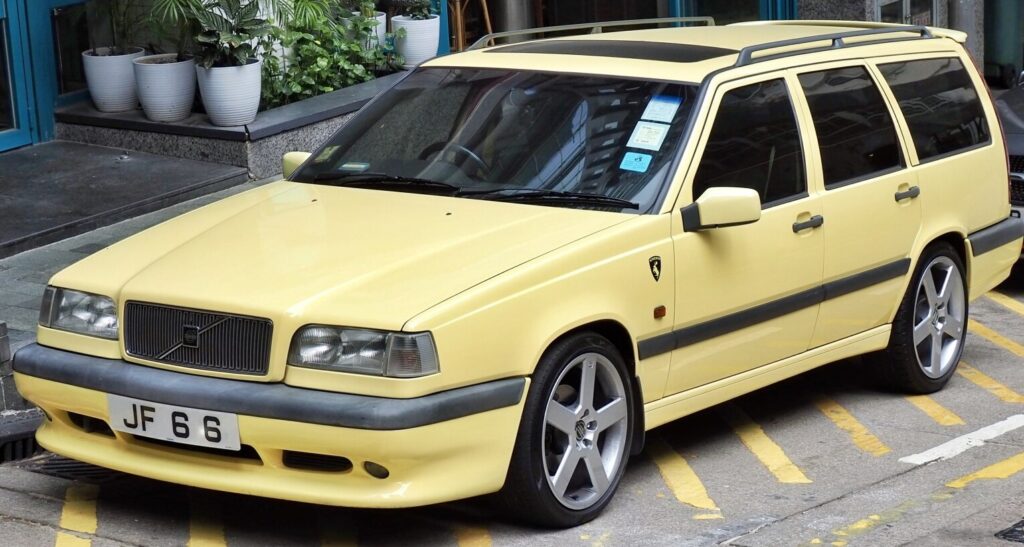
Technical Specifications
| Brand | Volvo |
| Model | 850 |
| Generation | 850 Combi (LW) |
| Type (Engine) | 2.0 10V (126 Hp) |
| Start of production | 1993 |
| End of production | 1997 |
| Powertrain Architecture | Internal Combustion engine |
| Body type | Station wagon (estate) |
| Seats | 5 |
| Doors | 5 |
| Fuel consumption (combined) | 9.1 l/100 km |
| Fuel consumption (US mpg) | 25.8 US mpg |
| Fuel consumption (UK mpg) | 31 UK mpg |
| Fuel consumption (km/l) | 11 km/l |
| Fuel Type | Petrol (Gasoline) |
| Acceleration 0 – 100 km/h | 11.7 sec |
| Acceleration 0 – 62 mph | 11.7 sec |
| Acceleration 0 – 60 mph | 11.1 sec |
| Maximum speed | 195 km/h (121.17 mph) |
| Weight-to-power ratio | 11.2 kg/Hp |
| Weight-to-torque ratio | 8.3 kg/Nm |
| Power | 126 Hp @ 6250 rpm |
| Power per litre | 63.5 Hp/l |
| Torque | 170 Nm @ 4800 rpm (125.39 lb.-ft. @ 4800 rpm) |
| Engine layout | Front, Transverse |
| Engine Model/Code | B5202FS |
| Engine displacement | 1984 cm3 (121.07 cu. in.) |
| Number of cylinders | 5 |
| Engine configuration | Inline |
| Cylinder Bore | 81 mm (3.19 in.) |
| Piston Stroke | 77 mm (3.03 in.) |
| Compression ratio | 10:1 |
| Number of valves per cylinder | 2 |
| Fuel injection system | Multi-port manifold injection |
| Engine aspiration | Naturally aspirated engine |
| Valvetrain | DOHC |
| Engine oil capacity | 5.3 l (5.6 US qt | 4.66 UK qt) |
| Coolant capacity | 7.2 l (7.61 US qt | 6.34 UK qt) |
| Kerb Weight | 1412 kg (3112.93 lbs.) |
| Max. weight | 1970 kg (4343.11 lbs.) |
| Max load | 558 kg (1230.18 lbs.) |
| Trunk (boot) space – minimum | 420 l (14.83 cu. ft.) |
| Trunk (boot) space – maximum | 1580 l (55.8 cu. ft.) |
| Fuel tank capacity | 73 l (19.28 US gal | 16.06 UK gal) |
| Length | 4709 mm (185.39 in.) |
| Width | 1761 mm (69.33 in.) |
| Height | 1415 mm (55.71 in.) |
| Wheelbase | 2670 mm (105.12 in.) |
| Front track | 1520 mm (59.84 in.) |
| Rear track | 1470 mm (57.87 in.) |
| Drivetrain Architecture | Front wheel drive |
| Number of gears | 5 |
| Gearbox type | Manual transmission |
| Front suspension | Wishbone |
| Rear suspension | Coil spring |
| Front brakes | Ventilated discs |
| Rear brakes | Disc |
| Assisting systems | ABS (Anti-lock braking system) |
| Steering type | Steering rack and pinion |
| Power steering | Hydraulic Steering |
| Tires size | 185/65 R15 |
| Wheel rims size | 15 |
The Volvo 850 Combi 2.0 10V, launched in 1993, marked a significant shift for the Swedish automaker. Before the 850, Volvo was largely associated with boxy, conservative designs. The 850, with its more aerodynamic and rounded styling, signaled a move towards a more contemporary aesthetic. The “Combi” designation identified the station wagon body style, a popular choice in the European market where practicality was highly valued. Built on Volvo’s new P80 platform (also known as the 850 series), this variant aimed to provide a spacious, safe, and reliable vehicle for families. The 2.0-liter engine, while not the most powerful in the 850 range, offered a good balance of fuel economy and performance for everyday driving.
Powertrain & Engine Architecture
The core of the 850 Combi 2.0 10V is the B5202FS engine, a naturally aspirated, inline-five cylinder gasoline engine. This engine, displacing 1984cc, features a cast iron block and an aluminum cylinder head. The “10V” designation refers to the engine’s ten valves – two valves per cylinder (one intake, one exhaust). Fuel delivery is managed by a Bosch multi-port fuel injection system, providing precise fuel metering for improved efficiency and reduced emissions. The engine utilizes a double overhead camshaft (DOHC) valvetrain, contributing to its relatively high power output for its displacement. The five-speed manual transmission, a M5R gearbox, was the standard offering for this trim level. This transmission is known for its durability and relatively smooth shifting characteristics. The front-wheel-drive configuration was standard for all 850 models.
Driving Characteristics
The 850 Combi 2.0 10V offered a comfortable and predictable driving experience. With 126 horsepower and 170 Nm (125 lb-ft) of torque, acceleration was adequate but not particularly brisk. Zero to 60 mph took around 11.1 seconds, and top speed was approximately 121 mph. The five-speed manual transmission allowed drivers to make the most of the engine’s powerband, although the gear ratios were geared towards fuel efficiency rather than outright performance. Compared to the turbocharged 850 T5, the 2.0-liter model felt noticeably slower, especially during overtaking maneuvers. However, the naturally aspirated engine provided a more linear power delivery, making it easier to modulate throttle response. The suspension, tuned for comfort, absorbed bumps and imperfections in the road well, providing a smooth ride for passengers.
Equipment & Trim Levels
The 850 Combi 2.0 10V typically came equipped with a reasonable level of standard features. Interior upholstery was usually cloth, with a practical and durable finish. Standard equipment included power steering, central locking, and an AM/FM radio. Optional extras included power windows, a sunroof, and upgraded audio systems. Safety features, a hallmark of Volvo, were also well-represented, with ABS anti-lock brakes being standard. The dashboard layout was functional and ergonomically designed, prioritizing ease of use. Trim levels were relatively simple, with the 2.0-liter model representing the entry-level offering in the Combi range.
Chassis & Braking
The 850 Combi 2.0 10V featured a robust chassis designed for both comfort and safety. The front suspension utilized independent wishbones, while the rear suspension employed a semi-independent coil spring setup. This configuration provided a good balance between ride quality and handling. Braking duties were handled by ventilated discs at the front and solid discs at the rear. The ABS anti-lock braking system was standard, enhancing braking performance and stability, particularly in adverse conditions. The steering system was a rack-and-pinion setup with hydraulic power assistance, providing precise and responsive steering feel.
Market Reception & Comparison
The Volvo 850 Combi 2.0 10V was generally well-received by critics and consumers alike. It was praised for its spacious interior, comfortable ride, and strong safety credentials. However, some reviewers noted that the engine lacked the punch of the turbocharged models. Compared to competitors like the Audi 80 Avant and the BMW 3 Series Touring, the 850 Combi offered a more practical and family-oriented package, albeit with slightly less sporty handling. Fuel economy was respectable for its class, averaging around 25.8 US mpg. Reliability was generally good, although some owners reported minor issues with the fuel injection system and electrical components.
Legacy
The Volvo 850 Combi 2.0 10V, while not the most sought-after variant in the 850 range, remains a popular choice among enthusiasts and classic car collectors. Its robust construction, simple mechanicals, and readily available parts make it a relatively easy vehicle to maintain. Today, well-maintained examples command reasonable prices in the used car market. The 850 series, as a whole, is credited with revitalizing Volvo’s image and paving the way for the company’s future success. The 2.0-liter engine, while not known for its high performance, proved to be a reliable and durable powerplant, contributing to the 850’s reputation for longevity.
