
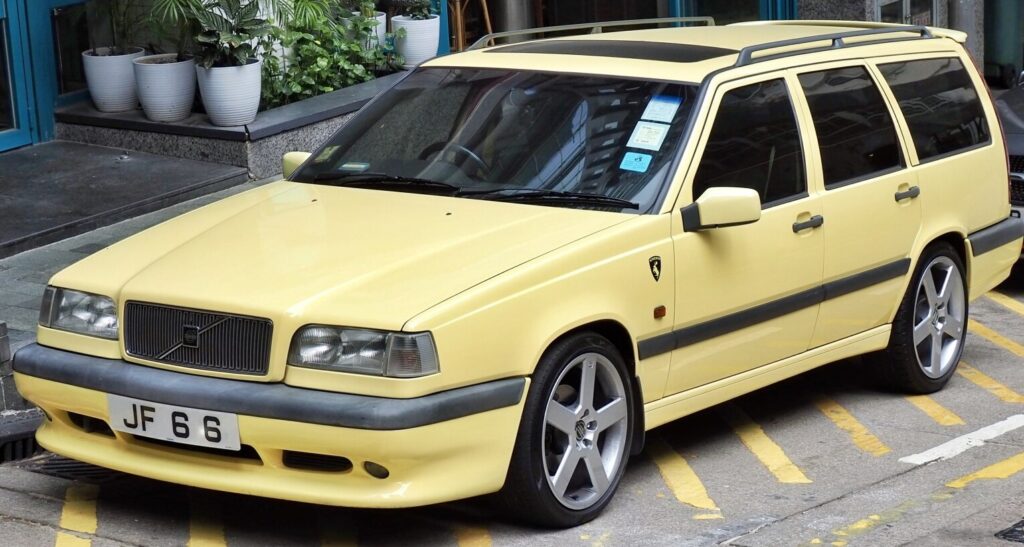
The Volvo 850 Combi 2.3 T5, produced between 1993 and 1997, represents a pivotal moment in Volvo’s history. This variant, a performance-oriented station wagon, was a key component of the 850 series (internally designated LW), built on Volvo’s new P80 platform. The 850 aimed to shake off Volvo’s conservative image and appeal to a younger, more dynamic audience. The Combi body style, or estate as it was known in Europe, offered a practical and spacious interior combined with surprisingly sporty performance, particularly in the T5 trim. It was a significant departure from the traditionally boxy Volvo designs and introduced a level of driving excitement previously unseen in the brand’s lineup.
Technical Specifications
| Brand | Volvo |
| Model | 850 |
| Generation | 850 Combi (LW) |
| Type (Engine) | 2.3 T5 (225 Hp) |
| Start of production | 1993 |
| End of production | 1997 |
| Powertrain Architecture | Internal Combustion engine |
| Body type | Station wagon (estate) |
| Seats | 5 |
| Doors | 5 |
| Fuel consumption (combined) | 9.4 l/100 km (25 US mpg, 30.1 UK mpg, 10.6 km/l) |
| Fuel Type | Petrol (Gasoline) |
| Acceleration 0 – 100 km/h | 7.4 sec |
| Acceleration 0 – 62 mph | 7.4 sec |
| Acceleration 0 – 60 mph | 7 sec |
| Maximum speed | 240 km/h (149.13 mph) |
| Weight-to-power ratio | 6.4 kg/Hp, 155.1 Hp/tonne |
| Weight-to-torque ratio | 4.8 kg/Nm, 206.8 Nm/tonne |
| Power | 225 Hp @ 5280 rpm |
| Power per litre | 97 Hp/l |
| Torque | 300 Nm @ 2000 rpm (221.27 lb.-ft. @ 2000 rpm) |
| Engine layout | Front, Transverse |
| Engine Model/Code | B5234T |
| Engine displacement | 2319 cm3 (141.51 cu. in.) |
| Number of cylinders | 5 |
| Engine configuration | Inline |
| Cylinder Bore | 81 mm (3.19 in.) |
| Piston Stroke | 90 mm (3.54 in.) |
| Compression ratio | 8.5:1 |
| Number of valves per cylinder | 4 |
| Fuel injection system | Multi-port manifold injection |
| Engine aspiration | Turbocharger |
| Valvetrain | DOHC |
| Engine oil capacity | 5.3 l (5.6 US qt | 4.66 UK qt) |
| Coolant | 7 l (7.4 US qt | 6.16 UK qt) |
| Kerb Weight | 1451 kg (3198.91 lbs.) |
| Max. weight | 1970 kg (4343.11 lbs.) |
| Max load | 519 kg (1144.2 lbs.) |
| Trunk (boot) space – minimum | 420 l (14.83 cu. ft.) |
| Trunk (boot) space – maximum | 1580 l (55.8 cu. ft.) |
| Fuel tank capacity | 73 l (19.28 US gal | 16.06 UK gal) |
| Length | 4709 mm (185.39 in.) |
| Width | 1761 mm (69.33 in.) |
| Height | 1415 mm (55.71 in.) |
| Wheelbase | 2670 mm (105.12 in.) |
| Front track | 1520 mm (59.84 in.) |
| Rear (Back) track | 1470 mm (57.87 in.) |
| Drivetrain Architecture | The Internal combustion engine (ICE) drives the front wheels of the vehicle. |
| Drive wheel | Front wheel drive |
| Number of gears and type of gearbox | 5 gears, manual transmission |
| Front suspension | Wishbone |
| Rear suspension | Coil spring |
| Front brakes | Ventilated discs |
| Rear brakes | Disc |
| Assisting systems | ABS (Anti-lock braking system) |
| Steering type | Steering rack and pinion |
| Power steering | Hydraulic Steering |
| Tires size | 205/50 R16 |
| Wheel rims size | 16 |
Powertrain & Engine Architecture
The heart of the 850 T5 is the B5234T, a 2.3-liter inline-five cylinder engine. This engine was a significant engineering achievement for Volvo, combining a relatively large displacement with a turbocharger and multi-port fuel injection. The five-cylinder configuration offered a unique balance of smoothness and power delivery. The B5234T featured a cast iron block and an aluminum cylinder head with a double overhead camshaft (DOHC) valvetrain. The turbocharger, a Mitsubishi TD04HL-13C, provided significant boost, contributing to the engine’s 225 horsepower and 221 lb-ft of torque. The engine utilized Bosch Motronic 3.1 engine management system to control fuel injection and ignition timing. The five-speed manual transmission was the standard offering, providing precise gear changes and enhancing the driving experience.
Driving Characteristics
The 850 Combi 2.3 T5 offered a surprisingly engaging driving experience for a station wagon. The turbocharger provided a noticeable surge of power, delivering strong acceleration. Zero to sixty mph was achievable in around 7 seconds, and top speed was electronically limited to 149 mph. The front-wheel-drive layout, while not ideal for ultimate handling, provided good traction and predictable behavior. The suspension, tuned for a balance of comfort and control, offered a relatively flat ride even when pushed hard. Compared to the naturally aspirated 850 models, the T5 felt significantly more responsive and capable. The manual transmission allowed for full control over the engine’s power, while the gear ratios were well-chosen to maximize acceleration and cruising efficiency.
Equipment & Trim Levels
The 850 T5 was generally well-equipped, reflecting Volvo’s reputation for safety and comfort. Standard features included power windows, power locks, a sunroof, and air conditioning. The interior typically featured comfortable cloth upholstery, although leather was available as an option. The dashboard layout was functional and ergonomically designed, with easy-to-read gauges and intuitive controls. Optional extras included a premium sound system, heated front seats, and automatic climate control. The T5 trim often included unique exterior styling cues, such as a rear spoiler and specific alloy wheel designs.
Chassis & Braking
The 850 Combi featured a robust chassis with independent front suspension utilizing wishbones and a coil-sprung rear suspension. The front brakes were ventilated discs, providing excellent stopping power, while the rear brakes were solid discs. Anti-lock braking system (ABS) was standard, enhancing safety and control during emergency braking. The steering was a rack-and-pinion system with hydraulic power assistance, offering precise and responsive steering feel. The relatively wide track and well-tuned suspension contributed to good stability and handling characteristics.
Market Reception & Comparison
The 850 T5 was generally well-received by automotive critics. It was praised for its performance, practicality, and distinctive styling. However, some critics noted the front-wheel-drive layout limited its handling potential compared to rear-wheel-drive competitors. Compared to the base 850 models, the T5 offered a significant performance upgrade, but at a higher price point. The 850 T5 also competed with other performance wagons of the time, such as the Audi S4 Avant and the BMW 3 Series Touring. Fuel economy was reasonable for a performance car of its era, averaging around 25 mpg in combined driving.
Legacy
The Volvo 850 T5 has become a popular classic among enthusiasts. The B5234T engine is known for its durability and tunability, making it a favorite for modifications and performance upgrades. While some maintenance items, such as the turbocharger and fuel injectors, can require attention with age, the 850 T5 remains a relatively reliable vehicle. On the used car market, well-maintained examples command a premium price, reflecting their rarity and desirability. The 850 T5 paved the way for future generations of performance Volvos, establishing the brand as a contender in the sporty wagon segment.
