
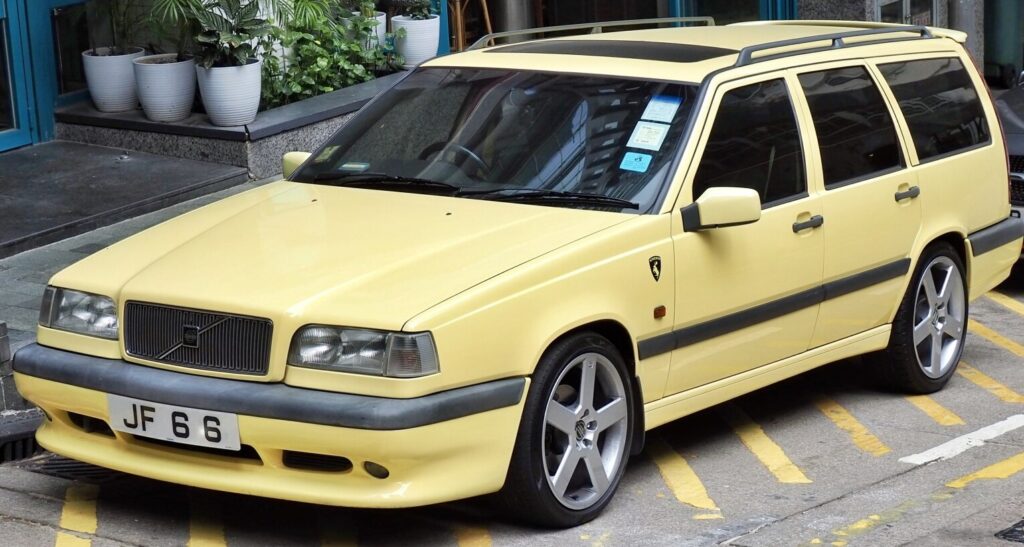
Technical Specifications
| Brand | Volvo |
| Model | 850 |
| Generation | 850 Combi (LW) |
| Type (Engine) | 2.5 10V (140 Hp) |
| Start of production | 1991 |
| End of production | 1994 |
| Powertrain Architecture | Internal Combustion engine |
| Body type | Station wagon (estate) |
| Seats | 5 |
| Doors | 5 |
| Fuel consumption (urban) | 11.7 l/100 km (20.1 US mpg, 24.1 UK mpg, 8.5 km/l) |
| Fuel consumption (extra urban) | 6.4 l/100 km (36.8 US mpg, 44.1 UK mpg, 15.6 km/l) |
| Fuel consumption (combined) | 8.1 l/100 km (29 US mpg, 34.9 UK mpg, 12.3 km/l) |
| Fuel Type | Petrol (Gasoline) |
| Acceleration 0 – 100 km/h | 10.5 sec |
| Acceleration 0 – 62 mph | 10.5 sec |
| Acceleration 0 – 60 mph | 10 sec |
| Maximum speed | 202 km/h (125.52 mph) |
| Weight-to-power ratio | 10 kg/Hp, 100 Hp/tonne |
| Weight-to-torque ratio | 6.8 kg/Nm, 147.1 Nm/tonne |
| Power | 140 Hp @ 5400 rpm |
| Power per litre | 57.5 Hp/l |
| Torque | 206 Nm @ 3600 rpm (151.94 lb.-ft. @ 3600 rpm) |
| Engine layout | Front, Transverse |
| Engine Model/Code | B5252FS |
| Engine displacement | 2435 cm3 (148.59 cu. in.) |
| Number of cylinders | 5 |
| Engine configuration | Inline |
| Cylinder Bore | 83 mm (3.27 in.) |
| Piston Stroke | 90 mm (3.54 in.) |
| Compression ratio | 10.5:1 |
| Number of valves per cylinder | 4 |
| Fuel injection system | Multi-port manifold injection |
| Engine aspiration | Naturally aspirated engine |
| Valvetrain | DOHC |
| Engine oil capacity | 5.3 l (5.6 US qt | 4.66 UK qt) |
| Coolant capacity | 7.2 l (7.61 US qt | 6.34 UK qt) |
| Kerb Weight | 1400 kg (3086.47 lbs.) |
| Max. weight | 1925 kg (4243.9 lbs.) |
| Max load | 525 kg (1157.43 lbs.) |
| Fuel tank capacity | 73 l (19.28 US gal | 16.06 UK gal) |
| Drivetrain Architecture | The Internal combustion engine (ICE) drives the front wheels of the vehicle. |
| Drive wheel | Front wheel drive |
| Number of gears and type of gearbox | 5 gears, manual transmission |
| Front suspension | Wishbone |
| Rear suspension | Coil spring |
| Front brakes | Ventilated discs |
| Rear brakes | Disc |
| Assisting systems | ABS (Anti-lock braking system) |
| Steering type | Steering rack and pinion |
| Power steering | Hydraulic Steering |
| Tires size | 185/65 R15 |
| Wheel rims size | 15 |
The Volvo 850 Combi 2.5 10V, launched in 1991, was a watershed moment for the Swedish automaker. It represented a significant departure from Volvo’s traditionally rear-wheel-drive layout, embracing front-wheel drive with a transversely mounted engine. This shift was driven by the need to offer more interior space and improve fuel efficiency, while still maintaining Volvo’s reputation for safety and durability. The “Combi” designation signified the station wagon body style, a popular choice in the European market, and the 2.5 10V indicated the engine’s displacement and valve configuration. The 850 series, built on the P80 platform, aimed to modernize Volvo’s image and appeal to a broader customer base.
Powertrain & Engine Architecture
At the heart of the 850 Combi 2.5 10V lies the B5252FS engine, a naturally aspirated, inline-five cylinder powerplant. This engine, displacing 2.4 liters (2435 cc), featured a cast iron block and an aluminum cylinder head. The “10V” designation refers to the ten valves – four valves per cylinder – operated by a double overhead camshaft (DOHC) valvetrain. Fuel delivery was managed by a Bosch multi-port fuel injection system, providing precise fuel metering for optimal combustion. The engine produced 140 horsepower at 5400 rpm and 206 Nm (151.94 lb-ft) of torque at 3600 rpm. The five-speed manual transmission, a standard feature, was chosen for its durability and relatively direct feel. The transmission’s gear ratios were tuned to provide a balance between acceleration and fuel economy, with a final drive ratio optimized for highway cruising.
Driving Characteristics
The 850 Combi 2.5 10V offered a comfortable and composed driving experience. While not overtly sporty, the 140 hp engine provided adequate power for everyday driving and even occasional highway passing maneuvers. Acceleration from 0 to 60 mph took approximately 10 seconds, and the top speed was around 125 mph. Compared to the turbocharged 850 models, the 2.5 10V felt less urgent in its acceleration, but it offered a smoother, more linear power delivery. The manual transmission allowed for precise control, and the front-wheel-drive configuration provided good traction in most conditions. The suspension, tuned for comfort, absorbed bumps and irregularities in the road effectively, making it a pleasant vehicle for long journeys.
Equipment & Trim Levels
The 850 Combi 2.5 10V typically came equipped with a respectable level of standard features. These included power steering, ABS anti-lock brakes, central locking, and electrically adjustable front windows. The interior featured cloth upholstery, a basic stereo system, and a functional dashboard layout. Optional extras included a sunroof, upgraded stereo systems, leather upholstery, and climate control. The trim level was generally considered a mid-range offering, providing a good balance of features and affordability. It was positioned above the base models but below the more luxurious and performance-oriented trims.
Chassis & Braking
The 850 Combi’s chassis was designed to prioritize safety and comfort. The front suspension utilized a MacPherson strut setup, while the rear suspension employed a coil spring arrangement. The braking system consisted of ventilated discs on the front wheels and solid discs on the rear, providing adequate stopping power. The ABS system helped to prevent wheel lockup during hard braking, enhancing stability and control. The car’s relatively heavy curb weight of 1400 kg (3086.47 lbs) contributed to its stable handling characteristics, but also impacted its acceleration performance.
Market Reception & Comparison
The Volvo 850 Combi 2.5 10V was generally well-received by automotive critics. It was praised for its spacious interior, comfortable ride, and strong safety features. However, some critics noted that the engine lacked the punch of the turbocharged variants and that the front-wheel-drive configuration didn’t offer the same level of driving engagement as rear-wheel-drive cars. Compared to other station wagons in its class, such as the Ford Mondeo Estate and the Opel/Vauxhall Vectra Estate, the 850 Combi offered a unique blend of Scandinavian design, practicality, and safety. Fuel economy was respectable, averaging around 29 US mpg in combined driving, but it wasn’t class-leading.
Legacy
The Volvo 850 Combi 2.5 10V played a crucial role in establishing Volvo as a modern and competitive automaker. The introduction of front-wheel drive and the P80 platform paved the way for future Volvo models. The B5252FS engine proved to be a reliable and durable powerplant, and many examples are still on the road today. In the used car market, the 850 Combi 2.5 10V is often sought after by enthusiasts who appreciate its classic Volvo styling, practicality, and relatively simple mechanicals. While maintenance costs can be higher than some contemporary vehicles, the 850’s robust construction and readily available parts supply make it a viable option for those seeking a dependable and characterful estate car.
