
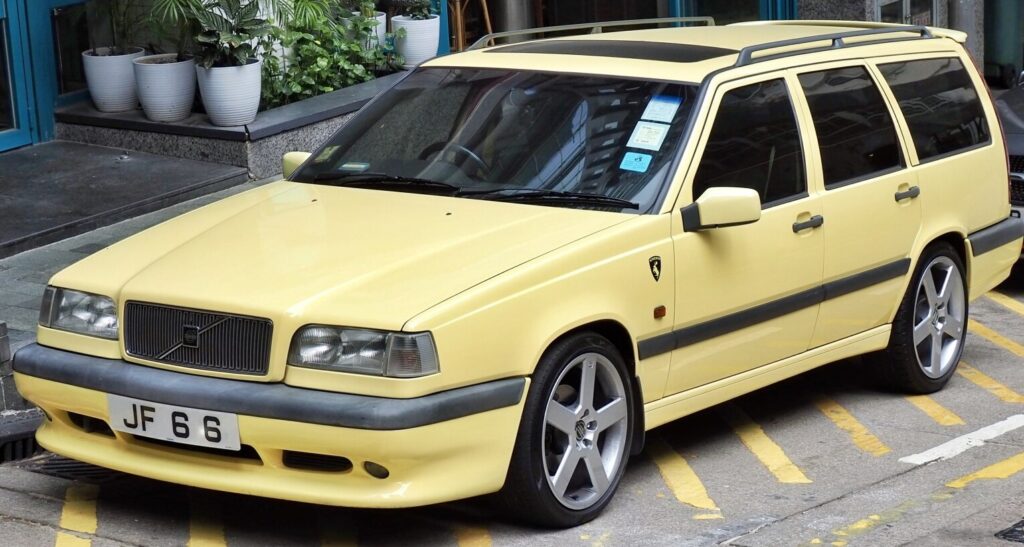
The Volvo 850 Combi 2.5 10V Automatic, produced between 1991 and 1994, represents a significant entry point into Volvo’s innovative 850 series. This variant, part of the first generation (LW) of the 850, was a five-door station wagon (estate) designed to blend practicality with Volvo’s renowned safety features. Positioned as a mid-range offering, it provided a comfortable and capable family vehicle, appealing to buyers who prioritized ease of use and space over outright performance. The 850 series, built on Volvo’s new P80 platform, was a departure from traditional Volvo designs, embracing a more aerodynamic and modern aesthetic.
Technical Specifications
| Brand | Volvo |
| Model | 850 |
| Generation | 850 Combi (LW) |
| Type (Engine) | 2.5 10V (140 Hp) Automatic |
| Start of production | 1991 |
| End of production | 1994 |
| Powertrain Architecture | Internal Combustion engine |
| Body type | Station wagon (estate) |
| Seats | 5 |
| Doors | 5 |
| Fuel consumption (urban) | 11.7 l/100 km (20.1 US mpg, 24.1 UK mpg, 8.5 km/l) |
| Fuel consumption (extra urban) | 6.8 l/100 km (34.6 US mpg, 41.5 UK mpg, 14.7 km/l) |
| Fuel consumption (combined) | 8.1 l/100 km (29 US mpg, 34.9 UK mpg, 12.3 km/l) |
| Fuel Type | Petrol (Gasoline) |
| Acceleration 0 – 100 km/h | 11.1 sec |
| Acceleration 0 – 62 mph | 11.1 sec |
| Acceleration 0 – 60 mph | 10.5 sec |
| Maximum speed | 194 km/h (120.55 mph) |
| Weight-to-power ratio | 10 kg/Hp, 100 Hp/tonne |
| Weight-to-torque ratio | 6.8 kg/Nm, 147.1 Nm/tonne |
| Power | 140 Hp @ 5400 rpm |
| Power per litre | 57.5 Hp/l |
| Torque | 206 Nm @ 3600 rpm (151.94 lb.-ft. @ 3600 rpm) |
| Engine layout | Front, Transverse |
| Engine Model/Code | B5252FS |
| Engine displacement | 2435 cm3 (148.59 cu. in.) |
| Number of cylinders | 5 |
| Engine configuration | Inline |
| Cylinder Bore | 83 mm (3.27 in.) |
| Piston Stroke | 90 mm (3.54 in.) |
| Compression ratio | 10.5:1 |
| Number of valves per cylinder | 4 |
| Fuel injection system | Multi-port manifold injection |
| Engine aspiration | Naturally aspirated engine |
| Valvetrain | DOHC |
| Engine oil capacity | 5.3 l (5.6 US qt | 4.66 UK qt) |
| Coolant capacity | 7.2 l (7.61 US qt | 6.34 UK qt) |
| Kerb Weight | 1400 kg (3086.47 lbs.) |
| Max. weight | 1925 kg (4243.9 lbs.) |
| Max load | 525 kg (1157.43 lbs.) |
| Fuel tank capacity | 73 l (19.28 US gal | 16.06 UK gal) |
| Drivetrain Architecture | The Internal combustion engine (ICE) drives the front wheels of the vehicle. |
| Drive wheel | Front wheel drive |
| Number of gears and type of gearbox | 4 gears, automatic transmission |
| Front suspension | Wishbone |
| Rear suspension | Coil spring |
| Front brakes | Ventilated discs |
| Rear brakes | Disc |
| Assisting systems | ABS (Anti-lock braking system) |
| Steering type | Steering rack and pinion |
| Power steering | Hydraulic Steering |
| Tires size | 185/65 R15 |
| Wheel rims size | 15 |
Powertrain & Engine Architecture
The heart of the 850 Combi 2.5 Automatic is the B5252FS engine, a 2.4-liter inline five-cylinder gasoline engine. This engine featured a cast iron block and an aluminum cylinder head, employing a dual overhead camshaft (DOHC) valvetrain with four valves per cylinder. Fuel delivery was managed by a Bosch multi-port fuel injection system. The 10V designation refers to the number of valves, a simpler design compared to the later 20V versions. The engine produced 140 horsepower at 5400 rpm and 206 Nm (152 lb-ft) of torque at 3600 rpm. Paired with this engine was a four-speed automatic transmission, providing smooth, if not particularly sporty, gear changes. This transmission was chosen to appeal to buyers seeking convenience and ease of driving, particularly in urban environments.
Driving Characteristics
The 850 Combi 2.5 Automatic offered a comfortable and relaxed driving experience. Acceleration from 0-60 mph took around 10.5 seconds, which was adequate for the time but noticeably slower than the manual transmission or higher-powered variants. The automatic transmission, while smooth, did sap some of the engine’s power, resulting in a less responsive feel. Gear ratios were optimized for fuel efficiency and cruising comfort rather than outright performance. The front-wheel-drive configuration provided predictable handling, but lacked the dynamic capabilities of all-wheel-drive models that would later become available in the 850 range. The car felt stable and planted on the road, making it a good choice for long journeys.
Equipment & Trim Levels
The 850 Combi 2.5 Automatic typically came equipped with a reasonable level of standard features. These included power windows and locks, central locking, and a basic audio system. Interior upholstery was typically cloth, with a functional and durable design. Optional extras included a sunroof, upgraded audio systems, and leather upholstery. Safety features were a Volvo hallmark, and even the base 850 Combi included ABS anti-lock brakes and a robust safety cage. The dashboard layout was clean and straightforward, prioritizing functionality over elaborate styling.
Chassis & Braking
The 850 Combi featured independent front suspension with wishbones and coil springs, providing a comfortable ride. The rear suspension utilized a coil spring setup. Braking duties were handled by ventilated discs at the front and solid discs at the rear. The ABS system helped to maintain control during hard braking. Steering was rack and pinion, with hydraulic power assistance. The car’s relatively heavy weight (around 1400 kg or 3086 lbs) contributed to its stability but also impacted its agility.
Market Reception & Comparison
The 850 Combi 2.5 Automatic was generally well-received by critics as a practical and safe family vehicle. However, its performance was often criticized as being somewhat underwhelming compared to the manual transmission versions or the more powerful 850 T5. Fuel economy was respectable for its class, averaging around 29 mpg on the combined cycle. Compared to the 850 2.3L manual, the automatic offered less spirited driving but greater convenience. The later 850 T5, with its turbocharged engine, provided a significant performance upgrade but came at a higher price point. The 850 Combi 2.5 Automatic filled a niche for buyers who valued comfort, safety, and practicality over outright speed.
Legacy
The B5252FS engine, while not the most powerful in the 850 lineup, proved to be a reliable and durable unit. With proper maintenance, these engines can continue to provide years of service. The four-speed automatic transmission is also generally considered to be robust, although it may exhibit some wear and tear with high mileage. Today, the 850 Combi 2.5 Automatic represents an affordable entry point into Volvo ownership. While not a collector’s item like some of the more desirable 850 variants, it remains a practical and well-regarded classic, appreciated for its spaciousness, safety, and enduring build quality. Finding well-maintained examples is becoming increasingly difficult, but they offer a unique blend of Scandinavian design and engineering.
