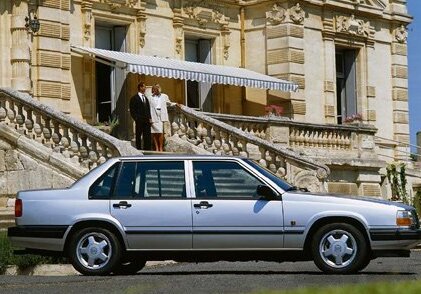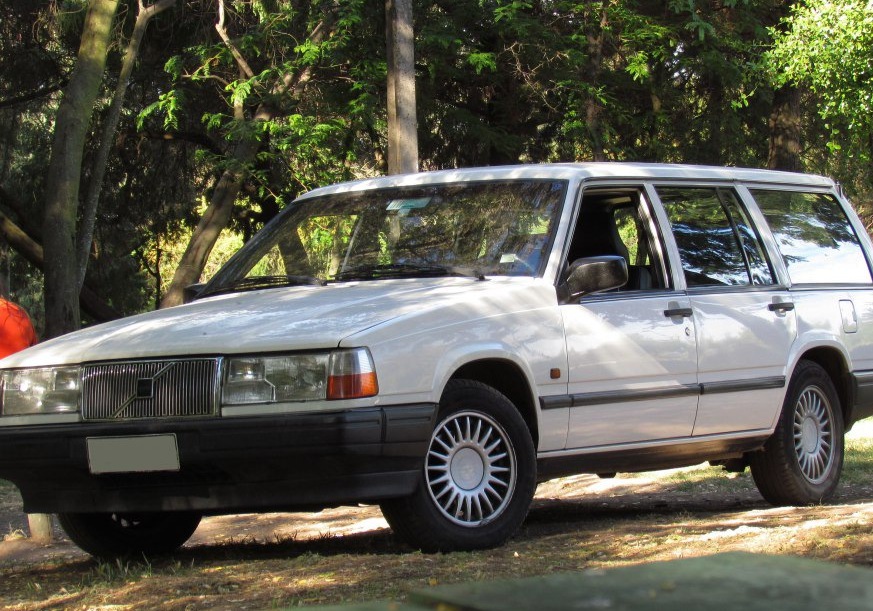
The Volvo 940 Combi (specifically the 945 variant) 2.3i Turbo, produced from 1991 to 1998, represents the pinnacle of Volvo’s long-running 900 series. This station wagon, known for its robust build quality and practicality, was a mainstay in the European market, offering a blend of performance, space, and safety. The 945 designation denotes the five-door wagon body style, and the 2.3i Turbo signifies the engine powering it. It sat within the 940 range as a higher-performance option, bridging the gap between the naturally aspirated models and the more focused performance variants like the later 960. The 940 series, built on Volvo’s robust rear-wheel-drive platform, was the last of the classic brick-shaped Volvos, and the 945 2.3i Turbo is a particularly sought-after version today.
Technical Specifications
| Brand | Volvo |
| Model | 940 |
| Generation | 940 Combi (945) |
| Type (Engine) | 2.3i Turbo (165 Hp) |
| Start of production | 1991 |
| End of production | 1998 |
| Powertrain Architecture | Internal Combustion engine |
| Body type | Station wagon (estate) |
| Seats | 5 |
| Doors | 5 |
| Fuel consumption (combined) | 9.9 l/100 km |
| Fuel consumption (US mpg) | 23.8 US mpg |
| Fuel consumption (UK mpg) | 28.5 UK mpg |
| Fuel consumption (km/l) | 10.1 km/l |
| Fuel Type | Petrol (Gasoline) |
| Acceleration 0 – 100 km/h | 9 sec |
| Acceleration 0 – 62 mph | 9 sec |
| Acceleration 0 – 60 mph | 8.6 sec |
| Maximum speed | 210 km/h (130.49 mph) |
| Weight-to-power ratio | 8.6 kg/Hp |
| Weight-to-torque ratio | 5.4 kg/Nm |
| Power | 165 Hp @ 5500 rpm |
| Power per litre | 71.2 Hp/l |
| Torque | 264 Nm @ 3450 rpm (194.72 lb.-ft. @ 3450 rpm) |
| Engine layout | Front, Longitudinal |
| Engine Model/Code | B230FT |
| Engine displacement | 2316 cm3 (141.33 cu. in.) |
| Number of cylinders | 4 |
| Engine configuration | Inline |
| Cylinder Bore | 96 mm (3.78 in.) |
| Piston Stroke | 80 mm (3.15 in.) |
| Compression ratio | 8.7:1 |
| Number of valves per cylinder | 2 |
| Fuel injection system | Multi-port manifold injection |
| Engine aspiration | Turbocharger |
| Valvetrain | OHC |
| Engine oil capacity | 3.9 l (4.12 US qt | 3.43 UK qt) |
| Coolant capacity | 9.3 l (9.83 US qt | 8.18 UK qt) |
| Kerb Weight | 1420 kg (3130.56 lbs.) |
| Max. weight | 1950 kg (4299.01 lbs.) |
| Max load | 530 kg (1168.45 lbs.) |
| Trunk (boot) space – minimum | 992 l (35.03 cu. ft.) |
| Trunk (boot) space – maximum | 2125 l (75.04 cu. ft.) |
| Fuel tank capacity | 75 l (19.81 US gal | 16.5 UK gal) |
| Length | 4810 mm (189.37 in.) |
| Width | 1750 mm (68.9 in.) |
| Height | 1435 mm (56.5 in.) |
| Wheelbase | 2770 mm (109.06 in.) |
| Front track | 1470 mm (57.87 in.) |
| Rear track | 1460 mm (57.48 in.) |
| Drivetrain Architecture | Rear wheel drive |
| Number of gears | 5 |
| Gearbox type | Manual transmission |
| Front suspension | Wishbone |
| Rear suspension | Coil spring |
| Front brakes | Ventilated discs |
| Rear brakes | Disc |
| Assisting systems | ABS (Anti-lock braking system) |
| Power steering | Hydraulic Steering |
| Tires size | 195/65 R15 V |
| Wheel rims size | 15 |
Powertrain & Engine Architecture
The heart of the 945 2.3i Turbo is the B230FT engine, a 2.3-liter inline-four cylinder powerplant. This engine is a descendant of Volvo’s long-running “Redblock” family, known for its durability and tunability. The ‘FT’ designation signifies a fuel-injected, turbocharged variant. The B230FT utilizes a Garrett turbocharger, boosting power output to 165 horsepower and 264 Nm (194.72 lb-ft) of torque. Fuel delivery is managed by Bosch multi-port fuel injection, providing precise control over the air-fuel mixture. The engine features a single overhead camshaft (OHC) design operating two valves per cylinder. The five-speed manual transmission, standard on this model, is a robust unit designed to handle the engine’s torque. The transmission’s gear ratios are geared towards providing a balance of acceleration and fuel efficiency, with a relatively long fifth gear for comfortable highway cruising.
Driving Characteristics
The 945 2.3i Turbo offers a distinctly 1990s driving experience. While not brutally fast by modern standards, the turbocharger provides a noticeable surge of power in the mid-range, making overtaking maneuvers relatively effortless. The rear-wheel-drive configuration contributes to a balanced feel, although the car’s weight (1420 kg / 3130.56 lbs) is noticeable. Compared to the naturally aspirated 940 models, the 2.3i Turbo offers significantly improved acceleration – around 9 seconds to 60 mph – and a higher top speed of 210 km/h (130.49 mph). The manual transmission allows for precise control, and the gear ratios are well-matched to the engine’s powerband. It doesn’t have the razor-sharp handling of some contemporary sports sedans, but it provides a secure and predictable driving experience, especially in adverse weather conditions.
Equipment & Trim Levels
The 945 2.3i Turbo typically came well-equipped, reflecting its position as a premium variant within the 940 range. Standard features included power windows, central locking, a basic stereo system, and heated front seats. Interior upholstery was typically cloth, although leather was available as an option. Dashboard configuration was functional and straightforward, prioritizing usability over flashy design. Optional extras included a sunroof, upgraded audio systems, and alloy wheels. Safety features, a Volvo hallmark, were also prominent, with ABS (Anti-lock Braking System) being standard equipment.
Chassis & Braking
The 945 2.3i Turbo utilizes a robust chassis with a wishbone front suspension and a coil spring rear suspension. The suspension setup is tuned for comfort and stability, providing a relatively smooth ride even on uneven surfaces. Braking duties are handled by ventilated discs at the front and solid discs at the rear. The ABS system enhances braking performance and control, particularly in slippery conditions. The car’s weight distribution is reasonably balanced, contributing to its predictable handling characteristics.
Market Reception & Comparison
The 945 2.3i Turbo was generally well-received by automotive critics. It was praised for its practicality, safety, and robust build quality. The turbocharged engine was seen as a significant improvement over the naturally aspirated models, providing a welcome boost in performance. Compared to other station wagons of the era, the 945 2.3i Turbo offered a compelling combination of space, performance, and safety. Fuel economy, at around 23.8 US mpg, was reasonable for a vehicle of its size and performance. Reliability was generally good, although turbocharger maintenance was a consideration. Compared to the later 960 models, the 945 2.3i Turbo offered a more raw and engaging driving experience, appealing to enthusiasts who preferred a more traditional rear-wheel-drive layout.
Legacy
The Volvo 945 2.3i Turbo has developed a strong following among classic Volvo enthusiasts. The B230FT engine is known for its durability and potential for modification, making it a popular choice for performance upgrades. While finding well-maintained examples can be challenging, the 945 2.3i Turbo remains a desirable vehicle in the used car market. Its combination of practicality, performance, and classic Volvo styling ensures its continued appeal for years to come. The robust construction and relatively simple mechanicals mean that, with proper maintenance, these cars can continue to provide reliable transportation for many more miles.