
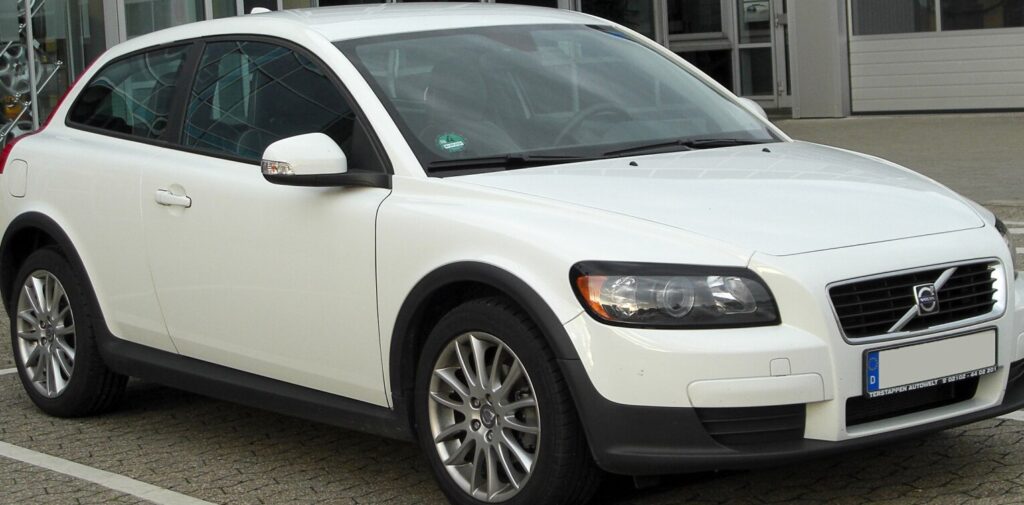
The Volvo C30 1.6 i 16V, produced between 2006 and 2010, represented the entry point into Volvo’s stylish and compact C30 range. Positioned as a premium small car, the C30 aimed to attract a younger demographic with its distinctive coupe-like profile and focus on design. This particular variant, powered by a 1.6-liter naturally aspirated engine producing 100 horsepower, served as the most accessible option within the C30 lineup, prioritizing fuel efficiency and affordability over outright performance. It was built on Volvo’s P1 platform, shared with the first-generation Ford Focus, and was primarily sold in the European market, though limited numbers were available in North America.
Technical Specifications
| Brand | Volvo |
| Model | C30 |
| Generation | C30 |
| Type (Engine) | 1.6 i 16V (100 Hp) |
| Start of production | 2006 |
| End of production | 2010 |
| Powertrain Architecture | Internal Combustion engine |
| Body type | Coupe |
| Seats | 4 |
| Doors | 3 |
| Fuel consumption (urban) | 9.3 l/100 km (25.3 US mpg) |
| Fuel consumption (extra urban) | 5.7 l/100 km (41.3 US mpg) |
| Fuel consumption (combined) | 7 l/100 km (33.6 US mpg) |
| CO2 emissions | 167 g/km |
| Fuel Type | Petrol (Gasoline) |
| Acceleration 0 – 100 km/h | 11.8 sec |
| Acceleration 0 – 62 mph | 11.8 sec |
| Acceleration 0 – 60 mph | 11.2 sec |
| Maximum speed | 185 km/h (114.95 mph) |
| Weight-to-power ratio | 12.8 kg/Hp |
| Weight-to-torque ratio | 8.5 kg/Nm |
| Power | 100 Hp @ 6000 rpm |
| Torque | 150 Nm @ 4000 rpm (110.63 lb.-ft. @ 4000 rpm) |
| Engine layout | Front, Transverse |
| Engine Model/Code | B4164S3 |
| Engine displacement | 1596 cm3 (97.39 cu. in.) |
| Number of cylinders | 4 |
| Engine configuration | Inline |
| Cylinder Bore | 79 mm (3.11 in.) |
| Piston Stroke | 81.4 mm (3.2 in.) |
| Compression ratio | 11:1 |
| Number of valves per cylinder | 4 |
| Fuel injection system | Multi-port manifold injection |
| Engine aspiration | Naturally aspirated engine |
| Valvetrain | DOHC |
| Engine oil capacity | 4 l (4.23 US qt | 3.52 UK qt) |
| Coolant capacity | 6.2 l (6.55 US qt | 5.46 UK qt) |
| Kerb Weight | 1279 kg (2819.71 lbs.) |
| Max. weight | 1700 kg (3747.86 lbs.) |
| Max load | 421 kg (928.15 lbs.) |
| Trunk (boot) space – minimum | 233 l (8.23 cu. ft.) |
| Fuel tank capacity | 55 l (14.53 US gal | 12.1 UK gal) |
| Length | 4252 mm (167.4 in.) |
| Width | 1782 mm (70.16 in.) |
| Height | 1447 mm (56.97 in.) |
| Wheelbase | 2640 mm (103.94 in.) |
| Front track | 1548 mm (60.94 in.) |
| Rear track | 1544 mm (60.79 in.) |
| Minimum turning circle | 11.1 m (36.42 ft.) |
| Drivetrain Architecture | Front wheel drive |
| Number of gears | 5 |
| Gearbox type | Manual transmission |
| Front suspension | Spring Strut |
| Rear suspension | Transverse stabilizer |
| Front brakes | Ventilated discs |
| Rear brakes | Ventilated discs |
| Assisting systems | ABS (Anti-lock braking system) |
| Steering type | Steering rack and pinion |
Powertrain & Engine Architecture
The C30 1.6 i 16V utilized Volvo’s B4164S3 engine, a 1.6-liter inline-four cylinder powerplant. This engine featured a double overhead camshaft (DOHC) valvetrain with four valves per cylinder, contributing to its relatively efficient breathing. Fuel delivery was managed by a multi-port fuel injection system. The engine produced 100 horsepower at 6000 rpm and 150 Nm (110.63 lb-ft) of torque at 4000 rpm. The engine’s 11:1 compression ratio was typical for naturally aspirated gasoline engines of the era. The engine was transversely mounted in the front of the vehicle, driving the front wheels. The standard transmission was a five-speed manual gearbox, offering a fairly conventional gear ratio spread designed for everyday usability rather than sporty performance. While an automatic transmission was offered in some C30 models, it wasn’t typically paired with this specific 1.6L engine.
Driving Characteristics
The 1.6-liter engine in the C30 provided adequate, but not exhilarating, performance. Acceleration from 0 to 60 mph took around 11.2 seconds, and the top speed was approximately 115 mph. The engine felt somewhat strained at higher RPMs, and its power delivery was relatively linear. The five-speed manual transmission was light and easy to operate, but the gear ratios were spaced to prioritize fuel economy over rapid acceleration. Compared to the more powerful 2.4-liter five-cylinder engines available in other C30 variants, the 1.6L felt noticeably slower, particularly during overtaking maneuvers. However, the lighter engine weight contributed to slightly improved handling and a more nimble feel in city driving.
Equipment & Trim Levels
The C30 1.6 i 16V typically came with a reasonable level of standard equipment. This included power windows and mirrors, central locking, a basic audio system, and ABS brakes. Interior upholstery was generally cloth, with a relatively simple dashboard layout. Optional extras included alloy wheels, a sunroof, upgraded audio systems, leather upholstery, and climate control. The C30’s interior design was a key selling point, offering a modern and Scandinavian aesthetic. Safety features were a Volvo hallmark, and even the base 1.6L model included features like side airbags and whiplash protection system (WHIPS).
Chassis & Braking
The C30’s chassis featured a MacPherson strut front suspension and a multi-link rear suspension, providing a comfortable and controlled ride. The front brakes were ventilated discs, while the rear brakes were also ventilated discs, a relatively uncommon feature in this class of vehicle. The steering was a rack and pinion system, offering precise and responsive handling. The C30’s relatively short wheelbase contributed to its agile handling characteristics. Stabilizer bars were fitted to both the front and rear axles to reduce body roll during cornering.
Market Reception & Comparison
The Volvo C30 1.6 i 16V was generally well-received by automotive critics, who praised its stylish design, comfortable interior, and strong safety credentials. However, the 1.6-liter engine was often criticized for being underpowered, particularly when compared to the more potent engine options available in the C30 range. Fuel economy was a strong point, with combined fuel consumption figures around 33.6 US mpg. In terms of reliability, the B4164S3 engine proved to be generally dependable, although regular maintenance was essential. Compared to rivals like the Audi A3 and BMW 1 Series, the C30 offered a more distinctive design and a focus on safety, but lacked the same level of performance and prestige.
Legacy
The Volvo C30, including the 1.6 i 16V variant, has developed a loyal following among enthusiasts who appreciate its unique styling and Scandinavian design. The B4164S3 engine, while not known for its performance, has proven to be a relatively reliable unit, and well-maintained examples are still relatively common on the used car market. The C30’s focus on safety and practicality, combined with its distinctive design, has ensured its place as a memorable and desirable small car from the early 21st century. Today, these cars represent an affordable entry point into Volvo ownership, offering a blend of style, safety, and Scandinavian charm.
