
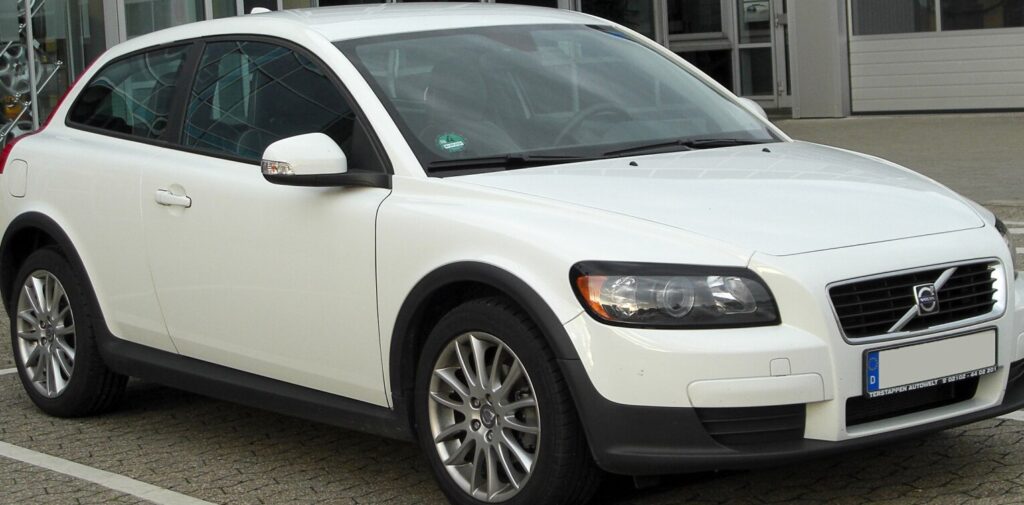
The Volvo C30 2.0D, produced between 2006 and 2010, represented Volvo’s foray into the premium compact coupe market. Positioned as a stylish and sporty alternative to traditional hatchbacks and sedans, the C30 aimed to attract a younger demographic to the Volvo brand. The 2.0D variant, equipped with a 136 horsepower diesel engine, served as a fuel-efficient and torque-rich option within the C30 lineup, appealing to buyers prioritizing economy without sacrificing driving enjoyment. It was built on Volvo’s P1 platform, shared with the first-generation Ford Focus and Mazda 3, but distinguished itself through unique styling and a more upscale interior.
Technical Specifications
| Brand | Volvo |
| Model | C30 |
| Generation | C30 |
| Type (Engine) | 2.0D (136 Hp) |
| Start of production | 2006 |
| End of production | 2010 |
| Powertrain Architecture | Internal Combustion engine |
| Body type | Coupe |
| Seats | 4 |
| Doors | 3 |
| Fuel consumption (urban) | 7.6 l/100 km (30.9 US mpg) |
| Fuel consumption (extra urban) | 4.6 l/100 km (51.1 US mpg) |
| Fuel consumption (combined) | 5.7 l/100 km (41.3 US mpg) |
| CO2 emissions | 151 g/km |
| Fuel Type | Diesel |
| Acceleration 0 – 100 km/h | 9.4 sec |
| Acceleration 0 – 62 mph | 9.4 sec |
| Acceleration 0 – 60 mph | 8.9 sec |
| Maximum speed | 210 km/h (130.49 mph) |
| Weight-to-power ratio | 10.4 kg/Hp |
| Weight-to-torque ratio | 4.4 kg/Nm |
| Power | 136 Hp @ 4000 rpm |
| Torque | 320 Nm @ 2000 rpm (236.02 lb.-ft. @ 2000 rpm) |
| Engine layout | Front, Transverse |
| Engine Model/Code | D4204T |
| Engine displacement | 1998 cm3 (121.93 cu. in.) |
| Number of cylinders | 4 |
| Engine configuration | Inline |
| Cylinder Bore | 85 mm (3.35 in.) |
| Piston Stroke | 88 mm (3.46 in.) |
| Compression ratio | 18.5:1 |
| Number of valves per cylinder | 4 |
| Fuel injection system | Diesel Commonrail |
| Engine aspiration | Turbocharger, Intercooler |
| Engine oil capacity | 5.5 l (5.81 US qt | 4.84 UK qt) |
| Coolant | 9.5 l (10.04 US qt | 8.36 UK qt) |
| Kerb Weight | 1421 kg (3132.77 lbs.) |
| Max. weight | 1840 kg (4056.51 lbs.) |
| Max load | 419 kg (923.74 lbs.) |
| Trunk (boot) space – minimum | 233 l (8.23 cu. ft.) |
| Fuel tank capacity | 52 l (13.74 US gal | 11.44 UK gal) |
| Length | 4252 mm (167.4 in.) |
| Width | 1782 mm (70.16 in.) |
| Height | 1447 mm (56.97 in.) |
| Wheelbase | 2640 mm (103.94 in.) |
| Front track | 1548 mm (60.94 in.) |
| Rear track | 1544 mm (60.79 in.) |
| Minimum turning circle | 11.1 m (36.42 ft.) |
| Drivetrain Architecture | Front wheel drive |
| Number of gears | 6 |
| Gearbox type | Manual transmission |
| Front suspension | Spring Strut |
| Rear suspension | Transverse stabilizer |
| Front brakes | Ventilated discs |
| Rear brakes | Ventilated discs |
| Assisting systems | ABS (Anti-lock braking system) |
| Steering type | Steering rack and pinion |
INTRODUCTION
The Volvo C30 2.0D, launched in 2006, was a distinctive three-door coupe designed to inject some youthful energy into Volvo’s traditionally conservative lineup. It represented a departure from the brand’s established sedan and wagon focus, aiming for a more emotionally driven and design-focused customer. The 2.0D model, powered by a turbocharged diesel engine, was a key component of the C30 range, offering a balance of performance, fuel efficiency, and practicality. It was available throughout the C30’s production run, ending in 2010, and became a popular choice in European markets where diesel engines were favored for their economy.
Powertrain & Engine Architecture
At the heart of the C30 2.0D lies the Volvo D4204T engine, a 1998cc inline-four cylinder diesel. This engine is part of Volvo’s modular engine family and utilizes a common-rail direct injection system, delivering fuel directly into the combustion chamber at extremely high pressure. This technology, coupled with a variable geometry turbocharger and intercooler, optimizes combustion for increased power and efficiency. The D4204T produces 136 horsepower at 4000 rpm and a substantial 320 Nm (236 lb-ft) of torque at just 2000 rpm. The engine features four valves per cylinder and a compression ratio of 18.5:1. The C30 2.0D was exclusively offered with a six-speed manual transmission, providing precise gear changes and enhancing the driving experience. The transmission’s gear ratios were tuned to maximize the engine’s torque output, providing strong acceleration in everyday driving situations.
Driving Characteristics
The C30 2.0D offered a surprisingly engaging driving experience for a compact coupe. The high torque output of the diesel engine meant strong acceleration from low speeds, making it well-suited for urban driving and overtaking maneuvers. While not a sports car, the C30 2.0D felt nimble and responsive, thanks to its relatively lightweight construction and well-tuned suspension. The six-speed manual transmission allowed drivers to fully exploit the engine’s powerband. Compared to the petrol-powered C30 variants, the 2.0D prioritized fuel economy and torque over outright horsepower. The manual transmission also provided a more connected feel than the optional automatic transmissions available on other C30 models. The steering was precise and well-weighted, contributing to a confident and enjoyable driving experience.
Equipment & Trim Levels
The C30 2.0D typically came equipped with a generous level of standard features. These included climate control, power windows and mirrors, a CD stereo system, and alloy wheels. Safety was, as with all Volvos, a priority, with standard features like ABS brakes, traction control, and multiple airbags. Higher trim levels offered options such as leather upholstery, a premium sound system, and parking sensors. Interior design was modern and minimalist, reflecting Scandinavian design principles. The C30’s unique dashboard layout featured a floating center console, giving the cabin a distinctive look. Optional extras included a panoramic sunroof and various customization options for interior trim and exterior colors.
Chassis & Braking
The C30 2.0D utilized a MacPherson strut front suspension and a multi-link rear suspension, providing a comfortable yet controlled ride. The suspension was tuned to balance handling and ride quality, offering a good compromise for everyday driving. Braking duties were handled by ventilated disc brakes on all four wheels, providing ample stopping power. The anti-lock braking system (ABS) and electronic brakeforce distribution (EBD) further enhanced safety. The C30’s chassis was designed to be rigid and strong, contributing to its handling stability and crashworthiness. Stabilizer bars were fitted to both the front and rear axles to reduce body roll during cornering.
Market Reception & Comparison
The Volvo C30 2.0D was generally well-received by automotive critics. It was praised for its stylish design, comfortable interior, and fuel-efficient engine. However, some critics noted the limited rear passenger space and the relatively small trunk capacity. Compared to other C30 variants, the 2.0D offered superior fuel economy and torque, making it a practical choice for drivers covering long distances. Against competitors like the Audi A3 and BMW 1 Series, the C30 2.0D offered a unique blend of Scandinavian design and practicality. The diesel engine provided competitive fuel economy, although it wasn’t as refined as some of its rivals.
Legacy
The Volvo C30 2.0D has proven to be a relatively reliable vehicle, with the D4204T engine generally regarded as durable and long-lasting. Common maintenance items include regular oil changes, filter replacements, and timing belt service. On the used car market, the C30 2.0D remains a popular choice for buyers seeking a stylish and economical coupe. Its distinctive design and practical features continue to appeal to a wide range of drivers. While parts availability isn’t an issue, specialized Volvo mechanics are recommended for more complex repairs. The C30, and particularly the 2.0D variant, represents a unique chapter in Volvo’s history, showcasing the brand’s willingness to experiment with new designs and target a younger audience.
