
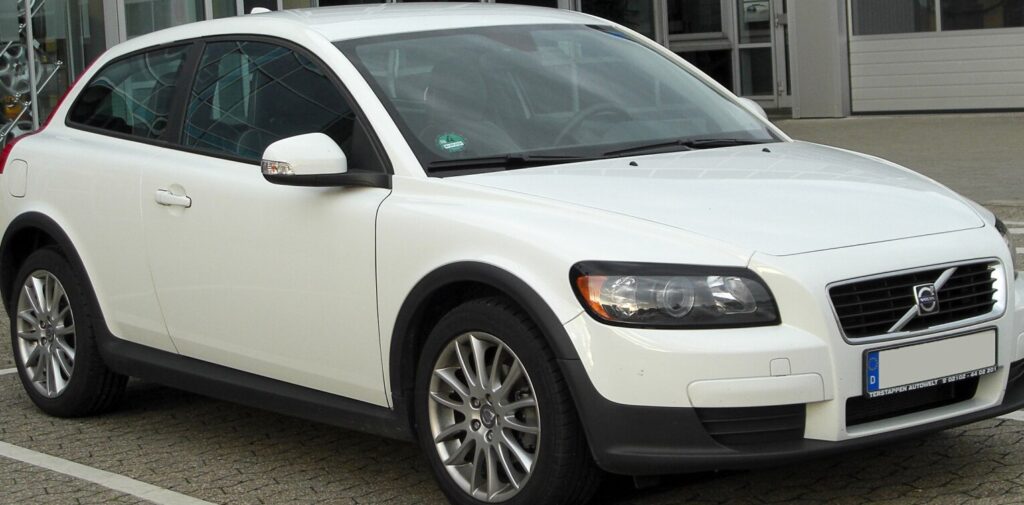
The Volvo C30 2.4i 20V, produced from 2006 to 2010, represents a unique offering in Volvo’s lineup – a sporty, compact coupe designed to appeal to a younger demographic. Positioned as the entry-level engine option within the C30 range, it provided a balance between performance and affordability. The C30 itself was built on Volvo’s P1 platform, shared with the Mazda 3 and Ford Focus, marking a shift towards more collaborative engineering within the Ford Motor Company at the time. This particular 2.4-liter variant aimed to deliver a more accessible driving experience compared to the higher-performance turbocharged models.
Technical Specifications
| Brand | Volvo |
| Model | C30 |
| Generation | C30 |
| Type (Engine) | 2.4 i 20V (170 Hp) |
| Start of production | 2006 |
| End of production | 2010 |
| Powertrain Architecture | Internal Combustion engine |
| Body type | Coupe |
| Seats | 4 |
| Doors | 3 |
| Fuel consumption (urban) | 12 l/100 km (19.6 US mpg) |
| Fuel consumption (extra urban) | 6.3 l/100 km (37.3 US mpg) |
| Fuel consumption (combined) | 8.4 l/100 km (28 US mpg) |
| CO2 emissions | 200 g/km |
| Fuel Type | Petrol (Gasoline) |
| Acceleration 0 – 100 km/h | 8.1 sec |
| Acceleration 0 – 62 mph | 8.1 sec |
| Acceleration 0 – 60 mph | 7.7 sec |
| Maximum speed | 220 km/h (136.7 mph) |
| Weight-to-power ratio | 8.4 kg/Hp |
| Weight-to-torque ratio | 6.2 kg/Nm |
| Power | 170 Hp @ 6000 rpm |
| Torque | 230 Nm @ 4400 rpm (169.64 lb.-ft. @ 4400 rpm) |
| Engine layout | Front, Transverse |
| Engine Model/Code | B5244S4 |
| Engine displacement | 2435 cm3 (148.59 cu. in.) |
| Number of cylinders | 5 |
| Engine configuration | Inline |
| Cylinder Bore | 83 mm (3.27 in.) |
| Piston Stroke | 90 mm (3.54 in.) |
| Compression ratio | 10.3:1 |
| Number of valves per cylinder | 4 |
| Fuel injection system | Multi-port manifold injection |
| Engine aspiration | Naturally aspirated |
| Valvetrain | DOHC |
| Engine oil capacity | 5.5 l (5.81 US qt | 4.84 UK qt) |
| Coolant | 9.5 l (10.04 US qt | 8.36 UK qt) |
| Kerb Weight | 1429 kg (3150.41 lbs.) |
| Max. weight | 1840 kg (4056.51 lbs.) |
| Max load | 411 kg (906.1 lbs.) |
| Trunk (boot) space – minimum | 233 l (8.23 cu. ft.) |
| Fuel tank capacity | 62 l (16.38 US gal | 13.64 UK gal) |
| Length | 4252 mm (167.4 in.) |
| Width | 1782 mm (70.16 in.) |
| Height | 1447 mm (56.97 in.) |
| Wheelbase | 2640 mm (103.94 in.) |
| Front track | 1548 mm (60.94 in.) |
| Rear (Back) track | 1544 mm (60.79 in.) |
| Minimum turning circle | 11.1 m (36.42 ft.) |
| Drivetrain Architecture | Front wheel drive |
| Number of gears | 5 |
| Gearbox type | Manual transmission |
Powertrain & Engine Architecture
The heart of the C30 2.4i is Volvo’s B5244S4 engine, a naturally aspirated 2.4-liter inline-five cylinder powerplant. This engine, a staple in Volvo’s mid-size offerings for years, is known for its smoothness and relative durability. The “20V” designation indicates the engine features 20 valves – four valves per cylinder – contributing to its breathing efficiency. Fuel delivery is managed by a multi-port fuel injection system, providing precise fuel metering for optimal combustion. The engine utilizes a double overhead camshaft (DOHC) valvetrain, further enhancing its volumetric efficiency. The five-speed manual transmission was the standard offering, providing a direct connection between the engine and the front wheels. This transmission was chosen for its simplicity and reliability, aligning with the overall character of this trim level.
Driving Characteristics
The C30 2.4i, with its 170 horsepower and 169.64 lb-ft of torque, offered a respectable, though not exhilarating, driving experience. Acceleration from 0-60 mph took around 7.7 seconds, making it competitive with other compact coupes of the era. The five-speed manual transmission provided adequate control, but the gear ratios were spaced to prioritize fuel economy and cruising comfort over outright performance. Compared to the turbocharged T5 version of the C30, the 2.4i felt noticeably less powerful, particularly during overtaking maneuvers. However, the naturally aspirated engine delivered a more linear power delivery, making it easier to modulate throttle response. The front-wheel-drive configuration provided predictable handling, though it lacked the all-weather capability of Volvo’s all-wheel-drive systems.
Equipment & Trim Levels
The C30 2.4i typically came standard with features like air conditioning, power windows and locks, a CD stereo system, and alloy wheels. Safety was, as always with Volvo, a priority, with standard inclusion of ABS brakes, airbags, and side impact protection systems. Interior upholstery was typically cloth, with optional leather available. Common optional extras included a sunroof, upgraded audio system, and metallic paint finishes. The C30’s interior design was minimalist and modern, reflecting the Scandinavian design aesthetic. The dashboard layout was driver-focused, with easy-to-read gauges and intuitive controls.
Chassis & Braking
The C30’s chassis was tuned to provide a balance between comfort and handling. The front suspension utilized MacPherson struts, while the rear employed a multi-link setup. A transverse stabilizer bar was fitted to both axles to reduce body roll during cornering. Braking duties were handled by ventilated discs on all four wheels, providing ample stopping power. The C30’s relatively low weight contributed to its agile handling characteristics. The steering was a rack-and-pinion system, offering precise and responsive steering feel.
Market Reception & Comparison
The Volvo C30 2.4i was generally well-received by automotive critics, who praised its stylish design, comfortable interior, and strong safety credentials. However, some reviewers noted that the 2.4-liter engine lacked the punch of the turbocharged T5 model. Fuel economy was considered average for its class, with combined figures around 28 US mpg. Compared to rivals like the Audi A3 and BMW 1 Series, the C30 offered a unique blend of Scandinavian design and Volvo’s renowned safety features. The 2.4i variant was often seen as a more sensible and affordable alternative to the more expensive and performance-oriented T5.
Legacy
The Volvo C30, while not a massive sales success, has gained a cult following among enthusiasts who appreciate its distinctive styling and driving dynamics. The 2.4i engine, while not the most powerful option, has proven to be remarkably reliable, with many examples still on the road today. Maintenance costs are generally reasonable, and parts availability is good. On the used car market, the C30 2.4i represents a relatively affordable entry point into Volvo ownership, offering a stylish and safe coupe experience.
