
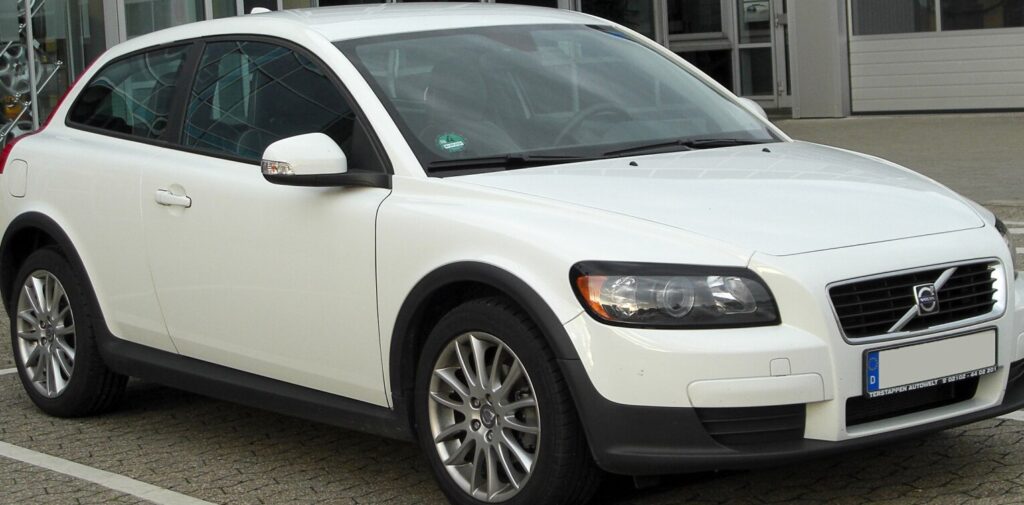
The Volvo C30 2.4i 20V Automatic, produced between 2006 and 2010, represents a unique offering within the first generation (2006-2013) of Volvo’s compact coupe. Positioned as a more stylish and driver-focused alternative to the traditional Volvo sedan or wagon, the C30 aimed to attract a younger demographic. The 2.4i variant, equipped with the five-speed automatic transmission, served as a mid-range option, balancing performance with ease of use. It slotted between the base 1.8L model and the high-performance T5 turbocharged version, offering a comfortable and refined driving experience.
Technical Specifications
| Brand | Volvo |
| Model | C30 |
| Generation | C30 |
| Type (Engine) | 2.4 i 20V (170 Hp) Automatic |
| Start of production | 2006 |
| End of production | 2010 |
| Powertrain Architecture | Internal Combustion engine |
| Body type | Coupe |
| Seats | 4 |
| Doors | 3 |
| Fuel consumption (urban) | 13.1 l/100 km (18 US mpg, 21.6 UK mpg) |
| Fuel consumption (extra urban) | 6.6 l/100 km (35.6 US mpg, 42.8 UK mpg) |
| Fuel consumption (combined) | 9 l/100 km (26.1 US mpg, 31.4 UK mpg) |
| CO2 emissions | 214 g/km |
| Fuel Type | Petrol (Gasoline) |
| Acceleration 0 – 100 km/h | 8.8 sec |
| Acceleration 0 – 62 mph | 8.8 sec |
| Acceleration 0 – 60 mph | 8.4 sec |
| Maximum speed | 220 km/h (136.7 mph) |
| Weight-to-power ratio | 8.4 kg/Hp, 119 Hp/tonne |
| Weight-to-torque ratio | 6.2 kg/Nm, 161 Nm/tonne |
| Power | 170 Hp @ 6000 rpm |
| Power per litre | 69.8 Hp/l |
| Torque | 230 Nm @ 4400 rpm (169.64 lb.-ft. @ 4400 rpm) |
| Engine layout | Front, Transverse |
| Engine Model/Code | B5244S4 |
| Engine displacement | 2435 cm3 (148.59 cu. in.) |
| Number of cylinders | 5 |
| Engine configuration | Inline |
| Cylinder Bore | 83 mm (3.27 in.) |
| Piston Stroke | 90 mm (3.54 in.) |
| Compression ratio | 10.3:1 |
| Number of valves per cylinder | 4 |
| Fuel injection system | Multi-port manifold injection |
| Engine aspiration | Naturally aspirated engine |
| Valvetrain | DOHC |
| Engine oil capacity | 5.5 l (5.81 US qt | 4.84 UK qt) |
| Coolant | 10 l (10.57 US qt | 8.8 UK qt) |
| Kerb Weight | 1429 kg (3150.41 lbs.) |
| Max. weight | 1840 kg (4056.51 lbs.) |
| Max load | 411 kg (906.1 lbs.) |
| Trunk (boot) space – minimum | 233 l (8.23 cu. ft.) |
| Fuel tank capacity | 62 l (16.38 US gal | 13.64 UK gal) |
| Length | 4252 mm (167.4 in.) |
| Width | 1782 mm (70.16 in.) |
| Height | 1447 mm (56.97 in.) |
| Wheelbase | 2640 mm (103.94 in.) |
| Front track | 1548 mm (60.94 in.) |
| Rear (Back) track | 1544 mm (60.79 in.) |
| Minimum turning circle | 11.1 m (36.42 ft.) |
| Drivetrain Architecture | ICE, Front wheel drive |
| Number of gears and type of gearbox | 5 gears, automatic transmission |
| Front suspension | Spring Strut |
| Rear suspension | Transverse stabilizer |
| Front brakes | Ventilated discs |
| Rear brakes | Ventilated discs |
| Assisting systems | ABS (Anti-lock braking system) |
| Steering type | Steering rack and pinion |
Powertrain & Engine Architecture
The heart of the C30 2.4i Automatic is Volvo’s B5244S4 engine, a naturally aspirated 2.4-liter inline-five cylinder powerplant. This engine, a staple of Volvo’s mid-size offerings for many years, is known for its smoothness and durability. The “20V” designation indicates the engine’s use of 20 valves (four valves per cylinder), contributing to its breathing efficiency. Fuel delivery is managed by a multi-port fuel injection system, providing precise fuel metering for optimal combustion. The engine utilizes a double overhead camshaft (DOHC) valvetrain, further enhancing its volumetric efficiency. Paired with this engine is a five-speed automatic transmission, offering convenient shifting for everyday driving. This transmission, while not known for its sportiness, provides smooth and predictable gear changes. The automatic transmission was chosen to broaden the C30’s appeal to buyers prioritizing comfort and ease of use over outright performance.
Driving Characteristics
The 2.4i Automatic C30 delivers a comfortable and refined driving experience. With 170 horsepower and 230 Nm (169.64 lb.-ft.) of torque, acceleration is adequate, reaching 0-60 mph in approximately 8.4 seconds. However, it’s noticeably slower than the turbocharged T5 model. The automatic transmission’s gear ratios are tuned for fuel efficiency and smooth cruising rather than aggressive acceleration. While the transmission offers a manual shift mode, it lacks the responsiveness of a dedicated sports automatic. The C30’s relatively low weight (1429 kg / 3150.41 lbs) helps to mitigate the engine’s modest power output, providing a reasonably engaging driving experience. The steering is precise and well-weighted, contributing to a confident feel on the road.
Equipment & Trim Levels
The C30 2.4i Automatic typically came standard with features such as air conditioning, power windows and locks, a CD stereo system, and alloy wheels. Safety was, as always with Volvo, a priority, with standard equipment including ABS brakes, traction control, and multiple airbags. Optional extras included leather upholstery, a sunroof, premium audio systems, and parking sensors. Interior trim levels varied, with options for different fabric and color combinations. The dashboard layout is clean and functional, typical of Volvo’s Scandinavian design aesthetic.
Chassis & Braking
The C30 utilizes a MacPherson strut front suspension and a multi-link rear suspension, providing a comfortable ride and good handling characteristics. The front suspension incorporates a stabilizer bar to reduce body roll during cornering. Braking duties are handled by ventilated discs on all four wheels, providing ample stopping power. The inclusion of ABS (Anti-lock Braking System) further enhances safety by preventing wheel lockup during hard braking. The C30’s chassis is relatively stiff, contributing to its responsive handling.
Market Reception & Comparison
The Volvo C30 2.4i Automatic received generally positive reviews, with critics praising its stylish design, comfortable interior, and strong safety credentials. However, some reviewers noted that the 2.4i engine lacked the punch of the T5 model. Fuel economy was considered average for its class, with combined fuel consumption around 9 l/100 km (26.1 US mpg). Compared to the T5, the 2.4i offered a more affordable entry point into the C30 range, appealing to buyers who prioritized comfort and fuel efficiency over outright performance. The 1.8L base model was even more economical but lacked the 2.4i’s power and refinement.
Legacy
The Volvo C30, while not a massive sales success, has gained a following among enthusiasts who appreciate its unique styling and Scandinavian design. The B5244S4 engine is known for its reliability and longevity, and well-maintained examples of the C30 2.4i Automatic can still provide years of dependable service. The automatic transmission, while not the most exciting, is generally reliable if properly serviced. Today, the C30 represents an interesting and affordable entry point into the Volvo brand, offering a distinctive alternative to more mainstream compact cars. Finding parts is generally straightforward, as the engine and many other components were used in a variety of Volvo models.
