
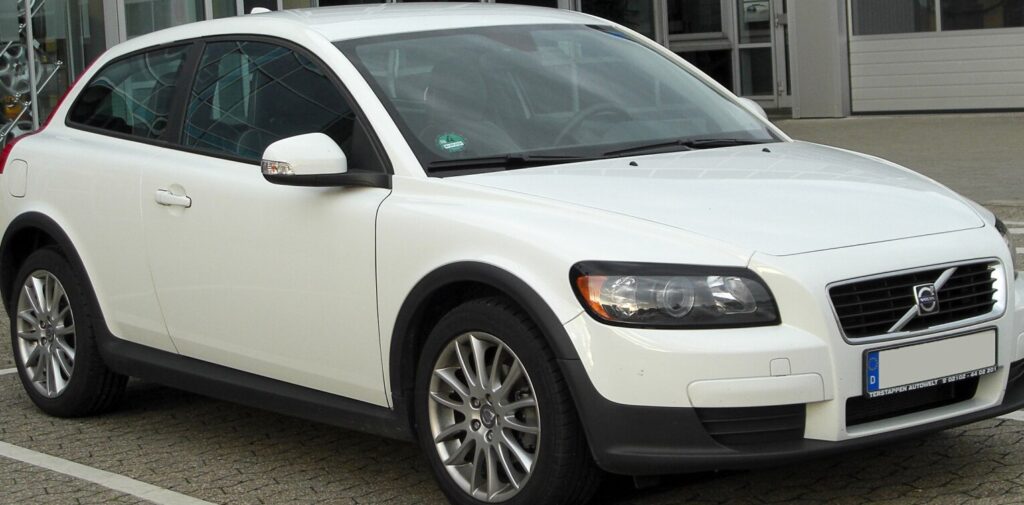
The Volvo C30 2.5 i 20V T5, produced from 2008 to 2010, represents a distinctive offering within the second generation of Volvo’s C30 compact coupe. Built on the Volvo P1 platform – shared with the Mazda 3 and Ford Focus – the C30 aimed to attract a younger demographic with its sporty styling and engaging driving dynamics. The 2.5 i T5 variant, equipped with the 230 horsepower turbocharged five-cylinder engine, served as the performance flagship of the C30 range, positioned above the base 1.6 and 2.0 liter models. It offered a blend of Scandinavian practicality and spirited performance, appealing to buyers seeking a unique and stylish alternative to more conventional hatchbacks.
Technical Specifications
| Brand | Volvo |
| Model | C30 |
| Generation | C30 |
| Type (Engine) | 2.5 i 20V T5 (230 Hp) |
| Start of production | 2008 |
| End of production | 2010 |
| Powertrain Architecture | Internal Combustion engine |
| Body type | Coupe |
| Seats | 4 |
| Doors | 3 |
| Fuel consumption (economy) – urban | 12.6 l/100 km (18.7 US mpg, 22.4 UK mpg, 7.9 km/l) |
| Fuel consumption (economy) – extra urban | 6.4 l/100 km (36.8 US mpg, 44.1 UK mpg, 15.6 km/l) |
| Fuel consumption (economy) – combined | 8.7 l/100 km (27 US mpg, 32.5 UK mpg, 11.5 km/l) |
| CO2 emissions | 208 g/km |
| Fuel Type | Petrol (Gasoline) |
| Acceleration 0 – 100 km/h | 6.7 sec |
| Acceleration 0 – 62 mph | 6.7 sec |
| Acceleration 0 – 60 mph | 6.4 sec |
| Maximum speed | 240 km/h (149.13 mph) |
| Weight-to-power ratio | 6.2 kg/Hp, 161.7 Hp/tonne |
| Weight-to-torque ratio | 4.4 kg/Nm, 225 Nm/tonne |
| Power | 230 Hp @ 5000 rpm |
| Power per litre | 91.2 Hp/l |
| Torque | 320 Nm @ 1500-5000 rpm (236.02 lb.-ft. @ 1500-5000 rpm) |
| Engine layout | Front, Transverse |
| Engine Model/Code | B5254T7 |
| Engine displacement | 2521 cm3 (153.84 cu. in.) |
| Number of cylinders | 5 |
| Engine configuration | Inline |
| Cylinder Bore | 83 mm (3.27 in.) |
| Piston Stroke | 93.2 mm (3.67 in.) |
| Compression ratio | 9:1 |
| Number of valves per cylinder | 4 |
| Fuel injection system | Multi-port manifold injection |
| Engine aspiration | Turbocharger, Intercooler |
| Engine oil capacity | 5.8 l (6.13 US qt | 5.1 UK qt) |
| Coolant | 9.5 l (10.04 US qt | 8.36 UK qt) |
| Kerb Weight | 1422 kg (3134.97 lbs.) |
| Max. weight | 1860 kg (4100.6 lbs.) |
| Max load | 438 kg (965.62 lbs.) |
| Trunk (boot) space – minimum | 233 l (8.23 cu. ft.) |
| Fuel tank capacity | 62 l (16.38 US gal | 13.64 UK gal) |
| Permitted trailer load with brakes (12%) | 1500 kg (3306.93 lbs.) |
| Permitted trailer load without brakes | 700 kg (1543.24 lbs.) |
| Permitted towbar download | 75 kg (165.35 lbs.) |
| Length | 4252 mm (167.4 in.) |
| Width | 1782 mm (70.16 in.) |
| Width including mirrors | 2039 mm (80.28 in.) |
| Height | 1447 mm (56.97 in.) |
| Wheelbase | 2640 mm (103.94 in.) |
| Front track | 1535 mm (60.43 in.) |
| Rear (Back) track | 1531 mm (60.28 in.) |
| Minimum turning circle | 10.6 m (34.78 ft.) |
| Drivetrain Architecture | The Internal combustion engine (ICE) drives the front wheels of the vehicle. |
| Drive wheel | Front wheel drive |
| Number of gears and type of gearbox | 6 gears, manual transmission |
| Front suspension | Spring Strut |
| Rear suspension | Transverse stabilizer |
| Front brakes | Ventilated discs |
| Rear brakes | Ventilated discs |
| Assisting systems | ABS (Anti-lock braking system) |
| Steering type | Steering rack and pinion |
| Tires size | 205/55 R16 |
| Wheel rims size | 16 |
Powertrain & Engine Architecture
The heart of the C30 T5 is Volvo’s B5254T7 engine, a 2.5-liter inline-five cylinder powerplant. This engine is a descendant of Volvo’s long-running whiteblock engine family, known for its robustness and tuning potential. The B5254T7 features a light-pressure turbocharger with an intercooler, multi-port fuel injection, and a 9:1 compression ratio. The engine’s variable valve timing system optimizes performance across the rev range. The engine produces 230 horsepower at 5000 rpm and 320 Nm (236 lb-ft) of torque between 1500 and 5000 rpm. The standard transmission for the T5 was a 6-speed manual gearbox, providing precise control and enhancing the driving experience. While a 5-speed automatic transmission was available, it was less common and generally considered to slightly diminish the car’s performance feel.
Driving Characteristics
The C30 T5 delivers a noticeably more engaging driving experience than its lower-powered siblings. The turbocharged five-cylinder provides strong acceleration, with 0-60 mph times around 6.4 seconds. The manual transmission allows for precise gear changes, and the chassis is well-balanced, offering good handling and stability. The steering is direct and responsive, contributing to a confident feel on winding roads. Compared to the 1.6 and 2.0 liter models, the T5 offers significantly more power and torque, making it more capable for overtaking and highway cruising. The automatic transmission, while offering convenience, does result in some power loss and a less direct connection to the engine.
Equipment & Trim Levels
The C30 T5 typically came well-equipped, reflecting its position as the range-topping model. Standard features included climate control, power windows and mirrors, a premium audio system, and alloy wheels. Leather upholstery and a sunroof were common optional extras. The interior design of the C30 is minimalist and Scandinavian, with a focus on functionality and simplicity. The dashboard layout is clean and uncluttered, and the seats are supportive and comfortable. Trim levels varied slightly depending on the market, but generally offered a range of customization options, including different interior color schemes and exterior styling packages.
Chassis & Braking
The C30’s chassis is based on the Ford Focus C-platform, providing a solid foundation for its sporty aspirations. The front suspension utilizes MacPherson struts, while the rear features a multi-link setup. This configuration delivers a good balance between ride comfort and handling precision. The T5 model typically featured larger diameter brakes than the base models, providing improved stopping power. All C30s were equipped with ABS (Anti-lock Braking System) as standard. The suspension tuning was slightly firmer in the T5 compared to the lower-powered models, further enhancing its handling characteristics.
Market Reception & Comparison
The Volvo C30 T5 received generally positive reviews from automotive critics. It was praised for its stylish design, engaging driving dynamics, and strong performance. However, some critics noted its limited rear passenger space and relatively small trunk capacity. Compared to rivals like the Audi A3 and BMW 1 Series, the C30 offered a unique blend of Scandinavian design and practicality. The T5 variant was often seen as a more compelling alternative to the base models, offering a significant performance upgrade without sacrificing too much fuel economy. Fuel economy figures averaged around 27 mpg combined, which was respectable for a performance-oriented hatchback.
Legacy
The Volvo C30 T5 has developed a loyal following among enthusiasts. The B5254T7 engine is known for its reliability and durability, and the car’s overall build quality is generally high. While not a high-volume seller, the C30 T5 remains a sought-after model on the used car market, particularly among those looking for a stylish and engaging coupe. Maintenance costs are generally reasonable, although sourcing parts for some of the more specialized components can sometimes be challenging. The C30 T5 represents a unique chapter in Volvo’s history, showcasing the brand’s willingness to experiment with design and performance.
