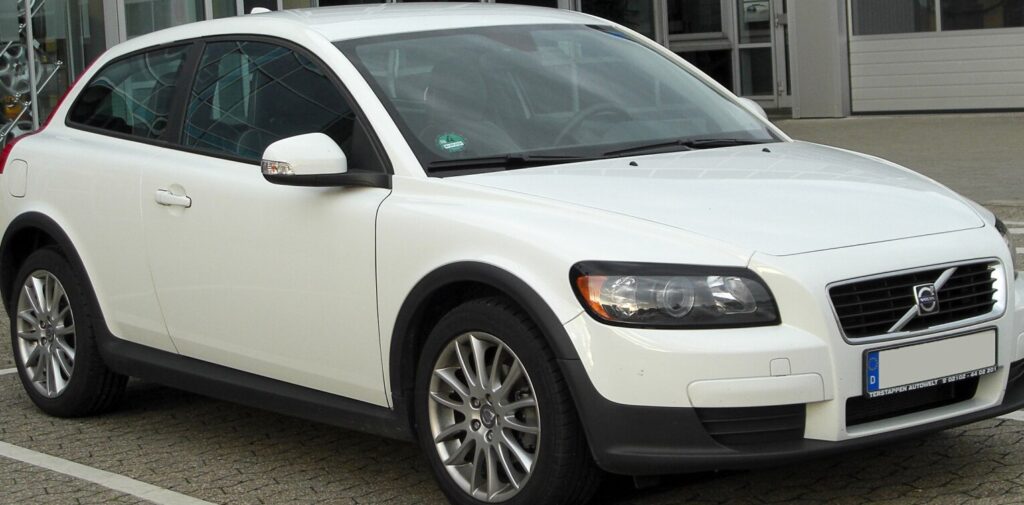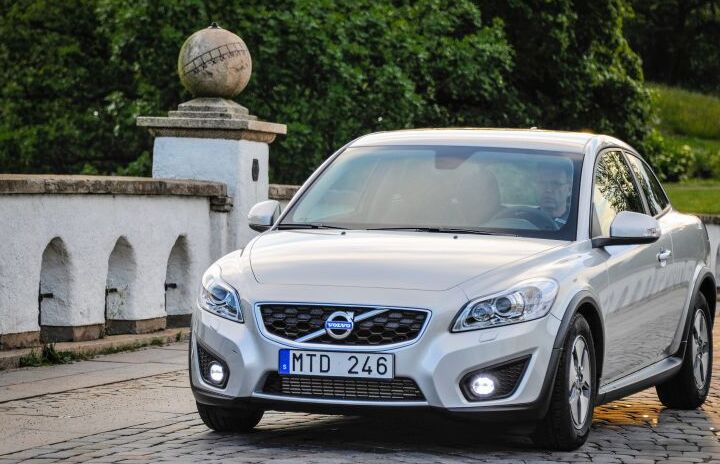
The Volvo C30 1.6 16V, produced from 2010 to 2013 as part of the C30 facelift, represented an entry-level offering within Volvo’s compact coupe lineup. Positioned below the more powerful 2.0L and T5 variants, this model aimed to provide a more accessible and fuel-efficient option for buyers attracted to the C30’s distinctive Scandinavian design. It was built on Volvo’s 1HX0 platform, shared with the first-generation Ford Focus, and primarily sold in the European market, with limited availability in North America. This variant focused on providing a stylish and practical vehicle for urban driving, prioritizing economy over outright performance.
Technical Specifications
| Brand | Volvo |
| Model | C30 |
| Generation | C30 (facelift 2010) |
| Type (Engine) | 1.6 16V (100 Hp) |
| Start of production | 2010 |
| End of production | 2013 |
| Powertrain Architecture | Internal Combustion engine |
| Body type | Coupe |
| Seats | 4 |
| Doors | 3 |
| Fuel consumption (urban) | 9.3 l/100 km (25.3 US mpg) |
| Fuel consumption (extra urban) | 5.7 l/100 km (41.3 US mpg) |
| Fuel consumption (combined) | 7 l/100 km (33.6 US mpg) |
| CO2 emissions | 167 g/km |
| Fuel Type | Petrol (Gasoline) |
| Acceleration 0 – 100 km/h | 11.8 sec |
| Acceleration 0 – 62 mph | 11.8 sec |
| Acceleration 0 – 60 mph | 11.2 sec |
| Maximum speed | 185 km/h (114.95 mph) |
| Weight-to-power ratio | 13.5 kg/Hp |
| Weight-to-torque ratio | 9 kg/Nm |
| Power | 100 Hp @ 6000 rpm |
| Torque | 150 Nm @ 4000 rpm (110.63 lb.-ft. @ 4000 rpm) |
| Engine layout | Front, Transverse |
| Engine Model/Code | B4164S3 |
| Engine displacement | 1596 cm3 (97.39 cu. in.) |
| Number of cylinders | 4 |
| Engine configuration | Inline |
| Cylinder Bore | 79 mm (3.11 in.) |
| Piston Stroke | 81.4 mm (3.2 in.) |
| Compression ratio | 11:1 |
| Number of valves per cylinder | 4 |
| Fuel injection system | Multi-port manifold injection |
| Engine aspiration | Naturally aspirated engine |
| Valvetrain | DOHC |
| Engine oil capacity | 4 l (4.23 US qt | 3.52 UK qt) |
| Coolant | 5.8 l (6.13 US qt | 5.1 UK qt) |
| Kerb Weight | 1354 kg (2985.06 lbs.) |
| Max. weight | 1700 kg (3747.86 lbs.) |
| Max load | 346 kg (762.8 lbs.) |
| Trunk (boot) space – minimum | 278 l (9.82 cu. ft.) |
| Trunk (boot) space – maximum | 921 l (32.52 cu. ft.) |
| Fuel tank capacity | 55 l (14.53 US gal | 12.1 UK gal) |
| Permitted trailer load with brakes (12%) | 1200 kg (2645.55 lbs.) |
| Permitted towbar download | 50 kg (110.23 lbs.) |
| Length | 4266 mm (167.95 in.) |
| Width | 1782 mm (70.16 in.) |
| Width including mirrors | 2039 mm (80.28 in.) |
| Height | 1447 mm (56.97 in.) |
| Wheelbase | 2640 mm (103.94 in.) |
| Front track | 1535 mm (60.43 in.) |
| Rear (Back) track | 1531 mm (60.28 in.) |
| Minimum turning circle | 10.6 m (34.78 ft.) |
| Drivetrain Architecture | Front wheel drive |
| Number of gears and type of gearbox | 5 gears, manual transmission |
| Front suspension | Spring Strut |
| Rear suspension | Transverse stabilizer |
| Front brakes | Ventilated discs |
| Rear brakes | Ventilated discs |
| Assisting systems | ABS (Anti-lock braking system) |
| Steering type | Steering rack and pinion |
| Tires size | 205/55 R16 |
| Wheel rims size | 16 |
INTRODUCTION
The facelifted Volvo C30 1.6 16V, introduced in 2010, continued the C30’s run as a stylish and somewhat unconventional offering in the premium compact segment. The C30, launched in 2006, was Volvo’s attempt to appeal to a younger demographic with its sporty coupe profile. The 2010 refresh brought updated styling, including a new front grille, headlights, and taillights, along with interior enhancements. The 1.6L engine variant served as the entry point to the C30 range, offering a balance between affordability and Volvo’s renowned safety features. It was designed to compete with cars like the Audi A3 and BMW 1 Series, though it often appealed to buyers seeking a more individualistic and design-focused vehicle.
Powertrain & Engine Architecture
The heart of the C30 1.6 16V is the Volvo B4164S3 engine, a 1.6-liter inline-four cylinder gasoline engine. This engine utilizes a multi-port fuel injection system and a double overhead camshaft (DOHC) valvetrain, operating with a compression ratio of 11:1. The engine produces 100 horsepower at 6000 rpm and 150 Nm (110.63 lb.-ft.) of torque at 4000 rpm. The engine is transversely mounted in the front of the vehicle. The 1.6L engine was paired with a 5-speed manual transmission as standard, offering a relatively conventional driving experience. While an automatic transmission was available in some markets, it was less common and often criticized for its sluggish performance and impact on fuel economy. The engine’s design prioritized fuel efficiency and smooth operation over outright power, making it suitable for city driving and longer commutes.
Driving Characteristics
The C30 1.6 16V, with its 100 horsepower and 5-speed manual transmission, delivers a modest but adequate driving experience. Acceleration from 0-60 mph takes around 11.2 seconds, and the top speed is 185 km/h (114.95 mph). Compared to the more powerful 2.0L and T5 models, the 1.6L feels noticeably slower, particularly during overtaking maneuvers. The gear ratios are tuned for fuel economy rather than performance, meaning the engine needs to be revved to extract the most from it. The handling is generally good, thanks to the C30’s relatively low center of gravity and well-tuned suspension. However, the front-wheel-drive configuration can lead to some understeer when pushed hard. The steering is precise and provides decent feedback, contributing to a confident driving experience.
Equipment & Trim Levels
The C30 1.6 16V typically came with a reasonable level of standard equipment, reflecting its position as an entry-level model. Standard features included air conditioning, power windows, power mirrors, a CD stereo system, and ABS brakes. Safety was a key focus, with standard features like airbags, stability control, and traction control. Optional extras included leather upholstery, a sunroof, upgraded audio systems, and parking sensors. Trim levels varied depending on the market, but generally offered packages that added convenience and aesthetic enhancements. The interior design was minimalist and Scandinavian-inspired, with a focus on functionality and clean lines.
Chassis & Braking
The C30 1.6 16V utilizes a MacPherson strut front suspension and a multi-link rear suspension, providing a comfortable and controlled ride. The suspension is tuned to balance handling and comfort, making it suitable for a variety of road conditions. Braking duties are handled by ventilated discs on all four wheels, providing adequate stopping power. The ABS (Anti-lock Braking System) is standard, enhancing safety during emergency braking situations. The C30’s chassis is relatively lightweight, contributing to its nimble handling characteristics. The weight distribution is also well-balanced, further enhancing its stability.
Market Reception & Comparison
The Volvo C30 1.6 16V received mixed reviews from automotive critics. While praised for its stylish design, safety features, and comfortable interior, it was often criticized for its lack of power and relatively high price compared to competitors. Compared to the 2.0L and T5 models, the 1.6L offered significantly less performance, but it also delivered better fuel economy. The 1.6L variant appealed to buyers who prioritized style, safety, and fuel efficiency over outright performance. Its fuel economy of around 33.6 US mpg combined was a key selling point, making it an attractive option for urban commuters.
Legacy
The Volvo C30 1.6 16V has developed a reputation for reliability, particularly the engine itself. While some owners have reported minor issues with the electrical system and suspension components, the B4164S3 engine is generally considered to be durable and long-lasting. On the used car market, the C30 1.6 16V represents an affordable entry point into Volvo ownership. Its distinctive styling and reputation for safety continue to attract buyers, making it a relatively sought-after model. However, potential buyers should be aware of the potential for higher maintenance costs associated with a European car and the limited availability of spare parts in some regions.