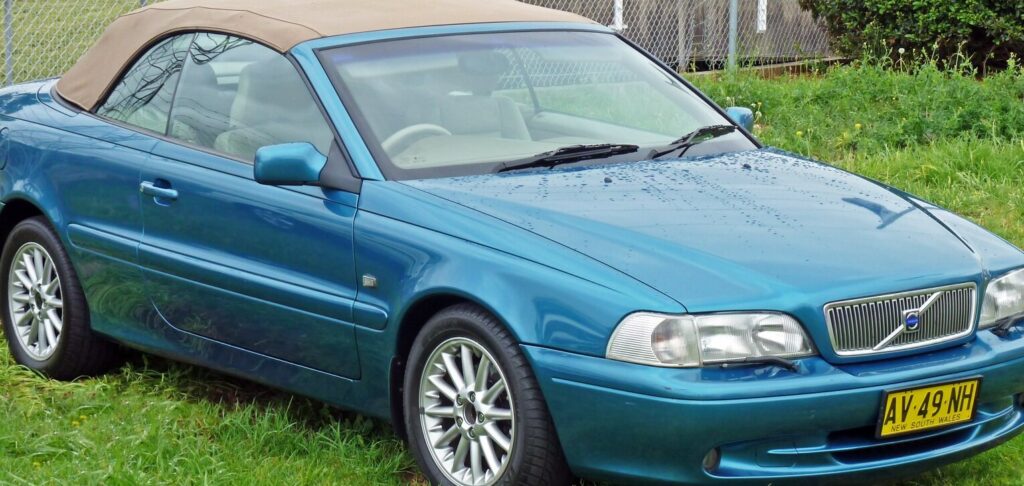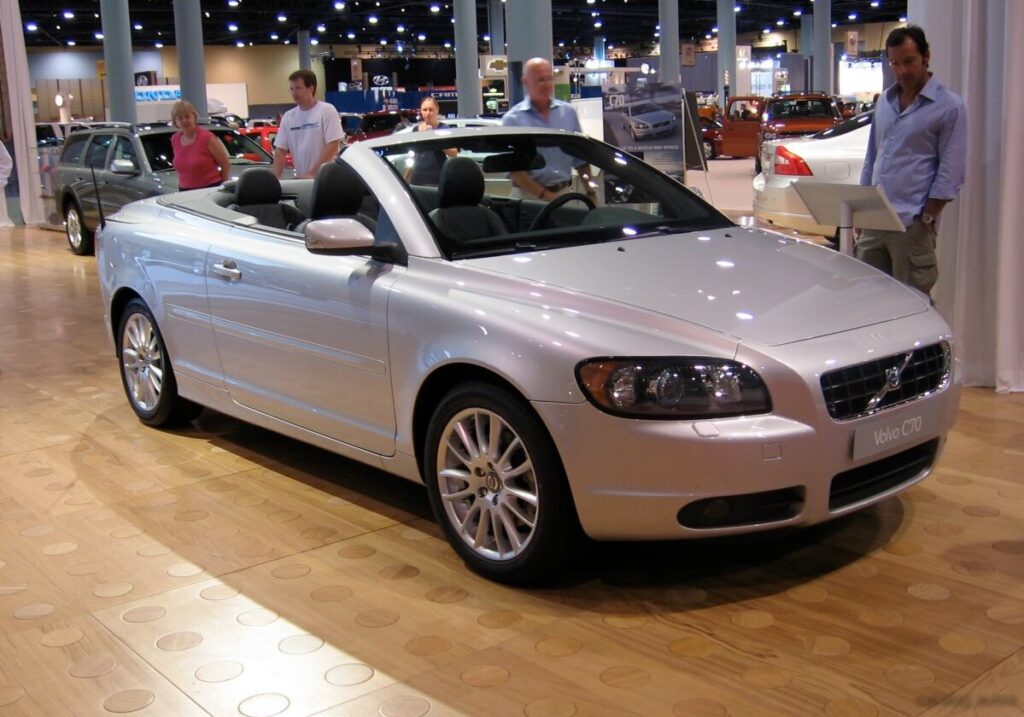
The Volvo C70 Coupe Cabriolet II, produced from 2006 to 2009, represented Volvo’s entry into the premium retractable hardtop convertible market. The 2.0 D variant, powered by a five-cylinder turbodiesel engine producing 136 horsepower, was available during the 2007-2009 model years. This version occupied a middle ground in the C70 lineup, offering a balance between fuel efficiency and reasonable performance, aimed at buyers prioritizing economy and practicality within a stylish package. It was built on Volvo’s P1 platform, shared with the Ford S40 and V50, though the C70 featured significant structural reinforcements to compensate for the loss of a fixed roof.
Technical Specifications
| Brand | Volvo |
| Model | C70 |
| Generation | C70 Coupe Cabrio II |
| Type (Engine) | 2.0 D (136 Hp) |
| Start of production | 2007 |
| End of production | 2009 |
| Powertrain Architecture | Internal Combustion engine |
| Body type | Coupe – Cabriolet |
| Seats | 4 |
| Doors | 2 |
| Fuel consumption (urban) | 8.1 l/100 km (29 US mpg) |
| Fuel consumption (extra urban) | 5.3 l/100 km (44.4 US mpg) |
| Fuel consumption (combined) | 6.0 l/100 km (39.2 US mpg) |
| CO2 emissions | 158 g/km |
| Fuel Type | Diesel |
| Acceleration 0 – 100 km/h | 11 sec |
| Acceleration 0 – 62 mph | 11 sec |
| Acceleration 0 – 60 mph | 10.5 sec |
| Weight-to-power ratio | 10.8 kg/Hp |
| Weight-to-torque ratio | 4.6 kg/Nm |
| Power | 136 Hp @ 4000 rpm |
| Torque | 320 Nm @ 2000 rpm (236.02 lb.-ft. @ 2000 rpm) |
| Engine layout | Front, Transverse |
| Engine Model/Code | D4204T |
| Engine displacement | 1997 cm3 (121.86 cu. in.) |
| Number of cylinders | 4 |
| Engine configuration | Inline |
| Piston Stroke | 85 mm (3.35 in.) |
| Fuel injection system | Diesel Commonrail |
| Engine aspiration | Turbocharger, Intercooler |
| Engine oil capacity | 5 l (5.28 US qt | 4.4 UK qt) |
| Coolant | 9.5 l (10.04 US qt | 8.36 UK qt) |
| Kerb Weight | 1472 kg (3245.2 lbs.) |
| Max. weight | 1960 kg (4321.06 lbs.) |
| Max load | 488 kg (1075.86 lbs.) |
| Trunk (boot) space – minimum | 417 l (14.73 cu. ft.) |
| Fuel tank capacity | 52 l (13.74 US gal | 11.44 UK gal) |
| Length | 4582 mm (180.39 in.) |
| Width | 1770 mm (69.69 in.) |
| Width including mirrors | 2025 mm (79.72 in.) |
| Height | 1457 mm (57.36 in.) |
| Wheelbase | 2640 mm (103.94 in.) |
| Front track | 1535 mm (60.43 in.) |
| Rear (Back) track | 1531 mm (60.28 in.) |
| Minimum turning circle | 11.1 m (36.42 ft.) |
| Drivetrain Architecture | Front wheel drive |
| Number of gears | 6 gears, manual transmission |
| Assisting systems | ABS (Anti-lock braking system) |
Powertrain & Engine Architecture
The heart of the C70 2.0 D is Volvo’s D4204T, a 1.997-liter inline-four cylinder turbodiesel engine. This engine is part of Volvo’s modular engine family, utilizing common components across different displacements. The D4204T features a common rail direct injection system, delivering fuel at extremely high pressure for optimized combustion. A variable geometry turbocharger (VGT) with an intercooler helps to boost power and torque while minimizing turbo lag. The engine employs a single overhead camshaft (SOHC) valvetrain operating four valves per cylinder. The 136 horsepower and 320 Nm (236 lb-ft) of torque are respectable figures for a diesel of this displacement, providing adequate performance for everyday driving. The engine is transversely mounted in the front of the vehicle, driving the front wheels.
Driving Characteristics
The 2.0 D-powered C70 offers a comfortable, rather than sporty, driving experience. Acceleration from 0-60 mph takes around 10.5 seconds, which is adequate but not particularly quick. The engine’s torque peak at 2000 rpm provides good responsiveness in everyday driving situations, making overtaking and merging onto highways relatively effortless. The six-speed manual transmission is well-matched to the engine’s characteristics, offering smooth shifts and allowing the driver to keep the engine in its optimal power band. Compared to the higher-output petrol versions of the C70, the 2.0 D feels noticeably slower, but it compensates with significantly improved fuel economy. The suspension is tuned for comfort, absorbing bumps and imperfections in the road well, though this can result in some body roll during cornering.
Equipment & Trim Levels
The C70 2.0 D typically came equipped with a reasonable level of standard features. These included climate control, power windows and mirrors, a leather-wrapped steering wheel, and a basic audio system. Safety features were a Volvo hallmark, and the C70 included ABS brakes, traction control, and multiple airbags. Optional extras included leather upholstery, premium audio systems, navigation, and parking sensors. Trim levels varied depending on the market, but generally, the 2.0 D sat in the lower to mid-range of the C70 lineup, offering a good balance of features and affordability.
Chassis & Braking
The C70’s chassis was extensively reinforced compared to the standard Ford P1 platform to maintain structural rigidity after the roof was retracted. The front suspension utilizes MacPherson struts, while the rear features a multi-link setup. The braking system consists of ventilated disc brakes at the front and solid disc brakes at the rear. ABS (Anti-lock Braking System) is standard, providing enhanced braking performance and stability. The steering is a rack-and-pinion system, offering precise and responsive handling. Stabilizer bars are fitted to both the front and rear axles to reduce body roll during cornering.
Market Reception & Comparison
The C70 2.0 D was generally well-received by automotive critics as a practical and fuel-efficient option within the premium convertible segment. It was praised for its comfortable ride, stylish design, and well-equipped interior. However, some critics noted that the performance was not as exhilarating as some of its competitors, particularly the higher-powered petrol versions of the C70. Compared to the 2.4 D5 variant, the 2.0 D offered lower running costs but sacrificed some performance. Against rivals like the BMW 1 Series Convertible and Audi A3 Cabriolet, the C70 2.0 D offered a unique combination of Scandinavian design, practicality, and fuel efficiency.
Legacy
The Volvo C70 Coupe Cabriolet II, including the 2.0 D variant, has proven to be a relatively reliable vehicle in the used car market. The D4204T engine is known for its durability, and with regular maintenance, it can provide many years of trouble-free service. Common issues include wear and tear on the retractable hardtop mechanism and occasional problems with the electronic systems. However, these are generally not major concerns. Today, the C70 2.0 D represents an affordable entry point into the world of premium retractable hardtop convertibles, offering a stylish and practical option for those seeking a comfortable and fuel-efficient open-top driving experience.