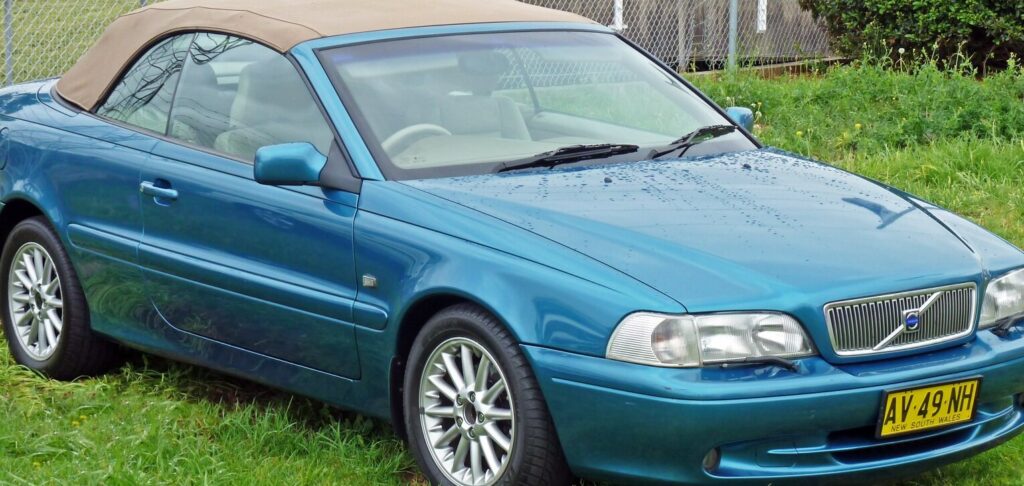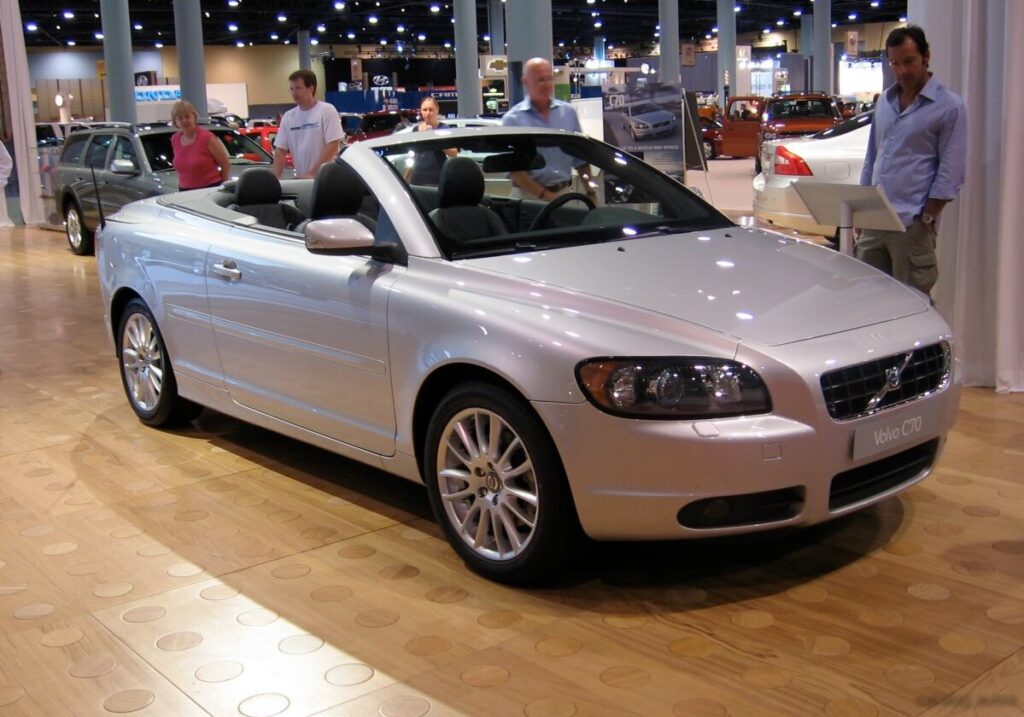
The Volvo C70 Coupe Cabriolet II, produced from 2006 to 2009, represented Volvo’s entry into the premium retractable hardtop convertible market. Positioned as a stylish and sophisticated alternative to traditional soft-top convertibles, the C70 aimed to blend the open-air driving experience with the security and refinement of a coupe. The 2.4 D5 variant, equipped with a five-cylinder diesel engine producing 180 horsepower, was a significant offering, particularly in European markets where diesel engines were favored for their fuel efficiency and torque. This model occupied a mid-range position within the C70 lineup, offering a balance between performance and economy, appealing to buyers seeking a comfortable and practical grand tourer.
Technical Specifications
| Brand | Volvo |
| Model | C70 |
| Generation | C70 Coupe Cabrio II |
| Type (Engine) | 2.4 D5 (180 Hp) |
| Start of production | 2006 |
| End of production | 2009 |
| Powertrain Architecture | Internal Combustion engine |
| Body type | Coupe – Cabriolet |
| Seats | 4 |
| Doors | 2 |
| Fuel consumption (economy) – urban (NEDC) | 8.7 l/100 km (27 US mpg, 32.5 UK mpg, 11.5 km/l) |
| Fuel consumption (economy) – extra urban (NEDC) | 5.4 l/100 km (43.6 US mpg, 52.3 UK mpg, 18.5 km/l) |
| Fuel consumption (economy) – combined (NEDC) | 6.6 l/100 km (35.6 US mpg, 42.8 UK mpg, 15.2 km/l) |
| CO2 emissions (NEDC) | 174 g/km |
| Fuel Type | Diesel |
| Acceleration 0 – 100 km/h | 9 sec |
| Acceleration 0 – 62 mph | 9 sec |
| Acceleration 0 – 60 mph | 8.6 sec |
| Maximum speed | 225 km/h (139.81 mph) |
| Emission standard | Euro 4 |
| Weight-to-power ratio | 9.3 kg/Hp, 107.5 Hp/tonne |
| Weight-to-torque ratio | 4.2 kg/Nm, 238.9 Nm/tonne |
| Power | 180 Hp @ 4000 rpm |
| Power per litre | 75 Hp/l |
| Torque | 400 Nm @ 1750-3250 rpm (295.02 lb.-ft. @ 1750-3250 rpm) |
| Engine layout | Front, Transverse |
| Engine Model/Code | D5244T13 |
| Engine displacement | 2400 cm3 (146.46 cu. in.) |
| Number of cylinders | 5 |
| Engine configuration | Inline |
| Cylinder Bore | 81 mm (3.19 in.) |
| Piston Stroke | 93.15 mm (3.67 in.) |
| Compression ratio | 17.3:1 |
| Number of valves per cylinder | 4 |
| Fuel injection system | Diesel Commonrail |
| Engine aspiration | Turbocharger, Intercooler |
| Valvetrain | DOHC |
| Engine oil capacity | 6 l (6.34 US qt | 5.28 UK qt) |
| Coolant | 9.5 l (10.04 US qt | 8.36 UK qt) |
| Kerb Weight | 1674 kg (3690.54 lbs.) |
| Max. weight | 2130 kg (4695.85 lbs.) |
| Max load | 456 kg (1005.31 lbs.) |
| Trunk (boot) space – minimum | 200 l (7.06 cu. ft.) |
| Trunk (boot) space – maximum | 404 l (14.27 cu. ft.) |
| Fuel tank capacity | 60 l (15.85 US gal | 13.2 UK gal) |
| Permitted trailer load with brakes (12%) | 1500 kg (3306.93 lbs.) |
| Permitted trailer load without brakes | 750 kg (1653.47 lbs.) |
| Permitted towbar download | 75 kg (165.35 lbs.) |
| Length | 4582 mm (180.39 in.) |
| Width | 1820 mm (71.65 in.) |
| Width including mirrors | 2025 mm (79.72 in.) |
| Height | 1400 mm (55.12 in.) |
| Wheelbase | 2640 mm (103.94 in.) |
| Front track | 1550 mm (61.02 in.) |
| Rear (Back) track | 1560 mm (61.42 in.) |
| Minimum turning circle | 12.7 m (41.67 ft.) |
| Drivetrain Architecture | The Internal combustion engine (ICE) drives the front wheels of the vehicle. |
| Drive wheel | Front wheel drive |
| Number of gears and type of gearbox | 6 gears, manual transmission |
| Front suspension | Independent, type McPherson with coil spring and anti-roll bar |
| Rear suspension | Independent multi-link spring suspension with stabilizer |
| Front brakes | Ventilated discs |
| Rear brakes | Disc |
| Assisting systems | ABS (Anti-lock braking system) |
| Steering type | Steering rack and pinion |
| Power steering | Electric Steering |
| Tires size | 215/55 R16; 235/45 R17 |
| Wheel rims size | 7.5J x 16; 7.5J x 17 |
Powertrain & Engine Architecture
The heart of the C70 D5 was the Volvo D5244T13, a 2.4-liter inline five-cylinder diesel engine. This engine was a mainstay of Volvo’s lineup for many years, known for its robust construction and strong torque output. The D5 featured a common rail direct injection system, delivering fuel at extremely high pressure for optimized combustion. A variable geometry turbocharger (VGT) and intercooler further enhanced performance, providing a broad torque curve. The engine produced 180 horsepower at 4000 rpm and a substantial 400 Nm (295 lb-ft) of torque between 1750 and 3250 rpm. The engine utilized a double overhead camshaft (DOHC) valvetrain with four valves per cylinder. The 6-speed manual transmission was the standard offering, providing precise gear changes and contributing to the car’s overall driving experience. While an automatic transmission was available, it wasn’t as commonly paired with the D5 engine as the manual.
Driving Characteristics
The C70 2.4 D5 offered a refined and comfortable driving experience. The engine’s ample torque meant strong acceleration in everyday driving situations, with effortless overtaking capabilities. While not a sports car, the C70 D5 provided a respectable 0-60 mph time of around 8.6 seconds. The manual transmission allowed for greater driver control, while the well-tuned suspension provided a good balance between ride comfort and handling. Compared to the petrol-powered C70 variants, the D5 offered significantly better fuel economy, making it a more practical choice for long-distance journeys. The higher-output petrol engines (like the T5) offered quicker acceleration, but at the expense of fuel efficiency. The D5’s torque delivery was more linear and predictable than the more peaky power delivery of the gasoline engines.
Equipment & Trim Levels
The C70 D5 typically came well-equipped, reflecting its premium positioning. Standard features included leather upholstery, automatic climate control, a premium audio system, and power-adjustable front seats. Safety features were also a priority, with standard ABS brakes, traction control, and a comprehensive airbag system. Optional extras included navigation system, upgraded audio systems, and various cosmetic enhancements. Trim levels varied depending on the market, but generally offered increasing levels of luxury and technology. The interior design was typically Scandinavian in style, emphasizing simplicity and functionality.
Chassis & Braking
The C70 utilized a McPherson strut front suspension and a multi-link rear suspension, providing a comfortable and controlled ride. The front brakes were ventilated discs, while the rear brakes were solid discs. ABS (Anti-lock Braking System) was standard, enhancing braking performance and stability. The chassis was designed to provide a good balance between rigidity and weight, contributing to the car’s handling characteristics. Stabilizer bars were fitted to both the front and rear axles to reduce body roll during cornering.
Market Reception & Comparison
The Volvo C70 2.4 D5 was generally well-received by automotive critics. It was praised for its stylish design, comfortable interior, and fuel-efficient engine. The diesel engine was particularly appreciated for its strong torque and relaxed cruising ability. Compared to other premium convertibles of the time, the C70 offered a unique combination of practicality and style. The diesel variant was often seen as a more sensible choice than the petrol models, particularly for drivers who covered long distances. However, some critics noted that the C70’s handling wasn’t as sharp as some of its rivals.
Legacy
The Volvo C70 Coupe Cabriolet II, and specifically the 2.4 D5 variant, has proven to be a relatively reliable vehicle. The D5 engine is known for its durability, and with regular maintenance, can provide many years of service. On the used car market, the C70 D5 represents a good value proposition, offering a stylish and well-equipped convertible at a reasonable price. Common issues include wear and tear on the retractable hardtop mechanism and potential problems with the electronic systems. However, these issues are generally well-documented and can be addressed with proper maintenance and repair. The C70 remains a popular choice for those seeking a sophisticated and practical convertible.