
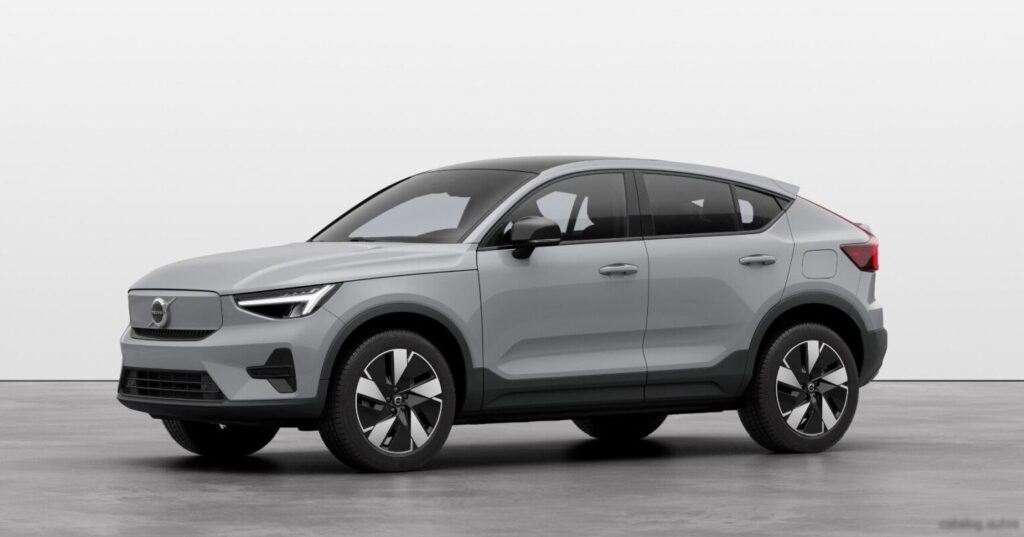
The Volvo EC40 82 kWh (408 Hp) AWD Twin Motor represents Volvo’s entry into the compact electric crossover segment, launched in February 2024. Built upon the Sustainable Experience Architecture (SEA) platform jointly developed with Geely, the EC40 aims to provide a stylish and technologically advanced alternative to established rivals like the Tesla Model Y and Hyundai Kona Electric. Positioned as a slightly more sporty and design-focused sibling to the XC40 Recharge, the EC40 prioritizes aerodynamic efficiency and a streamlined interior experience. It’s a key component of Volvo’s commitment to becoming a fully electric vehicle manufacturer.
| Brand | Volvo |
| Model | EC40 |
| Generation | EC40 |
| Type (Engine) | 82 kWh (408 Hp) AWD Twin Motor |
| Start of production | February, 2024 |
| Powertrain Architecture | BEV (Electric Vehicle) |
| Body type | Coupe, SUV |
| Seats | 5 |
| Doors | 5 |
| Fuel Type | Electricity |
| Acceleration 0 – 100 km/h | 4.7 sec |
| Acceleration 0 – 62 mph | 4.7 sec |
| Acceleration 0 – 60 mph | 4.5 sec |
| Maximum speed | 180 km/h (111.85 mph) |
| Weight-to-power ratio | 5.4 kg/Hp, 186.7 Hp/tonne |
| Weight-to-torque ratio | 3.3 kg/Nm, 306.6 Nm/tonne |
| Gross battery capacity | 82 kWh |
| Battery technology | Lithium-ion (Li-Ion) |
| Battery location | Below the floor |
| All-electric range (WLTP) | 551 km (342.38 mi) |
| Average Energy consumption (WLTP) | 17.3 kWh/100 km (27.84 kWh/100 mi) |
| Average Energy consumption (MPGe) | 121 MPGe |
| Average Energy consumption (km/kWh) | 5.8 km/kWh |
| Average Energy consumption (mi/kWh) | 3.6 mi/kWh |
| Electric motor 1 location | Rear axle, Transverse |
| Electric motor 1 type | Synchronous |
| Electric motor 2 location | Front axle, Transverse |
| Electric motor 2 type | Asynchronous |
| System power | 408 Hp |
| System torque | 670 Nm (494.17 lb.-ft.) |
| Kerb Weight | 2185 kg (4817.1 lbs.) |
| Max. weight | 2620 kg (5776.11 lbs.) |
| Max load | 435 kg (959.01 lbs.) |
| Trunk (boot) space – minimum | 404 l (14.27 cu. ft.) |
| Trunk (boot) space – maximum | 1205 l (42.55 cu. ft.) |
| Max. roof load | 75 kg (165.35 lbs.) |
| Permitted trailer load with brakes (12%) | 1800 kg (3968.32 lbs.) |
| Length | 4440 mm (174.8 in.) |
| Width | 1873 mm (73.74 in.) |
| Width with mirrors folded | 1938 mm (76.3 in.) |
| Width including mirrors | 2034 mm (80.08 in.) |
| Height | 1596 mm (62.83 in.) |
| Wheelbase | 2702 mm (106.38 in.) |
| Front track | 1598 mm (62.91 in.) |
| Rear (Back) track | 1603 mm (63.11 in.) |
| Front overhang | 870 mm (34.25 in.) |
| Rear overhang | 868 mm (34.17 in.) |
| Ride height (ground clearance) | 171 mm (6.73 in.) |
| Minimum turning circle (turning diameter) | 11 m (36.09 ft.) |
| Number of gears and type of gearbox | 1 gears, automatic transmission |
| Front brakes | Ventilated discs |
| Rear brakes | Ventilated discs |
| Front tires | 235/50 R19 |
| Rear tires | 255/45 R19 |
Powertrain & Engine Architecture
The EC40 82 kWh AWD Twin Motor utilizes a dual-motor all-wheel-drive (AWD) powertrain. The front axle is driven by an asynchronous electric motor, while the rear axle employs a synchronous motor. This configuration allows for precise torque vectoring, enhancing stability and handling. The combined system output is 408 horsepower and 670 Nm (494 lb-ft) of torque. The 82 kWh lithium-ion battery pack is positioned under the floor, contributing to a low center of gravity and maximizing interior space. The battery supports fast charging, capable of adding a significant range in a relatively short time using DC fast charging stations. The single-speed automatic transmission is inherent to electric vehicle design, providing seamless acceleration without traditional gear changes.
Driving Characteristics
The EC40 82 kWh AWD Twin Motor delivers brisk acceleration, achieving 0-60 mph in approximately 4.5 seconds. The dual-motor setup provides instant torque, resulting in a responsive and engaging driving experience. Compared to potential future single-motor, rear-wheel-drive variants, the AWD model offers superior traction and stability, particularly in adverse weather conditions. While the focus isn’t on outright sportiness like some performance EVs, the EC40 provides a confident and composed ride. The low center of gravity contributes to reduced body roll during cornering. Regenerative braking is adjustable, allowing drivers to customize the level of deceleration when lifting off the accelerator, maximizing energy recovery and extending range.
Equipment & Trim Levels
The EC40 82 kWh AWD Twin Motor comes standard with a comprehensive suite of technology and safety features. This includes a large, vertically oriented touchscreen infotainment system powered by Google Automotive Services, providing access to navigation, entertainment, and vehicle settings. Standard safety equipment includes automatic emergency braking, lane keeping assist, and adaptive cruise control. Interior upholstery typically consists of premium, sustainable materials, reflecting Volvo’s commitment to environmental responsibility. Available options include a panoramic sunroof, premium audio system, and advanced driver-assistance features like Pilot Assist. Trim levels are generally focused on aesthetic enhancements and additional convenience features rather than significant performance upgrades.
Chassis & Braking
The EC40 utilizes a MacPherson strut front suspension and a multi-link rear suspension, tuned for a balance of comfort and handling. Ventilated disc brakes are fitted on all four wheels, providing ample stopping power. The EC40’s relatively low weight, thanks to the efficient battery pack and lightweight construction, contributes to its agile handling characteristics. Electric power steering provides precise and responsive steering feel. The suspension is calibrated to absorb road imperfections while maintaining stability during cornering. The vehicle’s electronic stability control system works in conjunction with the AWD system to optimize traction and prevent skidding.
Market Reception & Comparison
The Volvo EC40 has been generally well-received by automotive critics, praised for its stylish design, comfortable interior, and advanced technology. Comparisons to rivals like the Tesla Model Y often highlight the EC40’s more refined interior and user-friendly infotainment system. However, the Tesla typically offers a longer driving range and access to a more extensive charging network. Fuel economy, expressed as MPGe, is competitive within the electric crossover segment. Reliability data is still emerging, given the vehicle’s recent launch, but Volvo has a generally good reputation for build quality and durability. The EC40’s price point positions it competitively against other premium electric crossovers.
Legacy
As a relatively new model, the long-term reliability of the EC40 82 kWh AWD Twin Motor powertrain remains to be fully established. However, Volvo’s experience in electric vehicle technology, gained through the XC40 Recharge and Polestar models, suggests a high level of durability. The EC40’s battery pack is expected to maintain a significant portion of its capacity over many years of use. In the used car market, the EC40 is likely to hold its value well, given the increasing demand for electric vehicles and Volvo’s strong brand reputation. The EC40 represents a significant step forward in Volvo’s transition to a fully electric future, showcasing the brand’s commitment to sustainability and innovation.
