
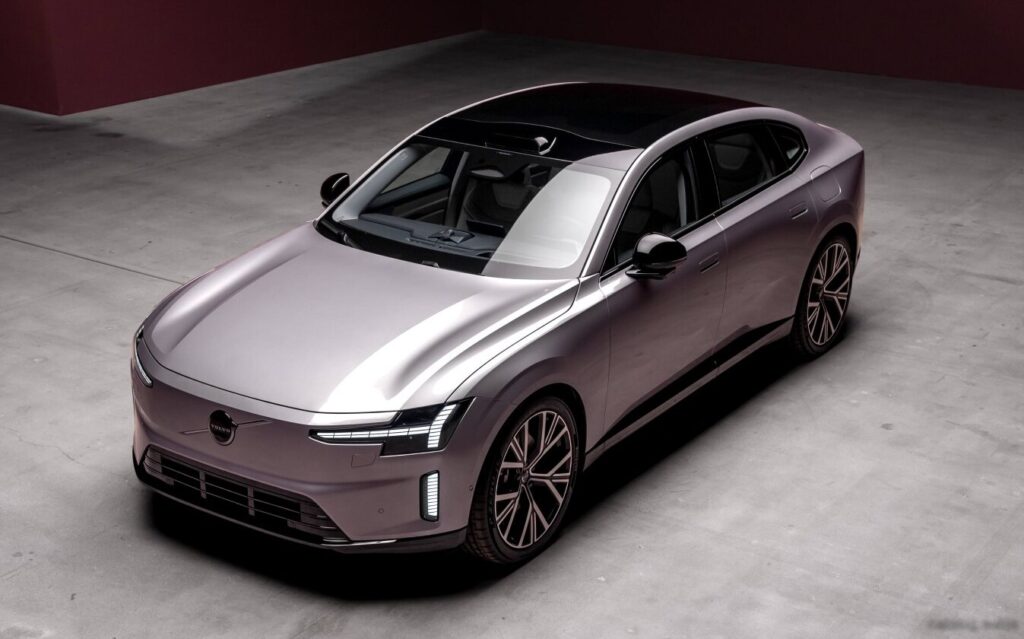
The Volvo ES90 (V551) 106 kWh (680 Hp) Twin Motor Performance represents Volvo’s entry into the premium all-electric liftback segment, slated for release in 2025. Positioned as a flagship model, the ES90 builds upon Volvo’s commitment to electrification and Scandinavian design. It’s built on a new scalable electric vehicle platform, intended to provide a spacious interior, long range, and high performance. This particular variant, boasting a dual-motor setup and a large 106 kWh battery pack, is expected to be a top-tier offering within the ES90 lineup, emphasizing both luxury and exhilarating acceleration.
Technical Specifications
| Brand | Volvo |
| Model | ES90 |
| Generation | ES90 (V551) |
| Type (Engine) | 106 kWh (680 Hp) Twin Motor Performance |
| Start of production | 2025 |
| Powertrain Architecture | BEV (Electric Vehicle) |
| Body type | Liftback |
| Seats | 5 |
| Doors | 5 |
| Fuel Type | Electricity |
| Acceleration 0 – 100 km/h | 4 sec |
| Acceleration 0 – 62 mph | 4 sec |
| Acceleration 0 – 60 mph | 3.8 sec |
| Maximum speed | 180 km/h (111.85 mph) |
| 100 km/h – 0 | 36 m |
| Weight-to-power ratio | 3.1 kg/Hp, 319.7 Hp/tonne |
| Weight-to-torque ratio | 2.4 kg/Nm, 409 Nm/tonne |
| Gross battery capacity | 106 kWh |
| Net (usable) battery capacity | 102 kWh |
| Battery technology | Lithium nickel manganese cobalt oxides (Li-NMC) |
| Battery location | Below the floor |
| All-electric range (WLTP) | 700 km (434.96 mi) |
| All-electric range (CLTC) | 740 km (459.81 mi) |
| Average Energy consumption (WLTP) | 17.1 kWh/100 km (27.52 kWh/100 mi, 122 MPGe, 5.8 km/kWh, 3.6 mi/kWh) |
| Electric motor 1 power | 381 Hp @ 5600-8100 rpm |
| Electric motor 1 Torque | 480 Nm @ 0-5600 rpm (354.03 lb.-ft. @ 0-5600 rpm) |
| Electric motor 1 location | Rear axle, Transverse |
| Electric motor 1 type | Synchronous |
| Electric motor 2 power | 299 Hp @ 5400-8000 rpm |
| Electric motor 2 Torque | 390 Nm @ 0-5400 rpm (287.65 lb.-ft. @ 0-5400 rpm) |
| Electric motor 2 location | Front axle, Transverse |
| Electric motor 2 type | Synchronous |
| System power | 680 Hp |
| System torque | 870 Nm (641.68 lb.-ft.) |
| Kerb Weight | 2127-2132 kg (4689.23 – 4700.26 lbs.) |
| Max. weight | 3040 kg (6702.05 lbs.) |
| Max load | 908-913 kg (2001.8 – 2012.82 lbs.) |
| Trunk (boot) space – minimum | 391 l (13.81 cu. ft.) |
| Trunk (boot) space – maximum | 1256 l (44.36 cu. ft.) |
| Max. roof load | 75 kg (165.35 lbs.) |
| Permitted trailer load with brakes (12%) | 2000 kg (4409.25 lbs.) |
| Length | 5000 mm (196.85 in.) |
| Width | 1942 mm (76.46 in.) |
| Width with mirrors folded | 2054 mm (80.87 in.) |
| Width including mirrors | 2120 mm (83.46 in.) |
| Height | 1546-1553 mm (60.87 – 61.14 in.) |
| Wheelbase | 3102 mm (122.13 in.) |
| Front track | 1666-1676 mm (65.59 – 65.98 in.) |
| Rear (Back) track | 1642-1666 mm (64.65 – 65.59 in.) |
| Front overhang | 891 mm (35.08 in.) |
| Rear overhang | 1007 mm (39.65 in.) |
| Ride height (ground clearance) | 177-184 mm (6.97 – 7.24 in.) |
| Drag coefficient (Cd) | 0.25 |
| Minimum turning circle (turning diameter) | 12.2 m (40.03 ft.) |
| Wading depth | 250 mm (9.84 in.) |
| Drivetrain Architecture | One electric motor drives the front wheels, one electric motor drives the rear wheels. |
| Drive wheel | All wheel drive (4×4) |
| Number of gears and type of gearbox | 1 gears, automatic transmission |
| Front suspension | Coil spring, Air Suspension – Optional |
| Rear suspension | Coil spring, Air Suspension – Optional |
| Front brakes | Ventilated discs, 366×26 mm |
| Rear brakes | Ventilated discs, 360×22 mm |
| Assisting systems | ABS (Anti-lock braking system) |
| Steering type | Steering rack and pinion |
| Power steering | Electric Steering |
| Wheel rims size | 20; 21; 22 |
Powertrain & Engine Architecture
The ES90 Twin Motor Performance utilizes a dual-motor, all-wheel-drive (AWD) powertrain. Each motor is a synchronous electric motor, with the rear motor producing 381 horsepower and 480 Nm (354 lb-ft) of torque, while the front motor delivers 299 horsepower and 390 Nm (288 lb-ft) of torque. Combined, the system generates a substantial 680 horsepower and 870 Nm (642 lb-ft) of torque. The 106 kWh battery pack, utilizing Lithium Nickel Manganese Cobalt Oxide (Li-NMC) chemistry, is positioned under the floor to optimize weight distribution and passenger space. The battery offers a usable capacity of 102 kWh, providing a WLTP-rated range of 700 km (435 miles) and a CLTC range of 740 km (460 miles). The single-speed automatic transmission is inherent to electric vehicle drivetrains, providing seamless power delivery.
Driving Characteristics
The dual-motor setup of the ES90 delivers impressive acceleration, achieving 0-60 mph in approximately 3.8 seconds. The instant torque characteristic of electric motors provides brisk acceleration in all conditions. The all-wheel-drive system enhances traction and stability, particularly in inclement weather. While specific gear ratios aren’t publicly available, the single-speed transmission is optimized for both acceleration and efficiency. Compared to potential lower-powered, single-motor ES90 variants, this Twin Motor Performance model prioritizes performance over maximizing range, offering a more engaging driving experience.
Equipment & Trim Levels
As a top-tier trim, the ES90 106 kWh Twin Motor Performance is expected to come standard with a comprehensive suite of features. These likely include a large touchscreen infotainment system running Volvo’s Google-based operating system, premium interior materials (leather or sustainable alternatives), advanced driver-assistance systems (ADAS) such as adaptive cruise control, lane keeping assist, and automatic emergency braking, and a high-end audio system. Optional extras may include air suspension for enhanced ride comfort, upgraded wheel designs, and various interior customization options. The interior design will likely follow Volvo’s minimalist Scandinavian aesthetic, emphasizing spaciousness and a calming atmosphere.
Chassis & Braking
The ES90 utilizes a coil spring suspension as standard, with optional air suspension available for a more refined ride. The air suspension allows for adjustable ride height and damping, adapting to different driving conditions. Braking duties are handled by ventilated discs on all four wheels, measuring 366x26mm at the front and 360x22mm at the rear. The vehicle is equipped with ABS (Anti-lock Braking System) and other electronic stability control systems to ensure safe and controlled braking. The chassis is designed to optimize weight distribution and rigidity, contributing to improved handling and stability.
Market Reception & Comparison
The ES90 enters a competitive segment of premium electric liftbacks, facing rivals such as the Porsche Taycan, Tesla Model S, and BMW i5. Early reviews are anticipated to focus on the ES90’s range, performance, and interior quality. Compared to potential lower-trim ES90 models, the Twin Motor Performance variant will likely appeal to buyers prioritizing performance and a more luxurious experience. Its energy consumption of 17.1 kWh/100km (122 MPGe) is competitive within its class, and its long-range capability will be a key selling point.
Legacy
As a relatively new model, the long-term reliability of the ES90 powertrain remains to be seen. However, Volvo has a strong reputation for safety and build quality, and the use of proven Li-NMC battery technology suggests a reasonable expectation of durability. The ES90 represents a significant step forward in Volvo’s electrification strategy, and its success will be crucial in establishing the brand as a leader in the premium EV market. The Twin Motor Performance variant, with its high power output and advanced technology, is poised to become a desirable and sought-after model in the used car market as the platform matures.
