
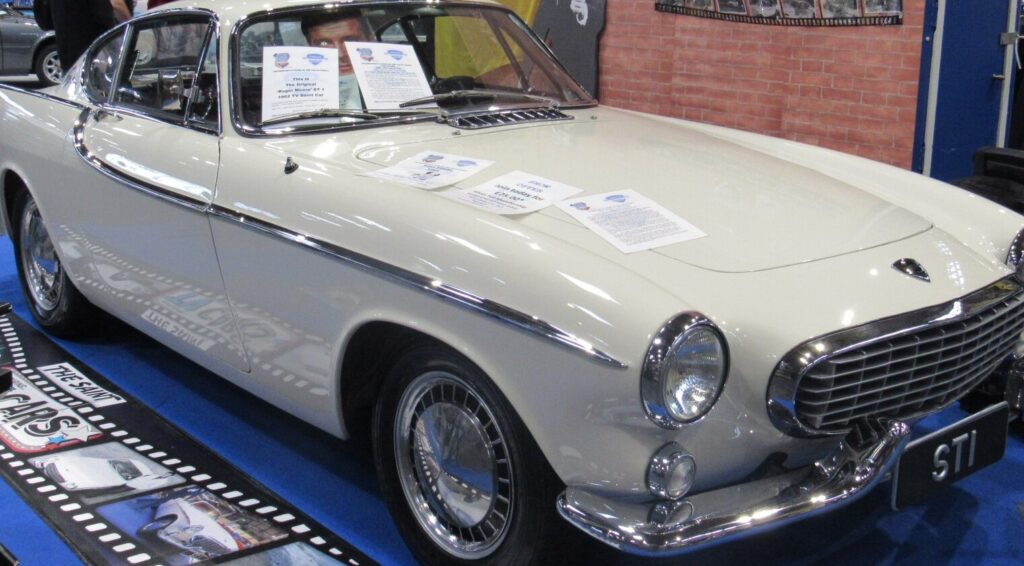
The Volvo P1800 1.8, producing 100 horsepower, was a pivotal model in Volvo’s history, representing the company’s ambition to enter the stylish grand touring car market. Produced from 1961 to 1963, this variant occupied an important position in the initial production run of the P1800 series (chassis 1800, 1800S, and later the 1800E). It was the first iteration of a car that would become iconic for its design and reliability, and it laid the groundwork for Volvo’s future success in the sports coupe segment. The P1800 was a departure for Volvo, traditionally known for practical, robust family cars, and signaled a desire to appeal to a more discerning, performance-oriented clientele.
Technical Specifications
| Brand | Volvo |
| Model | 1800 |
| Generation | P1800 |
| Type (Engine) | 1.8 (100 Hp) |
| Start of production | 1961 |
| End of production | 1963 |
| Powertrain Architecture | Internal Combustion engine |
| Body type | Coupe |
| Seats | 4 |
| Doors | 2 |
| Fuel Type | Petrol (Gasoline) |
| Maximum speed | 170 km/h (105.63 mph) |
| Weight-to-power ratio | 11.3 kg/Hp, 88.5 Hp/tonne |
| Weight-to-torque ratio | 7.7 kg/Nm, 130.1 Nm/tonne |
| Power | 100 Hp @ 5500 rpm |
| Power per litre | 56.2 Hp/l |
| Torque | 147 Nm @ 4000 rpm (108.42 lb.-ft. @ 4000 rpm) |
| Engine layout | Front, Longitudinal |
| Engine Model/Code | B18B |
| Engine displacement | 1780 cm3 (108.62 cu. in.) |
| Number of cylinders | 4 |
| Engine configuration | Inline |
| Cylinder Bore | 84.14 mm (3.31 in.) |
| Piston Stroke | 80 mm (3.15 in.) |
| Compression ratio | 9.5:1 |
| Number of valves per cylinder | 2 |
| Fuel injection system | Carburettor |
| Engine aspiration | Naturally aspirated engine |
| Valvetrain | OHV |
| Engine oil capacity | 3.75 l (3.96 US qt | 3.3 UK qt) |
| Coolant | 9 l (9.51 US qt | 7.92 UK qt) |
| Kerb Weight | 1130 kg (2491.22 lbs.) |
| Max. weight | 1400 kg (3086.47 lbs.) |
| Max load | 270 kg (595.25 lbs.) |
| Fuel tank capacity | 45 l (11.89 US gal | 9.9 UK gal) |
| Length | 4400 mm (173.23 in.) |
| Width | 1700 mm (66.93 in.) |
| Height | 1285 mm (50.59 in.) |
| Wheelbase | 2450 mm (96.46 in.) |
| Front track | 1315 mm (51.77 in.) |
| Rear (Back) track | 1315 mm (51.77 in.) |
| Ride height (ground clearance) | 155 mm (6.1 in.) |
| Minimum turning circle (turning diameter) | 9.5 m (31.17 ft.) |
| Drivetrain Architecture | The Internal combustion engine (ICE) drives the rear wheels of the vehicle. |
| Drive wheel | Rear wheel drive |
| Number of gears and type of gearbox | 4 gears, manual transmission |
| Front suspension | Coil spring, Wishbone, Transverse stabilizer |
| Rear suspension | Rigid axle suspension, Trailing arm, Coil spring |
| Front brakes | Disc, 254×12.7 mm |
| Rear brakes | Drum, 228.6×50.8 mm |
| Tires size | 165/80 R15 |
| Wheel rims size | 4.5J x 15 |
Powertrain & Engine Architecture
The heart of the P1800 1.8 was the Volvo B18B engine, an inline-four cylinder unit displacing 1778 cc (1.8 liters). This engine featured an overhead valve (OHV) configuration and was fed by a single SU carburetor. The B18B produced 100 horsepower at 5500 rpm and 147 Nm (108 lb-ft) of torque at 4000 rpm. The engine’s design emphasized durability and smooth operation rather than outright performance. The B18 was a robust engine, known for its ability to withstand high mileage. The early P1800s were exclusively offered with a four-speed manual transmission, designed to deliver power to the rear wheels. The engine was longitudinally mounted, contributing to a balanced weight distribution.
Driving Characteristics
The 1.8-liter, 100 hp P1800 offered a respectable, though not exhilarating, driving experience. Acceleration was adequate for the time, with a 0-60 mph time estimated around 11-12 seconds. The four-speed manual transmission provided precise shifts, and the rear-wheel-drive layout offered a balanced feel. Compared to later, more powerful P1800 variants (like those with the B20 engine), the 1.8 felt less urgent in its acceleration. However, it was more fuel-efficient and arguably more forgiving to drive. The gear ratios were tailored for cruising, making it a comfortable grand tourer for long distances. The relatively low horsepower meant that the car needed to be driven with some enthusiasm to extract its full potential, but it rewarded drivers with a connected and engaging experience.
Equipment & Trim Levels
The early P1800s were relatively sparsely equipped by modern standards, but they offered a comfortable and well-appointed interior for the early 1960s. Standard features included comfortable bucket seats, a wood-rimmed steering wheel, and a comprehensive instrument panel. Interior upholstery was typically vinyl, with options for cloth inserts. The dashboard layout was clean and functional, with clearly marked gauges. Optional extras included a radio, whitewall tires, and a sunroof. The P1800 was positioned as a premium offering within Volvo’s lineup, and its interior reflected this with a focus on quality materials and craftsmanship.
Chassis & Braking
The P1800 featured a robust chassis with independent front suspension utilizing coil springs and wishbones, along with a transverse stabilizer bar. The rear suspension employed a rigid axle with trailing arms and coil springs. This setup provided a comfortable ride and good handling characteristics. Braking was accomplished via disc brakes at the front and drum brakes at the rear. While the disc brakes offered good stopping power, the drum brakes at the rear were a limitation compared to all-disc setups found on some contemporary sports cars. The car’s relatively light weight (around 2491 lbs) helped to offset the limitations of the braking system.
Market Reception & Comparison
The Volvo P1800 was well-received by critics and the public alike. It was praised for its stylish design, comfortable ride, and robust build quality. However, some critics noted that the 1.8-liter engine was somewhat underpowered for a sports coupe. Compared to the later P1800S models, which featured a more powerful engine and improved suspension, the 1.8 felt less sporty. However, the 1.8 offered a more affordable entry point into the P1800 range. Fuel economy was reasonable for the time, and the car proved to be remarkably reliable. The P1800 quickly gained a reputation as a durable and dependable vehicle, which contributed to its long-term success.
Legacy
The Volvo P1800 1.8 holds a special place in automotive history as the car that established Volvo as a maker of stylish and desirable sports coupes. The B18 engine proved to be exceptionally durable, and many examples are still on the road today. The early P1800s are now highly sought after by collectors, and well-maintained examples command premium prices. The P1800’s influence can be seen in subsequent Volvo models, and it remains a beloved classic car that embodies the spirit of 1960s automotive design and engineering. The 1.8 variant, while not the most powerful P1800, represents the genesis of a truly iconic vehicle and a turning point for the Volvo brand.
